
Toolso.AI
Toolso.AI
All ToolsCategoriesTrendingLatest ToolsPricingBlog
Toolso.AI
Toolso.AI
Toolso.AI
Toolso.AI

Discover the best AI tools to boost your productivity

GitHubGitHubTwitterX (Twitter)YouTubeYouTubeTikTokEmail

Popular Categories

  • AI Writing
  • AI Image
  • AI Video
  • AI Coding
  • More Categories

Explore

  • Latest Tools
  • Popular Tools
  • More Tools
  • Submit Tool
  • Pricing

About

  • About Us
  • Contact
  • Blog
  • Changelog

Legal

  • Cookie Policy
  • Privacy Policy
  • Terms of Service
  • Refund Policy
© 2026 Toolso.AI All Rights Reserved
Limited timeLimited-time offerFeatured Listing24h priority review · No backlink · 30 days featured$29.90then $59.90Price rises to $59.90 after Oct 31Ends in--:--:--Submit now
  1. Home
  2. All Tools
  3. Image Editing
  4. Weavy
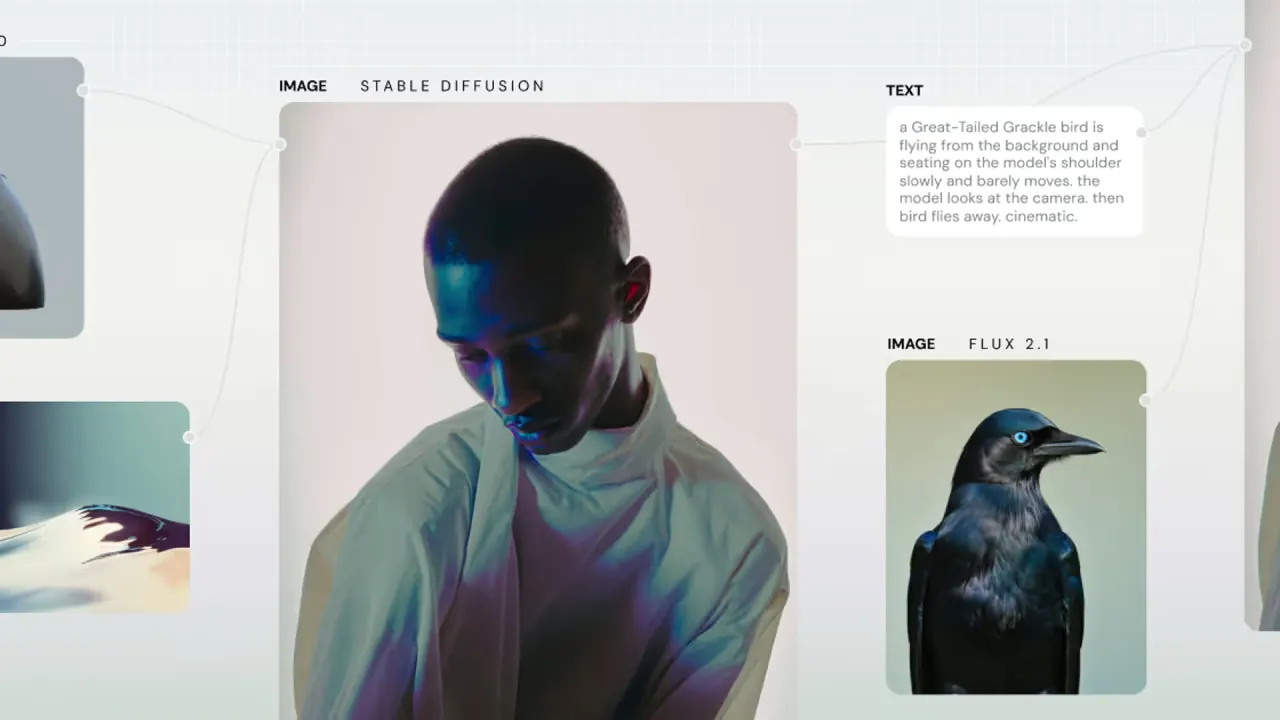
Weavy interface preview
Weavy logo

Weavy

Weavy (now Figma Weave) chains image, video and 3D models with editing nodes on one browser canvas, then turns workflows into shareable tools for creative teams.

Image EditingImage GenerationVideo Generation#Workflow Automation#AI Video Generation#AI Image Generation
View Pricing
Saves
Visits
Views
Pricing
Paid
Published
Sep 28, 2026
Domain
weavy.ai
Community rating

Used this tool? Rate it

Rate this tool

Weavy Product Information

View Pricing
Tool Information
Saves
Visits
Views
Pricing
Paid
Published
Sep 28, 2026
Domain
weavy.ai
Community rating

Used this tool? Rate it

Rate this tool

Featured Tools

Related Tools

View Pricing

What is Weavy?

Weavy (now branded Figma Weave) is a browser-based platform for AI image and video generation in which third-party models and professional editing steps are wired together as nodes. Weavy brings AI models together with professional editing tools on a single, browser-based canvas, so one output can feed the next step.

Figma announced its acquisition of Weavy in October 2025. Weavy is now called Figma Weave, and its new home is weave.figma.com; the old weavy.ai address forwards there. Deal coverage reported that 20 people from Weavy would join Figma, that the valuation was not disclosed, and that the Tel Aviv startup was founded in 2024 and had raised a $4 million seed round.

For now Weavy remains a separate product: it is offered as a standalone experience at weave.figma.com and is planned to integrate into the rest of the Figma platform over time.

Core features

Weavy puts AI models and professional editing tools in one node-based platform, and the whole product is built around that idea: a node-based AI workflow where each box is either a model call or an editing operation, and the wires decide what feeds what. The same chain can then be rerun with a new prompt or input image.

Multi-model generation

  • Model choice per step: each node can use a different provider, for example Seedance, Sora or Veo for cinematic video, Flux or Ideogram for realism, and Nano-Banana or Seedream for precise image work.
  • More than image and video: the model pricing list includes 3D, LLM and audio entries in addition to image and video models, such as an "AnyLLM" text node and a video-to-audio node.
  • Your own models: the terms describe Weavy as a platform for using third-party AI models and connecting customers' own models, labelled Customer Models; on the plan guide, imported models are a paid-plan feature.

Editing and compositing

  • Layer-based editing: the editing toolset includes layers, masks and advanced color grading, plus utility nodes such as inpaint, outpaint, upscale, relight and depth extraction.
  • Prompt-driven adjustments: generated media can be edited with layer edits, lighting adjustments, and prompt-driven color and angle changes.
  • Brand typography: Professional plan users can import custom fonts into Weavy for type layers.

Tools (formerly Design Apps)

Any existing workflow can be turned into a tool by adding an Output node connected to the end result. A tool hides the canvas and exposes only unlocked inputs, so teammates or clients get a simple form.

  • Access control: tool access can be limited to invited people, anyone in the workspace, or anyone with the link; sharing a tool is separate from sharing the underlying workflow.
  • Versioning: each time a tool is created or updated, Weavy saves a timestamped version; past versions can be opened and shared but not edited.

Figma connection

The Figma node brings a frame from a Figma Design file into a Weavy workflow, keeping the file's layout while you choose which layers Weavy may change. Finished Weave tools can also go the other way, into Figma Design (see Platforms).

Because every node can call a different vendor's model, capability, credit cost and usage rights are decided per node rather than per workspace. A workflow that mixes a cheap draft model with a premium video model, or a verified model with an unverified one, inherits the cost and terms of each step.

Guide

Turning a workflow into a shareable tool

  1. Build the chain on the canvas, add an Output node and connect it to the final result; the Tool tab then unlocks at the top of the canvas.
  2. Decide what users may change: tool attributes are generated from nodes that have no input, such as Prompt or Import Image nodes. Lock a node to hide it from the tool view.
  3. Click Create tool. Creating a tool asks for a name, a description and a thumbnail image.
  4. Use Share tool to invite people or copy a link, and Update tool to push later workflow edits to users.

Checking credit cost before a run

Clicking a model's node, or hovering over it in the Toolbox, shows its credit cost. Some model prices depend on parameters such as seconds or resolution, so the displayed cost changes as you adjust duration or output size.

Starting from existing workflows

When you select a Weavy community file on Figma, you are redirected to Weavy, where the file can be duplicated into your own account and edited. The vendor also runs free office hours, a video-on-demand library and a template library of workflows; Enterprise customers get team training sessions.

Use cases and examples

Architects use Weavy to generate staging images, visual effects artists create media and effects for games, television and film, marketers make videos and banners for social channels, and designers build assets for product mocks and branding.

  • Localized layouts: a Figma layout brought into Weavy as a Figma node can connect to a CSV of translated copy and generate a localized version for every region.
  • Mockups inside Figma: the Generate mockup Weave tool visualizes a design in a physical placement such as an out-of-home campaign or product packaging.
  • Style consistency: the Transfer style Weave tool applies the visual style of a source image to a target image so the two look consistent.

The common thread is repetition with control: each example reuses one approved chain or layout to produce many consistent outputs.

Who is it for

  • Occasional creators: Starter is described as for creators producing content occasionally, with unlimited workflows but no credit rollover.
  • Daily producers: Professional is described as for professionals generating media daily, and it adds credit rollover and a better top-up rate.
  • In-house and agency teams: Team is described as for in-house and agency visual teams. Its credit management lets admins set a monthly default or custom allocation per user and track usage in real time from a shared pool.
  • Figma-centred design teams: members on paid Figma plans can run published Weave tools without opening the full canvas.

It is a weaker fit in these cases:

  • Minors: individual users must be at least 18 or the minimum age required in their jurisdiction.
  • Purely personal use: the terms grant access solely for the customer's business activity.
  • Developers who need an API now: running workflows through an API is still listed as coming soon, so programmatic batch pipelines are not yet a self-serve option.

Platforms

  • Web app: Weavy runs in the browser; the pages checked this round listed no desktop or mobile app.
  • Sign-in: an existing Figma login can be used for a Weavy account. Accounts can be registered through third-party SSO accounts including Google.
  • Inside Figma Design: Weave tools in Figma are available on Figma Professional, Organization and Enterprise plans and require can-edit access to the Figma Design file. Only image or vector outputs can run in Figma Design.
  • Beta pricing inside Figma: Weave tools in Figma are free during the open beta and will consume Figma AI credits once generally available.
  • API: Enterprise includes your own API keys, while running workflows through an API is listed as coming soon.

The two vendor pages describe the integration differently. The pricing FAQ says Figma and Weavy currently operate independently and are "not yet" connected. Figma's help center says Weave tools are available in Figma Design for users on paid plans. The pages do not reconcile the two statements.

Pricing

Weavy pricing is credit-based: every plan includes a monthly credit allowance, and each generation spends credits at the rate of the chosen model. The pricing page offers Monthly and Annually billing options, with the annual option labelled -20%.

PlanPrice shownAnnual billing shownMonthly creditsPage's output estimateKey inclusions
Free$0 / month—150375 imagesAll image models, commercial license
Starter$24 / month$228 per year1,5003,750 images or 417 sec videoUnlimited workflows; no rollover
Professional$45 / month$432 per year4,00010,000 images or 1,111 sec videoCredit rollover; custom fonts
Team$60 / user / month$576 per year4,500 per user11,250 images or 1,250 sec videoShared credit pool, file sharing, admin controls
EnterpriseContact sales—Custom—Everything in Team plus extras below

The Free plan allows up to 5 workflows, while paid plans have unlimited workflows, and the image and video estimates depend on which models you run. Enterprise adds custom credit allocation, team training and premium support on Slack to the Team plan.

Top-ups, rollover and expiry

  • Top-ups: paid plans buy extra credits at $10 per 1,000 (Starter) or $10 per 1,200 (Professional and Team). Top-ups roll over for 12 months, and the Free plan has no top-ups.
  • Rollover: Professional and Team base credits roll over while subscribed, up to 3x the monthly amount, while Starter and Free have no rollover. The help center instead says Pro and Team unused credits roll over for up to three months.
  • Expiry in the terms: credits provided by Figma expire after 1 year unless otherwise specified at issuance.
  • Separate from Figma: Figma credits cannot be used in Weavy, and vice versa. A paid Figma plan does not include Weavy, because the two products require individual plans.

What a run costs

Different models cost different amounts of credits per generation; the pricing FAQ gives the example that Flux costs fewer credits than Veo 3. On the model price list, Flux Fast is listed at 0.4 credits per image run. Veo 3.1 Text To Video - Standard is listed at 320 credits per run, so a single premium video clip can use as many credits as hundreds of draft images.

Cancellation and price changes

Cancellation takes effect at the end of the current term; fees are non-refundable and purchased quantities cannot be decreased during the term. If fees change for an existing subscription, a customer who terminates within 30 days of the notice is refunded prepaid fees for the terminated portion of the term.

Weavy alternatives

A third-party AI directory's Weavy alternatives list includes ComfyUI alongside automation tools such as n8n and Zapier, which are business automation tools rather than creative canvases. Closer matches are node or canvas tools for generative media:

  • ComfyUI: ComfyUI connects models, processing steps and outputs on a canvas where every step is inspectable. Comfy also offers a beta developer platform to deploy a ComfyUI workflow as a production API, which is relevant while Weavy's own workflow API is still pending.
  • FLORA: FLORA describes itself as an AI canvas for designers, brand teams and agencies working across 50+ models.
  • Vibe Workflow: an open-source project that describes itself as a free, self-hostable node-based AI workflow builder and positions itself as an alternative to Weavy.

These descriptions are each vendor's own. The practical split is hosted canvases with bundled model access (Weavy, FLORA) versus tools built around inspectable pipelines, production APIs or self-hosting (ComfyUI, Vibe Workflow).

Limitations

Plan and product limits

  • Free plan scope: video models and imported models are only available on Starter, Pro, Team and Enterprise plans, so the Free plan has no video models.
  • Community publishing: publishing to the Figma Community is currently available on Starter, Pro and Team plans. Weave tools that use unverified models cannot be published to the Figma Community.
  • Changing catalog: model costs and availability may change from time to time.
  • No archive role: Weavy is not intended as a storage, backup or archiving service, and users are responsible for backing up their content.
  • Non-exclusive outputs: the service may generate similar or identical output for users providing similar input, and such output for other users is not considered yours.
  • Disputes: unless users opt out within 30 days, the terms require binding individual arbitration instead of class actions.

Rights, privacy and model terms

As between the parties, the user owns all Output generated from their Input. The pricing FAQ goes further: the vendor says the platform provides full commercial rights and never trains on user work, and that most models are cleared for commercial use and do not train on customer data. Rights therefore depend on each model's status.

  • Verified models: a verified model has a contract with its provider that prohibits using customer content to train or improve the provider's models when used via Weavy.
  • Unverified models: providers of unverified models have additional rights to user content, which may include training their generative AI models. Unverified models are provided as is, without warranty or performance obligations, and Figma has no indemnification obligations for them. The Figma Data Processing Addendum does not apply to unverified models. Users are solely responsible for reviewing and vetting unverified models and their terms for their use case.
  • Vendor data use: the vendor says it does not use user images or prompts to train its platform and collects anonymous workflow metadata to improve recommendations. Separately, the terms license Figma to collect, train on, publish and analyze non-identifying Use Data to run and improve the service and create new products.
  • Between Figma products: Figma says personal data and content used for AI features are not shared across the Figma and Weavy platforms.
  • Enterprise protections: the Enterprise offering lists enterprise-grade commercial rights, privacy, security and indemnity, plus tracing each asset back to its legal source; the plan guide describes this as expanded indemnity.

FAQ

Q1. Is Weavy the same product as Figma Weave?

Yes. Figma acquired Weavy and renamed it Figma Weave; weavy.ai now forwards to weave.figma.com.

Q2. Does a paid Figma plan include Weavy or its credits?

No. The products need separate plans and their credits are not interchangeable, although paid Figma plans can run published Weave tools inside Figma Design.

Q3. Can I use Weavy outputs in client and commercial work?

You own your Output under the terms, and the vendor states the platform grants full commercial rights; unverified models also carry their provider's own terms.

Q4. Do unused credits carry over?

Only on Professional and Team, up to three times the monthly amount while the subscription stays active. Starter and Free credits do not roll over; purchased top-ups last 12 months.

Q5. Can I get a refund if I cancel?

Fees already paid are non-refundable; cancellation stops renewal at the end of the term. The stated exception is terminating within 30 days of a price-change notice.

Q6. Does Weavy have an API?

Not yet: running workflows through an API is listed as coming soon, and Enterprise can use its own API keys.

Know a Similar Tool?
If you know other great AI tools, feel free to submit them to us