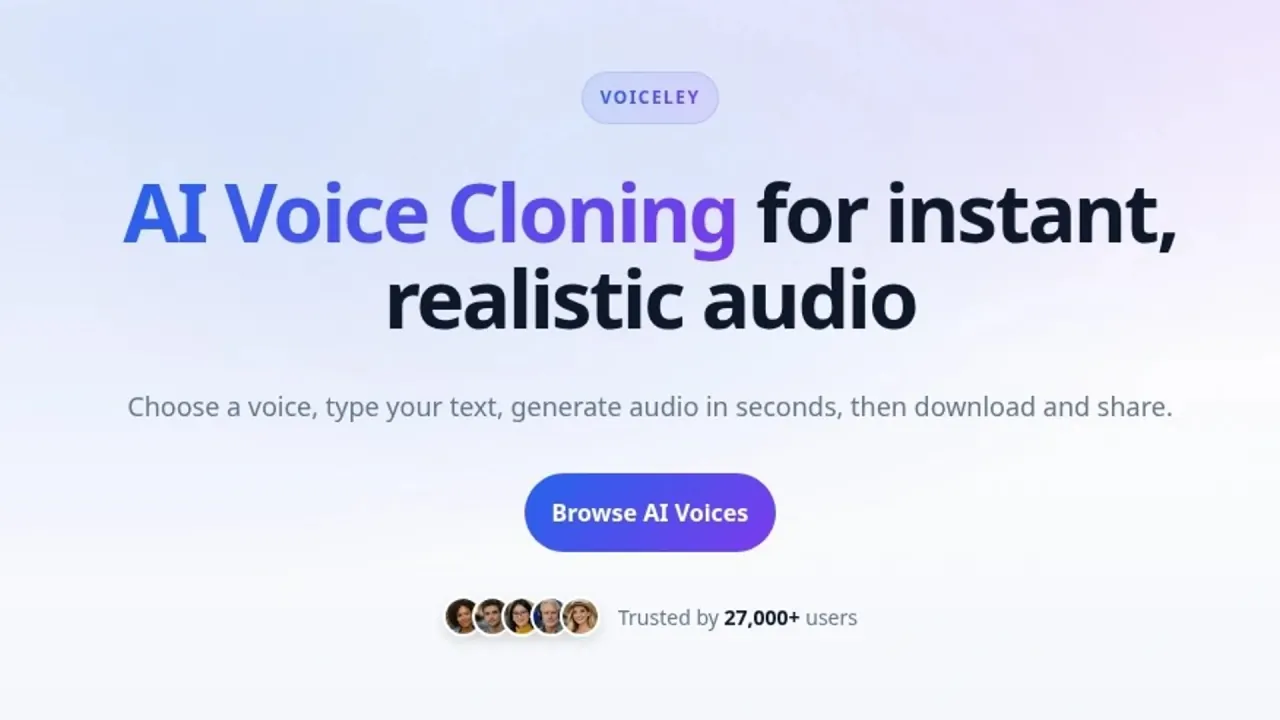

Voiceley is a web-based AI voice cloning and text-to-speech service: pick a celebrity, character or generic voice from its library, or upload a clean sample to build your own, type your line and download the generated audio.
Used this tool? Rate it
Used this tool? Rate it
Voiceley is a browser-based AI voice cloning and text-to-speech service. The homepage sums up the workflow in one line: choose a voice, type your text, generate audio in seconds, then download and share the result.
Its terms of service describe Voiceley as an AI-powered platform that lets users generate synthetic voice audio using text-to-speech technology and AI voice models, including custom and public voices. The same terms state that all audio generated through Voiceley is artificially generated and not a real recording of any individual.
Two things set the product apart from a generic narration tool. First, the public voice library is built largely around recognizable people and characters: its library page is titled as an AI voice model library and celebrity AI voice generator, and describes the collection as celebrity-style voices. Second, every paid plan includes custom AI voice cloning, so subscribers can upload a sample and reuse the resulting voice.
The homepage says Voiceley is trusted by 27,000+ users. That figure comes from the company itself and has not been independently verified.
What a reader should know up front:
Voiceley has three moving parts: a shared library of ready-made voices, private custom voices created from your own uploads, and a single generator box that turns a line of text into a downloadable clip.
Most named entries are modeled on real people or well-known cartoon and game characters; only a few, such as Robot and News Fish, are generic styles, so the choice of neutral narrator voices is narrow.
The pages checked for this review did not state a minimum sample length, accepted file formats or supported languages for cloning.
That quality claim sits alongside a disclaimer in the terms: output may contain inaccuracies or artifacts, and Voiceley does not guarantee accuracy, realism, or suitability for any purpose.
The homepage lays out a three-step process for library voices, and the custom-voice route adds an upload step behind a login.
The official FAQ gives concrete advice for better results: keep sentences clear, add punctuation, and avoid huge paragraphs. If a clip sounds off, it suggests rewriting the text like natural spoken language. With a 1000-character ceiling per generation on paid plans, longer scripts have to be split into several clips.
The disclaimer frames the service as intended for general informational and creative purposes only, and states that generated content does not constitute legal, medical, financial, or professional advice.
Voiceley targets people who want quick, short voice clips rather than long-form production. The plan names spell out the intended users: Starter is labeled "For casual use" and Studio "For heavy use".
A good fit if you:
A weaker fit if you:
No mobile app, desktop app, browser extension or public API was found on the site pages and sitemap checked for this review.
Voiceley pricing is built around three subscription tiers. The pricing section offers monthly or yearly billing and says yearly billing gives you two months free.
| Plan | Monthly price | Billed yearly | Generations per month | Characters per generation | Custom voices |
|---|---|---|---|---|---|
| Starter | $5.99 | $59.90 | 100 | 1000 | Up to 10 |
| Pro | $9.99 | $99.90 | 300 | 1000 | Up to 30 |
| Studio | $19.99 | $199.90 | 1000 | 1000 | Up to 50 |
All three tiers list priority processing and custom AI voice cloning, so the tiers differ only in monthly generation volume and the number of custom voices you can keep. Pro carries a "Popular" badge and the label "Best value."
The free tier is described inconsistently across the site. The refund policy says Voiceley offers a free usage quota that allows users to test the service before upgrading to a paid plan, and the homepage meta description mentions free monthly uses. The pricing section itself lists no free plan, and the only concrete allowance found was the guest counter showing a cap of three generations. The allowance for a registered free account was not shown on the pages checked. The privacy policy also says Voiceley may display advertisements to free users.
The two documents use different wording: the terms name only legal requirements as an exception, while the refund policy lists duplicate charges and unresolved technical issues. Both pages carry the same last-updated date.
AI tool directories list several broader text-to-speech platforms that include voice cloning. Two of them differ from Voiceley on consent and commercial rights.
ElevenLabs lists a free plan at $0 per month and a Starter plan at $6 per month that adds a commercial license and instant voice cloning. Its voice cloning page states that voice cloning is only possible with explicit permission from the voice owner, which is the kind of consent rule Voiceley's pages do not spell out.
Murf positions voice cloning inside a larger voice platform, and its voice cloning page says the tool supports 20+ languages such as English, Spanish and French. Voiceley's pages checked for this review did not list supported languages.
The acceptable use policy bars using Voiceley for impersonation of real individuals; fraud, scams, or deceptive practices; harassment, defamation, or harmful content; misleading others into believing AI-generated audio is real; and violating the rights of others, including publicity, privacy, or intellectual property rights. Voiceley reserves the right to suspend or terminate accounts that break these rules, and the termination section says this may happen without notice.
For celebrity voices, the terms say these are AI-generated simulations, that no endorsement or affiliation is implied, that rights belong to their respective owners, and that you are solely responsible for ensuring lawful use of such voices. The disclaimer adds that Voiceley is not affiliated with, endorsed by, or associated with any celebrity, public figure, or rights holder.
The FAQ answers the question "Is voice cloning allowed?" only with a general instruction: use Voiceley responsibly and do not use it for fraud, deception, or harmful impersonation. No clause requiring the consent of the person whose voice is uploaded was found in the pages checked; the closest rules are the ban on impersonation and the ban on violating publicity rights.
The disclaimer also states that audio outputs should not be presented as authentic recordings or used in a misleading way. That rule sits in tension with a library built around real people's voices, and the responsibility for staying on the right side of it rests with the user.
You keep ownership of the text you submit, and you grant Voiceley a limited, non-exclusive license to process it solely to provide the service. The terms state that Voiceley does not claim ownership of your generated audio. They do not say whether generated audio may be used commercially, and for public-figure voices they place the rights with the respective owners.
As of September 22, 2026, no independent media coverage or substantial third-party review sample for the current Voiceley service was found in the review platforms, media and community channels checked.
Partly. Guests can generate clips on library voice pages under a counter capped at three generations. The refund policy mentions a free usage quota, but the pricing section lists only paid plans starting at $5.99 per month.
Yes, on a paid plan. You upload a clean audio sample, and the resulting custom voice is private to your account. The number you can keep depends on the tier: 10 on Starter, 30 on Pro and 50 on Studio.
The pages checked contain no explicit consent requirement for uploaded samples. They do ban impersonation of real individuals and violating anyone's publicity, privacy or intellectual property rights, and they make you solely responsible for lawful use.
Generally not. The terms say payments are non-refundable unless required by law, while the refund policy allows exceptions for accidental duplicate charges and unresolved technical issues that prevent access.
