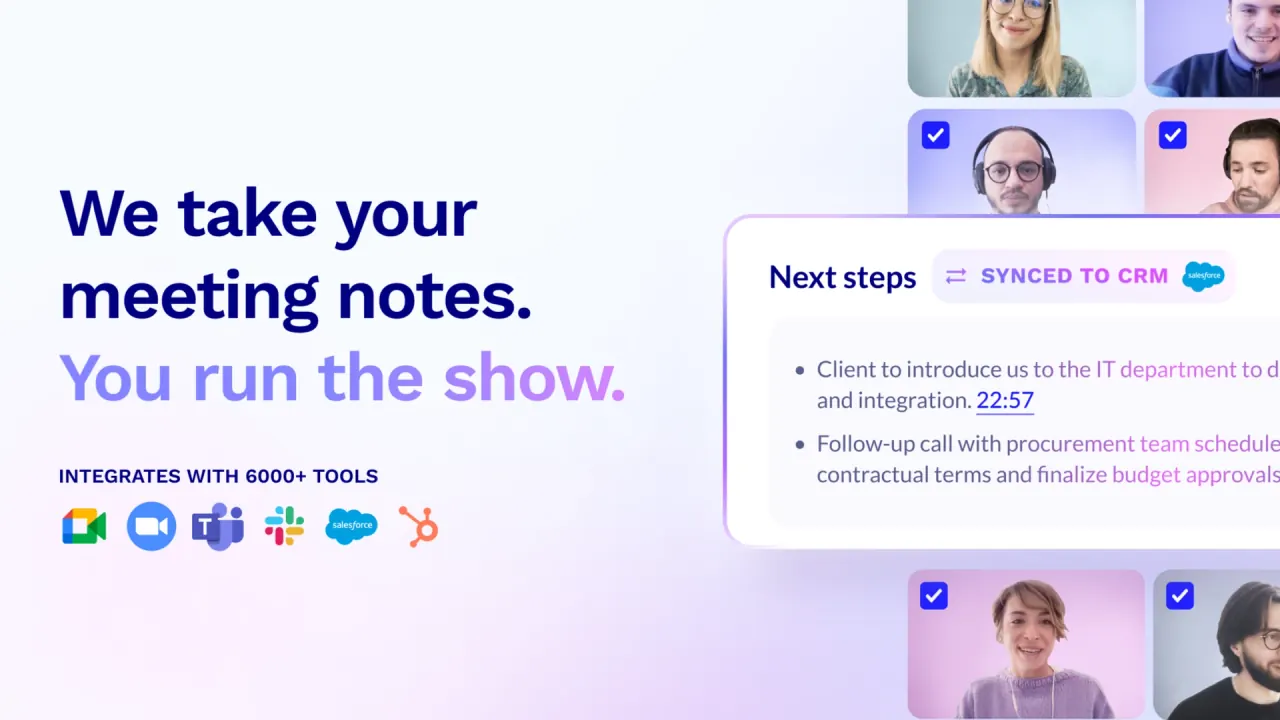

tldv records Google Meet, Zoom and Microsoft Teams calls with a meeting bot or a bot-free desktop app, then turns them into transcripts, AI notes and CRM updates for sales, customer success and internal teams.
Used this tool? Rate it
Used this tool? Rate it
tldv (written tl;dv on its official pages, short for "Too Long, Didn't View") is an AI meeting notetaker that records online calls, transcribes them and turns them into summaries and searchable insights. It captures Google Meet, Zoom and Microsoft Teams meetings through a recording bot, through a desktop app that records system audio without a bot, or through a mobile app for in-person conversations.
The operating company is tldx Solutions GmbH, registered in Aachen, Germany (HRB 23730). The company says tldv was founded in Germany in 2020 by three co-founders. A 2022 technology-press report covered a €4.3 million seed round led by Madrid-based K Fund.
Three facts shape most buying decisions. The free plan keeps recording and transcription unlimited in number but caps AI notes and keeps free recordings for only three months. Paid plans are priced per seat, with annual prices shown publicly and monthly prices not shown in the captured page. And in August 2026 an independent researcher disclosed a flaw that exposed meeting metadata; the company says both attack paths are now closed (details under Limitations).
The bot and the desktop app are not interchangeable. Bot-free recording captures audio only, meaning your microphone and any system audio, and does not record video, screen sharing or chat messages. Any other sound playing on the computer, such as music or notifications, is recorded too. The company says the bot-free option is especially useful for Google Meet, where it states Google now flags third-party notetaker bots as "potential risk" and defaults to denying them entry.
The standard model is described by the company as 96% accurate, a vendor figure rather than an independent measurement. Industry terms and brand names are where the help center suggests the custom dictionary matters most.
On macOS, the app needs Screen Recording and Microphone permissions under Privacy & Security. On Windows, bot-free recording works automatically after installing the desktop app, with no additional setup.
Once enabled, tldv replaces the calendar meeting link with a consent link. Participants who decline can still join, but tldv will not join or record. A decline made by mistake cannot be reversed for that meeting; recording again requires a new meeting.
These examples depend on plan level. Multi-meeting questions are capped on Free and Pro, so recurring cross-call analysis such as weekly objection reviews fits Business, where multi-meeting Ask AI is unlimited.
Less suited:
Official pages disagree on mobile. The homepage FAQ says tldv does not have a native mobile app yet, the mobile landing page labels the app "Early Beta Access", and the help center and pricing table list iOS and Android apps.
The Chrome extension showed 4.6 out of 5 from 596 ratings and 400,000 users on its store listing as captured on September 28, 2026.
| Plan | Listed price | AI meeting notes | Weekly web recordings | Data retention |
|---|---|---|---|---|
| Free | $0, no credit card | Up to 10 meetings | 40 | Up to 3 months |
| Pro | $18 per seat/month, billed annually | Unlimited | 80 | Custom |
| Business | $29 per seat/month, billed annually | Unlimited | 120 | Custom |
| Enterprise | Custom, via sales | Unlimited | 500 | Custom |
The Free plan is $0 with no credit card required and includes unlimited video recordings, unlimited transcription in 30+ languages and 10 meetings with AI notes. Pro is listed at $18 per seat per month, billed annually. Business is listed at $29 per seat per month, billed annually, with no usage-based AI fees. Enterprise pricing is available on request. The pricing table sets weekly web recording capacity at 40, 80, 120 and 500 recordings for the four plans.
Pro and Business are sold with monthly or annual payment options. The captured pricing page showed only annual prices, and its page description advertises 40% off on every annual plan. The monthly rate was not displayed in the version reviewed.
Free-plan AI limits apply for the lifetime of the account and do not renew monthly. The first 10 meetings get full automatic AI notes; after that, only the first 10 minutes of each meeting are summarized automatically. Single-meeting and multi-meeting Ask AI are each capped at 5 queries on Free, and multi-meeting Ask AI stays at 5 queries on Pro.
Seats are only needed for members who use paid features. A workspace can have a single Pro account alongside 100 free users. Unless otherwise agreed, all fees are non-refundable under the terms. Non-profits and NGOs can request a discount through the support chat by stating the seat count and cause.
tldv's own pricing-page comparison still describes the Fireflies free plan as "3 transcriptions", "No video" and "5 hours storage/m", which does not match the Fireflies page captured the same day. The main contrast in this group is the free-tier model: tldv counts meetings with AI notes and weekly recordings, Otter counts transcription minutes, and Fireflies caps storage.
"Unlimited" in the plan list refers to the total number of recordings; it sits alongside the weekly caps above.
An independent researcher reported a flaw that allowed access to metadata for 181,874 meeting records across all users. The researcher wrote that the issue was reported on January 28, 2026 and was still open in July 2026. In a statement dated August 5, 2026, tldv's CTO said the original flaw had been fixed and validated months earlier, that a second, previously unknown path was closed within 24 hours, and that Firebase is being removed from the stack. The company says exposed data was limited to metadata, including conference IDs and participant emails, and did not include recordings, transcripts, AI notes or passwords.
Yes. The Free plan costs $0, includes unlimited recordings and transcription, and gives full AI notes for the first 10 meetings. Free recordings are deleted after 3 months, with a notice 4 weeks before deletion.
No. The bot is the default for scheduled Google Meet, Zoom and Teams calls, but the desktop app can record system audio without a bot. That route saves audio only.
The privacy policy says customer content is not used to train or improve foundation models or generative AI models, by tldv or by its AI providers.
Data is hosted in the European Economic Area. Parts of transcripts sent to AI features can be processed in the EU or the US, depending on the AI hosting location selected in preferences.
