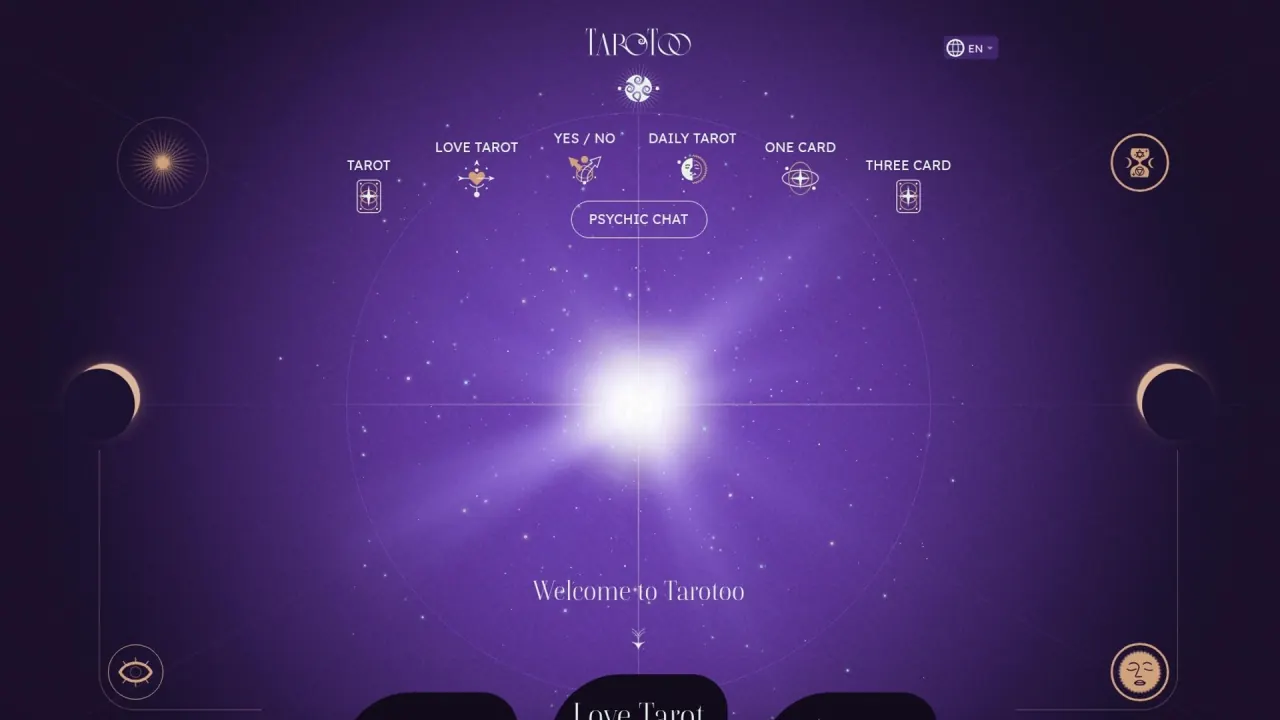

Choose animated tarot cards and receive an AI interpretation shaped by your question and spread. Tarotoo also offers a free website chat for astrology, numerology, dreams, and personal reflection.
Used this tool? Rate it
Used this tool? Rate it
Tarotoo is an interactive website for online tarot that combines Rider–Waite symbolism with AI-generated interpretations. It is positioned for self-reflection, spiritual exploration, and thinking about emotions, choices, and recurring patterns.
Tarotoo describes its tarot readings and Psychic Chat as symbolic and subjective, without guaranteed outcomes or supernatural abilities. Psychic Chat is automated AI: it does not connect you to a human psychic, spirits, or deceased people.
Tarotoo says its AI tarot readings interpret card combinations in the context of your question, focus, and chosen cards.
The documented generation process retrieves relevant card information from Tarotoo’s dataset, combines it with the question and reading context in a structured prompt, and uses an AI language model to write the interpretation. Tarotoo identifies OpenAI as its model provider and says the completed prompt is sent through an encrypted API connection.
The public dataset covers all 78 cards, while current website readings use the 22 upright Major Arcana. Website draws therefore exclude Minor Arcana and reversed cards, despite their presence in the reference material.
Website Psychic Chat brings astrology, Human Design, numerology, dreams, and spiritual practices into an AI conversation. It supports follow-up questions and switching tools within the same conversation.
Tarotoo says the AI does not control the shuffle, choose cards, or use your question or personal information to influence which cards you select.
A completed reading cannot be edited after the cards have been selected and the result generated. Using a different question or different cards requires starting a new reading.
The tarot-page Settings menu offers Original and New design. Both use the same 22 upright Major Arcana and card meanings; the difference is visual. A design can be selected before entering a question or before picking cards; it becomes fixed once card selection starts.
Sound can be turned on or off in Settings. The optional Remember my deck and sound settings on this device setting retains those preferences in the same browser on that device. It does not save questions or readings, and unchecking it removes the saved preferences.
Psychic Chat accepts an open-ended message or a tool selected from its menu. Back to menu ends the current information-entry flow so another tool can be chosen. The interface uses the most recent active buttons; buttons in older messages may be inactive.
After a result, the chat supports additional context and follow-up requests for another focus, a simpler explanation, or more detail. Messages must stay within the character limit shown beside the input.
Daily Tarot uses three cards to explore love, mood, and spiritual growth. Your name, birth date, and the current date supply additional context for astrology and numerology elements, such as a zodiac sign. Tarotoo says these inputs personalize the symbolic interpretation; they do not establish personality facts or predict how the day will unfold.
The dream tools explore a dream’s imagery, emotions, and possible connections to waking life. Dream symbols focuses on an individual detail, while recurring-dream conversations explore repeated themes.
These are symbolic exploration tools with different input requirements, rather than psychological assessments or factual forecasts.
Tarotoo distributes the dataset through GitHub, Hugging Face, Kaggle, and Zenodo, and provides JavaScript and Python packages plus an MCP server for developers and compatible AI tools.
Tarotoo provides a website plus separate apps distributed through the App Store and Google Play. The company says the website and apps may differ in features, tarot spreads, reading methods, and safeguards.
The Android app listing describes an animated 78-card Major and Minor Arcana deck and spreads including a ten-card Celtic Cross. It also describes Tarot Companion, which uses a taken or uploaded photo of a physical spread to identify visible cards and generate a symbolism-based interpretation. These app-listing descriptions do not establish identical features in the website or every app version.
The website lists English, Spanish, French, Italian, German, and Brazilian Portuguese. On desktop, the language selector is a dropdown with a globe icon in the top-right corner. In a mobile browser, it appears inside the top-right menu below the logo.
Tarotoo says the website is completely free, requires no registration, and offers unlimited tarot readings at no cost. Its website Psychic Chat and spiritual tools are also described as free without registration.
| Experience | Publicly described access | Relevant boundary |
|---|---|---|
| Website tarot | Free, no registration, unlimited readings | Current website draws use 22 upright Major Arcana |
| Website Psychic Chat | Free chat and spiritual tools, no registration | Separate advertisements can lead to paid third-party services |
| Android app | Free and optional subscriber features | Some advanced spreads and features require a subscription |
The Android description says basic Psychic Chat sessions are available without a subscription, while unlimited conversations may require one. An optional subscription can unlock unlimited AI tarot readings, advanced spreads, expanded interpretations, unlimited chat, and additional reflective prompts.
App purchases are processed by the relevant store. Tarotoo’s terms say price, currency, subscription period, billing frequency, included features, and trial or promotional conditions are shown before purchase confirmation. Purchase-specific information controls over the general terms for that transaction, subject to applicable law.
Tarotoo may receive commissions from separately labeled promotions for independent psychic services. It says these promotions are separate from the tarot-reading process, and app or affiliate revenue does not influence card selection, meanings, AI instructions, Psychic Chat responses, or individual readings.
FlipTarot is an alternative for readers who want explicit handling of upright and reversed orientation together with follow-up questions about the same spread. Its description says the AI relates card meanings, positions, and orientation to the question, then connects the cards into an interpretation that can be discussed further.
Its access model also differs from Tarotoo’s free, no-registration website. FlipTarot advertises one free Daily Guidance reading and three free basic readings per day after sign-in; additional readings cost one credit each or are included with Premium. The comparison is between orientation and follow-up controls, and an account-based daily allowance.
Tarotoo warns that readings and other content may be inaccurate, incomplete, inconsistent, outdated, generalized, misleading, or unsuitable for a particular person’s circumstances.
The service does not provide medical, legal, financial, psychological, psychiatric, mental-health, or other professional advice. Its terms also exclude using the service as a substitute for professional care, diagnosis, treatment, advice, or support.
Website safety checks run before tarot card selection and when a message is submitted to Psychic Chat. Tarotoo says sensitive or high-stakes questions receive a safety response instead of direct tarot guidance, potentially with an alternative question focused on reflection. An immediate crisis or urgent safety concern does not receive that reflective continuation.
Tarotoo acknowledges that safeguards may miss a crisis or misunderstand a situation. It cannot monitor user safety, contact emergency services, or replace immediate human support.
Users retain any rights they have in their submitted inputs. The terms grant Tarotoo and its providers limited permission to process those inputs as reasonably necessary to provide, maintain, and secure the service, investigate misuse, enforce terms, respond to support, and comply with law. This permission does not transfer ownership of the inputs to Tarotoo.
Generated content may be non-unique, and other users may receive the same or similar material. Tarotoo does not guarantee that output qualifies for intellectual-property protection or that every use is lawful or free of third-party claims. Subject to the terms and third-party rights, generated readings may be saved and shared for personal, non-commercial use. The separate dataset’s MIT license covers different material.
The website has no server-side reading-history feature. App history may be stored locally, is not automatically synchronized with the website, and is not maintained as account-based history by Tarotoo. Uninstalling an app, clearing its data, losing or replacing a device, or a device failure may permanently delete local history; recovery is not guaranteed.
Tarotoo says AI inputs and relevant reading selections are sent to OpenAI to generate responses. It does not use prompts or responses to train its own AI models and keeps optional OpenAI API data sharing disabled. Its policy says OpenAI may retain API content and related metadata for up to 30 days for abuse monitoring, subject to applicable data controls and legal or security exceptions. No server-side reading history does not mean no third-party processing or retention.
Website birthplace searches and birth-chart calculations use a calculator hosted on Vercel. It processes the search text, birth details, selected location, and any optional name. Tarotoo says this calculator does not save submitted inputs or chart results in database records or files, or put user inputs in application logs. Relevant calculated results and conversation context are sent to OpenAI when needed for an interpretation or follow-up.
The website may process technical information including IP address, access time, requested URL, response status, referring page, browser or device type, language, and cookie-consent choices. Tarotoo says Google Analytics is consent-based; its stated retention settings are two months for event-level data and fourteen months for user-level data, while aggregated reports may remain longer. It also says it does not currently place advertising cookies on the website.
Tarotoo says it does not sell personal information or share it for cross-context behavioral advertising. Analytics consent can be changed through Consent Preferences in the website footer. Local app history is different from server-held data: Tarotoo may be unable to access or delete it remotely, and its policy describes deletion through the app, clearing app data, or uninstalling. These are published company statements, rather than an independent privacy audit.
No. Tarotoo says it cannot access another person’s private information, read thoughts, track actions, or verify their feelings or intentions.
The question and additional details supply the interpretation’s context. Tarotoo says different wording or information may produce a different interpretation of the same cards. The AI does not know your complete situation, thoughts, or emotions; it works from information supplied during the reading.
No. Tarotoo says expert review applies to the overall methodology, symbolic framework, prompts, AI logic, spread structures, tone, and safety approach. Individual readings are generated automatically and are not manually written, approved, or reviewed before display.
