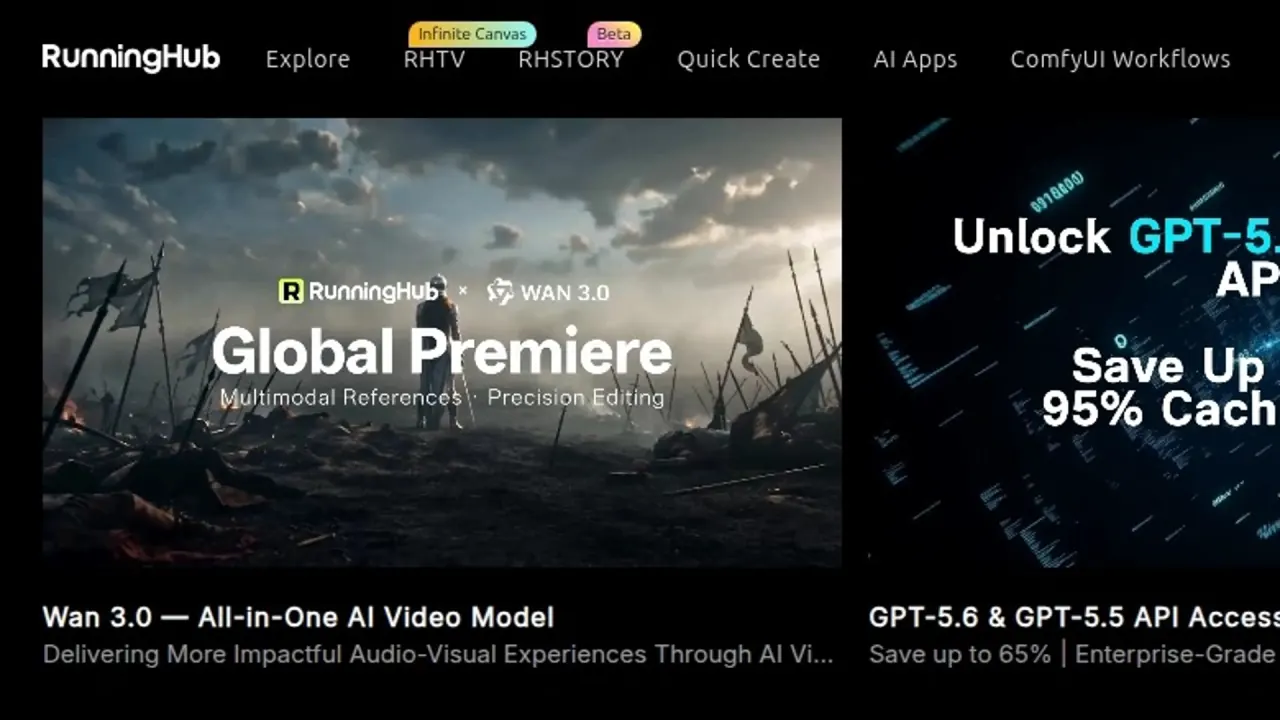

RunningHub runs ComfyUI workflows on hosted GPUs, lets creators publish them as AI apps, and offers pay-as-you-go APIs for hundreds of image, video, audio and language models.
Used this tool? Rate it
Used this tool? Rate it
RunningHub is a cloud ComfyUI platform that runs in the browser: it hosts ComfyUI workflows on remote GPUs, lets creators publish those workflows as AI apps, and resells API access to a large catalog of image, video, audio, 3D and language models. The company describes it as an all-in-one content creation platform powered by native AI agents, combining ComfyUI workflows, an infinite canvas, AI apps, image and video generation, and model API access.
Two company names appear on runninghub.ai. The User Service Agreement is concluded with Hong Kong Huize Technology Co., Limited. The Chinese-language About text on the same site, however, says the RunningHub product belongs to Anhui Haima Cloud Intelligent Technology Development Co., Ltd. (安徽海马云智能科技发展有限公司). Neither page explains how the two companies relate.
RunningHub also runs a separate Chinese site at runninghub.cn, and the two sites publish separate user agreements: the runninghub.cn agreement names Anhui Haima Cloud as the contracting company.
The product sits inside the wider open-model ecosystem. A Chinese tech-media report on the open-source release of MiniMax H3, relaying MiniMax's announcement, listed RunningHub among 16 chip makers, developer communities and cloud inference platforms that completed launch-day adaptation.
RunningHub connects three layers that are usually separate products: a hosted ComfyUI environment for building node graphs, an app layer that wraps a finished graph in a simple input form, and an API layer that exposes the same apps, workflows and third-party models to code. A workflow built in the first layer can be published as an app in the second and called from the third, which is why creators, app users and developers end up on the same platform.
Publishing is tied to an incentive program. Creators can earn income by publishing workflows or AI apps, and usage is counted by the number of users who successfully run a published workflow, app or model, including API calls. Favorites and originality are further factors in the reward calculation.
The RunningHub API offers multimodal and large language model capabilities so developers can integrate image, video, audio, AI apps, workflows and LLM models into products or automation pipelines. It is split into four types: Model API, AI App API, Workflow API and LLM API. The Workflow API works as a ComfyUI workflow API for graphs composed of multiple nodes, suited to complex creative pipelines.
As captured on September 28, 2026, the API page listed 322 video generation models, 189 image generation models, 47 audio generation models and 16 3D generation models. Video is the largest group, and the AI video generation API catalog spans model families such as Seedance, Kling, Vidu, Hailuo and Google Veo, each with its own unit price.
RHTV is an AI-powered canvas for video and image generation built for end-to-end creative workflows, where users create videos, images and storyboards with prompt-based editing, visual pipelines and AI-assisted guidance. It runs on its own subdomain and shows community short films on its start page, while the ComfyUI workflow editor remains the tool for building node graphs by hand.
The documentation describes the same task-based pattern for the Model API, AI App API and Workflow API:
The LLM API does not use the task flow; requests go directly to protocol-compatible endpoints and return regular or streaming responses depending on the endpoint.
The official use-case pages point at a small set of concrete jobs rather than general creativity.
RunningHub separates individual and organizational use at the account level.
It is a weaker fit for buyers who need a clear commercial license for everything they generate, for anyone who needs published plan prices before buying, and for users bound to the models or terms of the runninghub.cn site, which is governed by a different agreement.
RunningHub is a web service with several developer entry points around it.
RunningHub is a paid service: users access its services by paying to activate a membership or by purchasing RHcoins, the platform's virtual currency. Membership plan prices were not shown on the public pages checked on September 28, 2026, so the table lists the billing routes and the figures that are public.
| Route | How it is charged | Public figure as captured |
|---|---|---|
| Membership | Validity period plus RHcoins | Plan prices not shown publicly |
| Separate RHcoins purchase | Coins valid for one year | Not shown |
| Model API | Per image, per second or per million tokens, by model | nano-banana-2: $0.067 struck through, $0.027/image, 60% OFF |
| Enterprise-Dedicated key | Requires buying a dedicated machine | Not shown |
The API price table shows a struck-through price next to a lower price and a discount label; the pages checked do not define the struck-through figure.
Beyond the table, these rules change what a purchase costs in practice:
Promotions change often. As captured on September 28, 2026, the homepage advertised a limited-time offer of one month of unlimited free generations for members, next to a "13 Hours Free Daily" window of 9 AM–10 PM ET.
Hosted ComfyUI is a crowded category, and the main differences are licensing, how much control over the machine you get, and whether you pay per run or per GPU hour.
RunningHub's case against these options is its catalog: community workflows, published apps and hundreds of third-party model APIs share one account and one balance.
Both carry the RunningHub brand, but they are separate sites with separate user agreements. The runninghub.ai agreement is with Hong Kong Huize Technology Co., Limited, and the runninghub.cn agreement is with Anhui Haima Cloud.
Generally not. Activated services are non-refundable except for severe defects, legal requirements or cases RunningHub agrees to, and separately bought RHcoins expire after one year without a refund.
An Enterprise-Shared key. Consumer-Member keys only work with the AI App API and Workflow API, and Enterprise-Dedicated keys require buying a dedicated machine.
The User Service Agreement says rights in content you upload and synthesize belong to you or the original copyright owner, but you also grant RunningHub a global, free, sublicensable license that covers promotional use.
The official pages disagree. The Paid Service Agreement limits the license to personal, non-commercial use, while the API documentation describes personal accounts as fit for individual commercial use.
