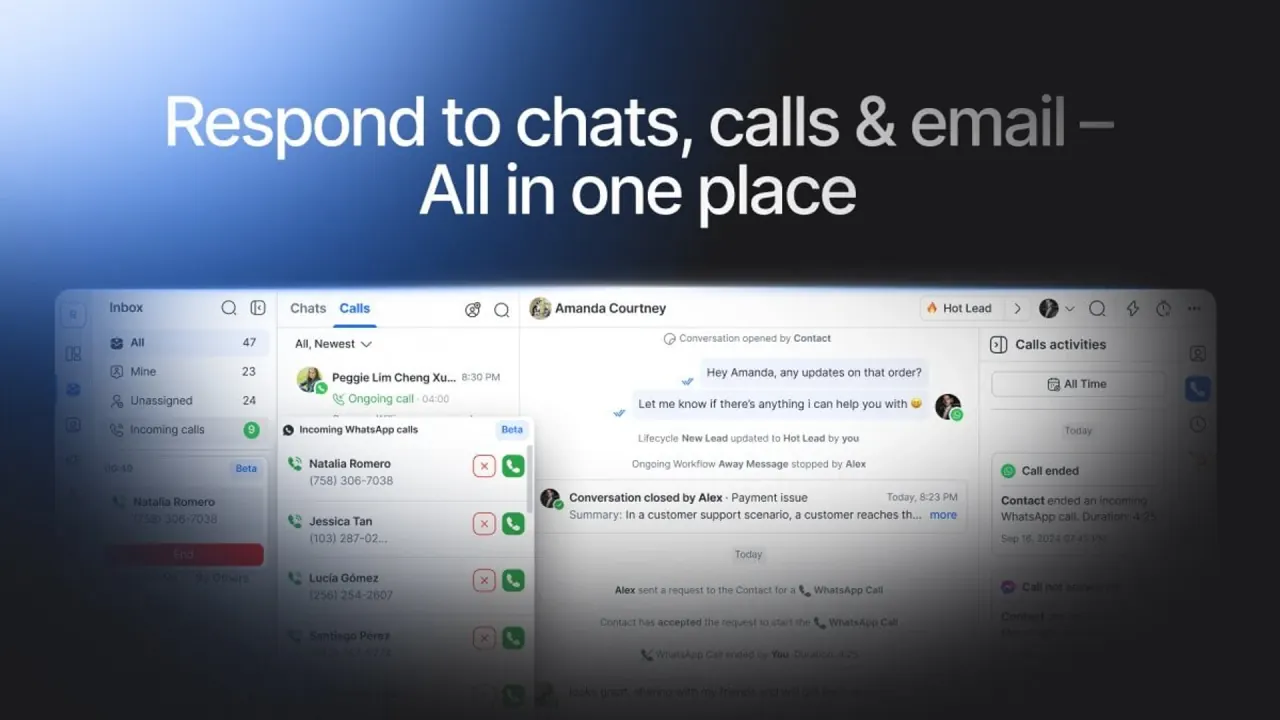

A WhatsApp-first conversation platform that unifies messaging, voice calls and email in a single team inbox with AI agents, workflow automation and CRM sync, priced by the contacts you talk to rather than by user seat.
Respond.io is a customer conversation management platform for businesses whose buyers arrive by message rather than by web form. Chats, voice calls and email from the same person land in one thread, so a conversation does not break when the customer switches channel.
Billing is charged per Monthly Active Contact rather than per seat, so the invoice tracks how many people you spoke to, not how many staff were logged in.
It is a WhatsApp Business Solution Provider rather than a general inbox with a messaging connector bolted on, so the WhatsApp Business API sits at the centre of the product. That shows in details generalists do not carry, such as Coexistence, which keeps one number usable in the WhatsApp Business app while that same number is connected to the API.
Contracting is with Rocketbots Limited, a Hong Kong company whose parent is Respond, Inc. in Dover, Delaware. The earlier name is still visible: independent directories and review platforms index the product under Rocketbots.
Original technology-press reporting places the founding in Hong Kong in 2017 and the move to Malaysia two years later, records a $62.5 million Series B led by Camber Partners with Endeavor Catalyst after a $7 million Series A in 2022, and puts the stated sweet spot at companies of 200 to 10,000 employees in high-consideration categories such as healthcare and automotive.
An omnichannel team inbox is only as useful as the channels it treats as first-class and the plan each sits behind.
Messaging covers WhatsApp Business Platform, Facebook Messenger, Instagram, Telegram, Viber, LINE, WeChat and TikTok Business Messaging, plus SMS through Twilio, MessageBird or Vonage, email through Gmail, Outlook and Microsoft 365 or plain IMAP/SMTP, and a web chat widget with plugins for WordPress, Shopify, Wix and Squarespace. Anything unlisted connects through a Custom Channel over API or webhook.
Three labels change planning. TikTok Business Messaging is marked Beta, Facebook Messenger Calls is marked Coming soon so Messenger is currently text-only, and Viber is absent from the entry plan entirely — it starts at Growth, as do Make and the generic Webhook integration.
WhatsApp Business Calling and outbound VoIP to any phone number run inside the same conversation record as messages and email, so a chat-to-call escalation is a click rather than a context transfer. Calls feed the AI layer through recording, transcription and summary.
AI Agents hold conversations and take actions, Voice AI Agents handle calls, and assistive features cover drafting, translation, suggested replies, summaries and transcription.
All of it draws on one AI credit meter with published rates. Drafting, translation, reply suggestion and summaries cost one credit each; transcription runs at roughly two credits per minute; an AI Agent response costs two to five credits; a Voice AI Agent costs roughly seventy credits per minute. Model that last figure before committing to voice automation: ten minutes of call consumes what several hundred text replies would.
Agents answer from knowledge you supply: PDF, TXT, MD, CSV, DOCX, PPTX and PPSX documents, image files, and public web pages crawled to a configurable depth, three levels by default and up to a hundred.
An agent cannot judge which document is most relevant, and cannot look a document up by title; it matches keywords inside content. Telling it to check the pricing guide does nothing, while telling it to search for a specific term works.
Workflows carry the deterministic side: lifecycle stages, routing rules and contact-field updates. Contacts sync with HubSpot, Salesforce, Pipedrive, ActiveCampaign and Zendesk, and automation reaches further through Zapier, Make, n8n and an MCP server.
Setup order decides whether the first invoice surprises you.
Qualifying paid-ad traffic without adding headcount. When a conversation starts from a Meta or TikTok click-to-chat ad, the AI Agent automatically receives an ads context block naming the platform, campaign, ad group and creative, so one agent can open differently for a clearance campaign and a premium launch. The catch is documented: that block is attached only if the ad entry happened within the last 20 messages, and only the most recent entry is included.
Re-engaging a segment on a schedule. Broadcasts are counted in messages sent rather than contacts reached — 2,000 contacts messaged weekly is 8,000 broadcast messages a month. Plan that arithmetic in advance, because exceeding the monthly allowance does not trim the send; the entire broadcast is blocked.
This suits mid-market B2C operations where messaging is the primary sales surface: retail chains, clinics, dealerships, education providers and travel agencies with high conversation volume across WhatsApp and social messaging, and enough process to benefit from routing and lifecycle stages.
It also suits teams whose headcount and conversation volume have decoupled: because billing follows contacts rather than seats, adding supervisors or a night shift does not multiply the subscription, though extra users still cost $12 a month on Starter, $20 on Growth and $24 on Advanced.
It fits less well in three cases. Small teams with modest volume face a high entry point: the cheapest plan is $79 a month billed yearly before any Meta messaging fees, and independent reviewers raise cost, one calling the product very expensive for a small team. Teams needing advanced automation cannot start at the bottom either, since Workflows, AI Agents, broadcasts and the developer API all begin at Growth. And anyone expecting plug-and-play should budget setup time.
Regulated buyers should read the eligibility terms early: use is restricted to businesses and to adults, and barred for users located in countries under a US government embargo or listed on US restricted-party lists.
The platform is browser-first: the full workspace lives on the web and the mobile apps are agent companions rather than replacements. Multiple workspaces, for keeping brands or regions apart under one bill, start on Advanced.
Both mobile apps are published by Rocketbots Limited. The iOS build requires iOS 13.4 or later and also runs on Macs with Apple silicon and on visionOS; its listing is in English only and rated 17+. The Android build is registered to the same Hong Kong address, and its data-safety declaration states that no data is shared with third parties, while Apple's privacy labels declare contact info, identifiers, usage data and diagnostics as linked to identity — two disclosures about different things, under two different store policies.
Infrastructure is hosted on Amazon Web Services, with 256-bit TLS in transit and 256-bit AES at rest, daily backups and replication across data centres. The company states it holds ISO 27001 certification and is GDPR-compliant; both are assertions on its own security page rather than findings verified here. For developers there is a Developer API from Growth upward, webhooks and HTTP request steps from Advanced, and Custom Channels.
Four tiers, headline rates quoted for annual billing. Monthly billing costs materially more: $99, $199 and $349 a month for Starter, Growth and Advanced, against annual totals of $948, $1,908 and $3,348.
| Plan | Yearly rate | Included users | Extra user | Monthly Active Contacts | AI credits |
|---|---|---|---|---|---|
| Starter | $79/month | 5 | $12/month | Unlimited | 5,000 fixed |
| Growth | $159/month | 10 | $20/month | From 1,000 | 10× MAC tier |
| Advanced | $279/month | 10 | $24/month | From 1,000 | 20× MAC tier |
| Enterprise | Custom | Unlimited | — | Custom | 40× MAC tier |
An active contact is broader than "someone who replied". A contact counts if they send or receive a message, or make or receive a call, during the billing month — and outbound messages that fail to send still count, broadcasts excepted. Overage bills per 100 contacts: $12 on Growth, $15 on Advanced.
AI credits scale with the contact tier, then stop. Growth includes ten times the contact limit in credits, Advanced twenty times, Enterprise forty — and that scaling ends at the 10,000-contact tier, above which self-served plans get the 10,000-tier allowance. Overage runs at $15 per 1,000 credits rounded up to a whole block, capped at 200% of the allowance, after which AI features pause. On current paid plans this on-demand billing cannot be switched off.
Messaging fees are separate and unmarked-up. WhatsApp charges are not included in any subscription; Meta bills them by recipient country, message type and monthly volume. The company states it adds no provider markup and that inbound messages and calls are free on its side.
The trial is a Growth trial. Seven days, no card, full Growth functionality for five users and 1,000 contacts, with broadcasts excluded — so the feature most likely to justify Growth is the one you cannot test.
Cancelling takes effect at the end of the billing cycle: incoming messages are not stored during cancellation, workflows stop running, and the organisation is flagged for deletion after 30 days. Downgrades wait for the next cycle; upgrades apply immediately.
The most informative thing here is that independent sources disagree with the vendor about which category this belongs to.
An independent software directory files it among help desk platforms and CRM systems, leading its alternatives with a self-hosted help desk and a live chat widget. An independent review platform lines it up against broad service-desk and CRM suites, incumbents carrying thousands of reviews each against this listing's sixty. Neither indexes it primarily as a messaging-first platform, which is how the product positions itself.
That gap is the decision. If your problem is ticket volume arriving by email and phone, the suites those directories surface are the mature answer. If WhatsApp, Instagram and TikTok already carry your revenue while your help desk treats them as an afterthought, the specialisation is what you are buying.
On ratings, the company advertises a 4.8 average from more than 500 reviews on a major third-party review platform. That platform refused automated retrieval in this round, so the figure stands here as a vendor statement rather than a checked one.
The AI Agent's limitation register is unusually candid. An agent sees at most the 20 most recent messages and cannot see internal comments, so anything it must remember belongs in contact fields or lifecycle stages. It also cannot see the message a customer is quoting when they use the reply feature, even when that original falls inside the 20-message window — a common route to contextually wrong answers. Instagram Story replies arrive as a bare placeholder with no text or media, with no workaround. Assigning an agent from an external tool such as the developer API, n8n or Make deliberately does not make it speak; it waits for the customer to message first.
Knowledge ceilings are per workspace rather than per plan: 20MB of total storage, 100 file-based sources and 50 add-or-edit actions a day, with single files capped at 1MB on trial against 20MB on paid plans. Google Sheets links are unsupported as a web source, and saved snippets cannot be used as knowledge.
Broadcasts fail all-or-nothing: exceed the monthly message allowance and the whole send is refused rather than partially delivered. A broadcast already in progress cannot be cancelled, and custom send rates are a sales-gated add-on.
Two documentation problems cost money if missed. The billing help pages warn that the in-app pricing screen can show older plans than the website. And the WhatsApp messaging-limits article contradicts itself about the step above the 250-conversation tier: its scaling-tier list names 2K, while two of its own FAQ answers describe a 1,000 tier.
On one independent review platform the listing carries 4.6 out of 5 across 60 reviews, with ease of use at 4.7 and customer service at 4.5. Seven named reviewers among those sixty raise three themes, each more than once: cost, from very expensive for a small team to contact-based pricing that feels high; technical effort during setup and integration; and limited reporting and sidebar-field customisation. Seven of sixty is a small slice, so treat these as signals, not measured frequencies.
The binding documents are blunter than the marketing. The company states it does not filter or moderate customer content, while reserving the right to remove or block it and to cut off access on a complaint, an intellectual-property notice, an authority order or a perceived risk. Backups are performed but explicitly not guaranteed against loss or corruption, and the terms ask you to keep your own copy of your content. An account cannot be terminated until the paid period expires.
Rocketbots Limited is the named data controller, with Article 27 representatives in Bonn and Peterborough for EU and UK data subjects, and server log files are deleted after 30 days.
No. WhatsApp fees sit outside every plan and are charged by Meta by recipient country, message type and monthly volume. The company states it adds no markup of its own, and that inbound messages and calls are free on its side.
Any contact who sends or receives a message, or makes or receives a call, during the billing month. The rule that catches people out: outbound messages which fail to send still count, broadcasts excepted.
Only up to a ceiling. Overage is $15 per 1,000 credits rounded up to a whole block, and consumption in a cycle is capped at 200% of the included allowance, after which AI features pause.
Not reliably. The agent receives only the new message, never the quoted one, even when the quoted message is inside its 20-message window. The documented mitigation is to instruct the agent to ask the customer to restate the request.
Cancellation takes effect at the end of the current billing cycle. Incoming messages are not stored during cancellation, workflows stop running, and the organisation is flagged for deletion after 30 days, so export conversation and contact data first.
