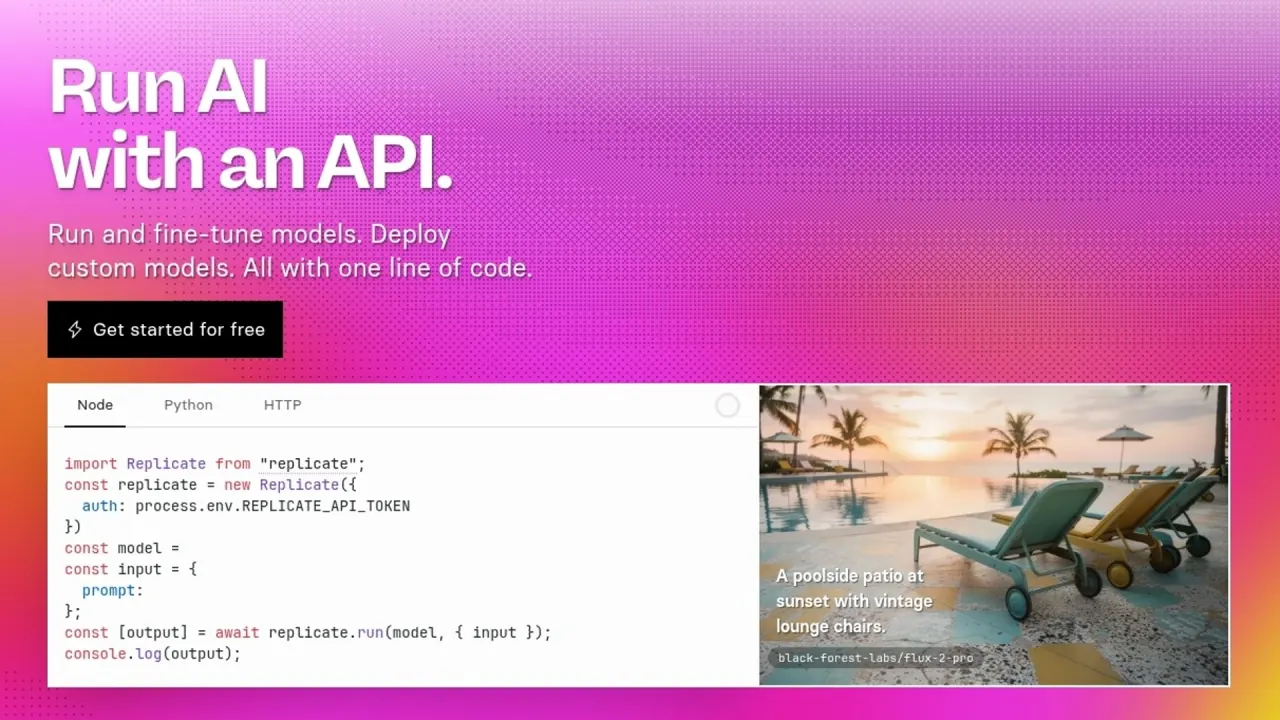

Replicate is a cloud platform that runs, fine-tunes and hosts AI models behind a single HTTP API. Most models bill per second of GPU time, a maintained subset bills per output, and credit is bought upfront.
Replicate lets you run AI models with a cloud API, without having to understand machine learning or manage your own infrastructure. One HTTP request sends an input to an image, video, audio or language model and returns the result — no GPU to rent, no container to build.
Three jobs sit behind that interface: running a model someone else published, fine-tuning one on your own data, and deploying code you packaged yourself — each reachable in a single line of code.
The operator is Replicate, LLC. 101 Townsend Street San Francisco, CA 94107. On 17 November 2025 the owner changed: Replicate, the leading platform for running AI models, is joining Cloudflare. The product surface was excluded — the API isn't changing. The models you're using today will keep working — and the acquirer matched it: your APIs and workflows will continue to work without interruption. Shipping continued as well; the newest changelog entry adds markdown instruction files that give coding assistants expert knowledge about working with AI models on Replicate.
Catalog size is a vendor figure: the announcement puts it at more than 50,000 open-source models and fine-tuned models, and no independent count surfaced in the channels checked this round.
One API fronts four things that behave differently in latency and cost:
"A model on Replicate" is therefore not one performance profile: official models are always warm and ready to respond to requests, so you can run them without worrying about cold boots, while a rarely used community model loads from scratch first.
Capacity moves both ways unconfigured: if you get a ton of traffic, Replicate scales up automatically to handle the demand, and scales back to zero when idle. Where that is too loose, deployments are a feature that allow you to, among other things, control the hardware and scaling parameters of any model. For teams, organizations let you share access to models, API tokens, billing, dashboards, and more.
The default safety filter is narrower than it sounds: the platform enables the safety checker for web predictions on the SDXL base model, the Flux base model, and all derivative fine-tunes of both SDXL and Flux. There is also an escape hatch — you can disable the safety checker when running the model with the API — which leaves the API path without a guaranteed filter.
The first integration is short, but two of these steps are cheap now and expensive later.
The documented capabilities map onto a narrow set of jobs.
The same facts mark the boundary: a guaranteed response time, a run over thirty minutes, or outputs stored for later retrieval fall outside what is documented for a standard account.
It fits software teams that want serverless GPU inference without owning the machine learning stack and can absorb a variable bill instead of running clusters. It also fits model authors: publishing and fine-tuning are first-class operations.
Four situations fit badly, each traceable to a published term:
Everything is reachable over HTTP. First-party clients cover Node.js, Python, Swift and Go, plus a hosted MCP client; other ecosystems such as Elixir are maintained by contributors rather than the vendor, which changes the support you can expect.
Models also run from the site itself, the fastest way to inspect a model's inputs before writing code.
Replicate pricing has no plan tiers. You only pay for what you use on Replicate. Some models are billed by hardware and time, others by input and output. Which meter applies is a property of the model, not of your account. On the time meter the rate follows the hardware:
| Hardware | Per second | Per hour |
|---|---|---|
| Nvidia T4 | $0.000225 | $0.81 |
| Nvidia L40S | $0.000975 | $3.51 |
| Nvidia A100 (80GB) | $0.001400 | $5.04 |
| Nvidia H100 | $0.001525 | $5.49 |
Those are prices per second of runtime, not per request: most models are billed by the time they take to run. The price-per-second varies according to the hardware in use, so an unchanged prompt costs more on a heavier model. The output meter works the other way: official models are priced by predictable metrics such as images generated, seconds of video output, or input and output tokens, with published examples from $0.04 / output image to $3.75 / million input tokens. Only on that meter is a per-request budget calculable in advance, and the largest tiers are not self-serve: additional Multi-GPU H100 capacity is available with committed spend contracts.
Cold starts are a latency problem on shared capacity and a billing problem on dedicated capacity. On the shared path, when you use a public model on Replicate, you only pay for the time it's active processing your requests. Setup and idle time for the model is free. The wait is still real — in some cases this process can take several minutes — and not under your control, since by default, you share a hardware pool with other customers, meaning your requests enter a shared queue alongside other customer requests.
Removing the wait moves the meter. On dedicated capacity you pay for all the time instances of the model are online: the time they spend setting up; the time they spend idle, waiting for requests; and the time they spend active, processing your requests. Fast booting fine-tunes are the exception, and are charged only for active processing time whether they are public or private.
Free access is bounded and undefined. You can run select models on Replicate for free, but after a bit you'll be asked to set up billing — no amount, model list or duration is attached. Unfunded accounts are throttled: if you have been granted credit and don't have a payment method on file, you'll also be rate limited to 1 request per second with a maximum of 6 requests per minute.
Paid access is prepaid and expires. Purchased credit is valid for 1 year from the purchase date and is not refundable other than where law requires, and the contract restates the expiry: each payment to fund the Prepaid Balance will expire at the end of twelfth (12th) month after the date of payment if not fully used. Auto-reload has floors — the minimum threshold is $5 and the minimum reload balance is $15 — and once the balance hits zero, new work is blocked and running infrastructure is shut down.
Enterprise terms are negotiated, not published: a dedicated account manager, priority support, higher GPU limits and performance SLAs, with volume discounts tied to committed spend.
Two facts do most of the comparison work. The first is breadth: enterprise users get access to 50,000+ models through one API and one contract, unlike a service tuned for one modality. The second is that the cheapest configuration is the shared one, where you will sometimes encounter cold boots or scaling limits depending on how other customers are using the model.
Independent sources name the field rather than rank it. Signed technology reporting at the company's February 2023 launch described a crowded market: the startup competes with vendors including Hugging Face and OctoML (and to an extent Runway ML), which collectively have raised hundreds of millions in venture capital. A public developer discussion later produced a longer practitioner list — how many players are there in this space? Replicate, RunPod, Modal, Northflank, FAL.
Three questions separate them: does the provider publish a per-second hardware rate or only a per-output price; does it bill idle time once you pin instances; and does it keep outputs or delete them on a timer. No independent benchmark met the source bar this round — the comparison pages that surfaced came from competing platforms or referral aggregators.
The documentation and the contract say different things about work that fails. The billing documentation states that a failed run is not charged for any model, while cancelling a run on an official model may still be billed. The terms state instead that partial runs and failed attempts are billable depending on the exact point of failure recorded in the vendor's logs. A third rule covers chained models: if the model fails, you will be billed for the duration of the run, plus the cost of the downstream models that were called before the failure occurred. The pages are inconsistent, and those same logs are the record used to settle billing disputes, so a failure-heavy workload needs the rule in writing.
Nothing on a self-serve plan is contractually pinned. Replicate reserves the right, in its sole discretion, to make any changes to the Services at any time (including by limiting or discontinuing certain features of the Service), temporarily or permanently, without notice to you. A model you depend on can therefore disappear without notice — so pin versions and keep a fallback. Disputes are constrained too: these Terms shall be governed by the Laws of the State of California, and no class arbitration proceedings shall be permitted.
A uniform interface hides non-uniform licences: you must not use machine learning models in violation of the model owner's open-source license restrictions. Permissive, research-only and proprietary terms sit behind the same call.
Retention is asymmetric. API predictions are wiped on a one-hour timer, while data for predictions created through the web interface is kept indefinitely, so the browser path accumulates the record. Monitoring is explicit: Replicate reserves the right to monitor your use of the Services to ensure compliance with this Policy. This includes automated and manual reviews of content and activities. The privacy policy separately warns that training data may include any type of information, some of which could be deemed 'sensitive' under various privacy laws.
Output rights are broad but conditional. Replicate hereby grants to you all right, title and interest, if any, in and to Output, including your use of Output for commercial purposes such as sale or publication, subject to any Third Party Terms — the condition being the licence of whichever model produced it. In return you license your inputs to the extent necessary to provide the Output, train and generate Customer Derivative Models, provide the Services under these Terms, and create and compile Resultant Data. On whether those inputs train the vendor's own models, the published policies say nothing either way.
Replicate does not 'sell' or 'share' personal information, as defined by any U.S. state privacy law, and the policy states that personal information is not intentionally collected from children under the age of 16.
A bounded free allowance, not a free plan: selected models run for free until you are asked to set up billing, and no quota, duration or model list is published. Without a payment method on file, throughput is capped at one request per second.
Not on public models, where setup and idle time are free — but pinning capacity changes that, because dedicated instances and deployments bill setup and idle time too.
Yes. Credit is valid for one year from purchase and the contract says each payment expires at the end of the twelfth month after it was made if not fully used. All Prepaid Balances are non-refundable, except as otherwise required by law or as expressly set forth in this Agreement.
Not by default on the API: inputs, outputs, files and logs are removed after an hour, so anything you need must be copied out. Browser predictions are kept until you delete them.
