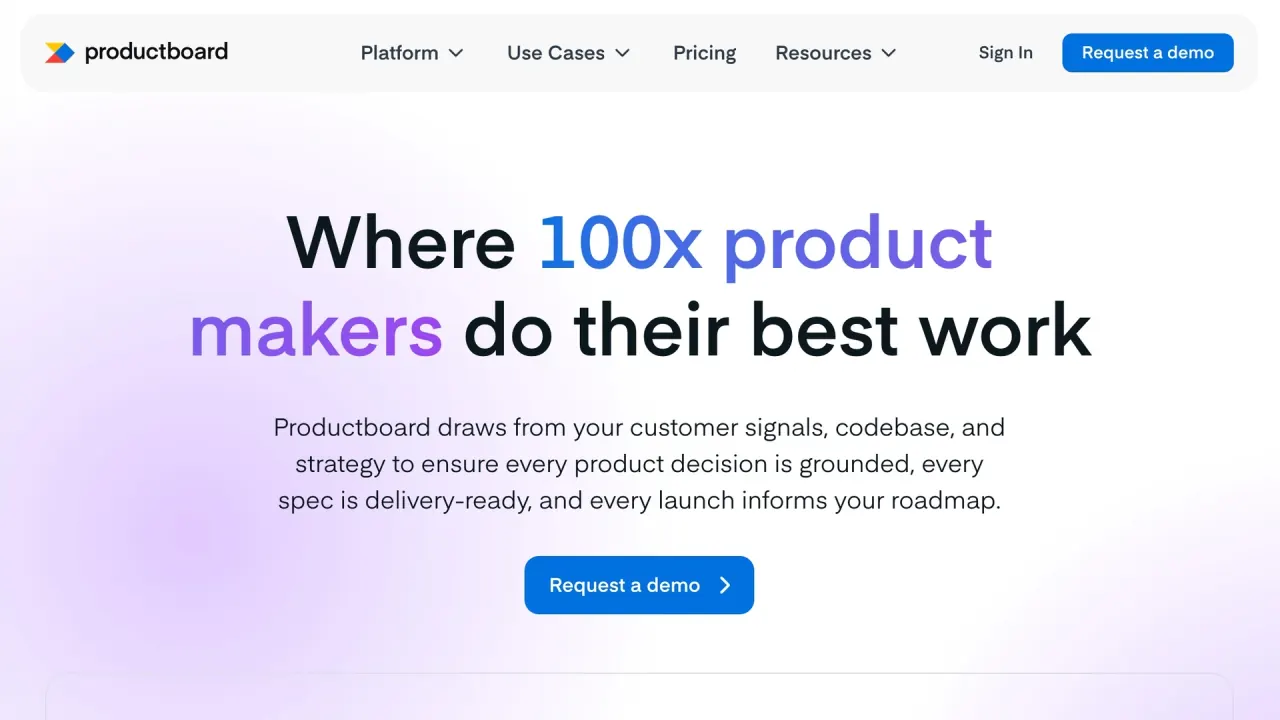

Connect customer feedback, product strategy, and roadmaps in one collaborative workspace. Spark helps product teams analyze signals and draft context-aware specifications.
Used this tool? Rate it
Used this tool? Rate it
Productboard is an AI product management platform that turns customer signals into priorities, product specifications, and roadmaps. Spark is Productboard’s built-in agent for product makers, including product managers, product leaders, and collaborators; it is presented as part of the system rather than a separate add-on.
Spark connects product data, customer feedback, strategy documents, competitive intelligence, product documentation, and the product codebase to carry out analysis and information synthesis.
Productboard brings product requests and feedback from customers and colleagues into one searchable repository, with automatically detected insights that can be linked to related feature ideas.
For many types of responses, Spark provides citations to underlying internal documents, customer conversations, product data, or external resources, allowing the reasoning to be traced to source material.
Productboard’s prioritization tools include top-requested features, customer segmentation, links from user insights to features, a flexible product hierarchy, prioritization formulas, and business impact rollups.
Portfolio planning brings objectives, initiatives, and features into a unified view across products, with broad planning horizons or specific timelines.
Opportunity discovery refreshes newly surfaced opportunities every week, combining market signals with strategic context, customer feedback with segment sizing, and competitive intelligence with roadmap analysis.
Customer feedback analysis supports monitoring trending findings, exploring a customer need, and generating voice-of-customer reports.
Product specification work can synthesize large amounts of context, surface technical requirements through codebase analysis, and make specifications available to Claude Code, Codex, or Cursor through MCP.
Post-launch evaluation connects product analytics and recent customer feedback to the original objectives and success metrics in a specification, supporting analysis of outcomes and subsequent investments.
Competitive intelligence can use publicly available competitor pricing pages, product reviews, and feature announcements without requiring connected data sources.
Productboard is positioned for deciding what to build, how to build it, and whether it worked; prioritized work is pushed into integrated delivery planning tools, so Spark is not presented as a replacement for a development issue tracker.
Productboard is a cloud-based service, and its evaluation terms place responsibility for the required equipment and third-party services on the evaluator.
Jira and Azure DevOps integrations push prioritized features into delivery, track their status, and synchronize key data; GitHub receives development-ready features as issues, while Trello receives cards.
Spark supports MCP connectors, including custom connectors, so it can draw on other tools’ data when carrying out a task, generating content, or answering a question. The Productboard API supports custom integrations, while Productboard’s MCP server lets coding agents pull specifications and leave updates back in Productboard.
The Linear MCP connector can create and update issues and check backlog or project progress; the Google Drive MCP connector searches and reads files with read-only access.
On-premises Jira or Azure DevOps integration and the Salesforce integration are unavailable in Business and included in Enterprise; API access is included in both. The plan comparison lists “5” for Business in both the Jira and Azure DevOps integration rows and marks Enterprise “Included”; the number’s unit is not specified in those rows.
Business uses a request-demo route, while Enterprise uses contact-sales; both include Spark, and the comparison lists a minimum of five makers for either plan.
| Plan | Collaboration and administration included |
|---|---|
| Business | Business includes full Spark access, unlimited roadmaps and prioritization, 25 contributors, unlimited feedback and teamspaces, a shared skills library, and two Product Portals. |
| Enterprise | Enterprise adds unlimited contributors, SAML SSO, SCIM provisioning, enhanced data governance, custom roles and permissions, Salesforce integration, and live onboarding and customer support. |
Business includes 500 credits per maker each month; Enterprise includes 1,500 base credits plus 800 per additional maker each month.
Credit consumption varies with task complexity: Productboard gives examples of around 30–50 credits for analyzing 100 customer feedback items and 50–200 credits for a comprehensive specification. These are the vendor’s task examples, not fixed prices for every feedback analysis or specification.
Exhausting credits preserves access to the workspace, documents, and feedback, but Spark’s AI features pause until the next monthly renewal resets credits or a top-up is purchased.
Top-ups are listed as 50-credit bundles for $5 on monthly plans or 600-credit bundles for $60/year on annual plans, with no stated purchase-count limit and prorated mid-cycle purchases.
The subscription agreement quotes fees in United States dollars, defaults to annual prepaid billing unless an order form specifies otherwise, and makes payment obligations non-cancellable and paid fees non-refundable except where the agreement expressly provides otherwise.
Plans and maker counts can be changed, with costs and credits prorated when an upgrade occurs mid-cycle. For subscription-based accounts, added seats are prorated; removed annual or multi-year seats take effect at renewal, and removed monthly seats take effect with the next billing cycle, without a refund for the remaining days.
Annual or multi-year subscription accounts must give at least 30 days’ non-renewal notice, while monthly accounts can cancel before the next monthly renewal date. The subscription agreement separately provides for automatic renewal for the same subscription period unless either party gives written non-renewal notice at least 30 days before renewal, with renewal pricing based on then-current prices.
A support article updated March 24, 2026 describes a 15-day trial with full functionality and unlimited invited colleagues, followed by locked access unless the workspace upgrades or converts to a free Starter plan. A separate support article updated March 24, 2026 says that the free trial can start without credit card details.
The evaluation agreement effective September 1, 2026 instead uses the period specified in an order form or online, defaulting to seven days when none is specified; evaluation fees, if any, are set by the order form or online. The support articles and evaluation agreement describe different trial arrangements; a universal current trial period cannot be inferred from them.
These alternatives describe their own capabilities; they are not independent evaluations of Productboard.
UserVoice connects feedback with account and CRM context so demand can be evaluated by customer segment, account value, urgency, importance, and relevance instead of vote totals alone.
ProductPlan offers visual timeline roadmaps, audience-specific views for leadership, engineering, and external stakeholders, real-time Jira and Azure DevOps integrations, and roadmap sharing through secure links.
Productboard says it will not use Customer Property to train or fine-tune proprietary AI models and requires third-party AI providers not to use it for training, fine-tuning, or other commercial purposes.
Separately from that no-training commitment, the AI terms grant Productboard a royalty-free, worldwide, transferable, sublicensable, irrevocable, perpetual license to use AI Content for product development, quality monitoring, statistical analysis, and diagnostics unless the customer opts out through service settings.
Spark’s data context can include workspace strategy and specification documents, feedback from integrations, forms and Portals, MCP-connected tools, uploaded PDFs, CSVs and Markdown files, public company and competitor information, and product entities such as objectives, initiatives, releases, and features.
The privacy policy covers information Productboard collects for its own purposes as a controller; when it processes personal information for subscribers as a processor, the subscribers act as controllers and their privacy practices generally govern that processing.
The subscription agreement allows export for up to 60 days after termination of all applicable order forms and/or the agreement and provides for deletion within 90 days of that effective date unless legally prohibited.
The subscription-account support article instead says that data remains for up to 60 days after termination and is automatically deleted after that period. The support article and subscription agreement give different deletion windows.
The privacy policy retains personal information while there is a justifiable business need or for the stated purposes, subject to longer periods required or permitted by law; information is then deleted, anonymized, or isolated in secure backup storage until deletion becomes possible.
Productboard’s security statement places its service and data in AWS us-east-1 in the United States. For website visitors’ and subscribers’ personal information, the privacy policy describes primary storage in the EEA and United States, possible worldwide transfers and access, and reliance generally on Data Privacy Framework certification or Standard Contractual Clauses for EEA, UK, or Swiss transfers, while allowing other legally approved mechanisms.
Productboard reports meeting ISO 27001:2022 and SOC 2 Type II standards; its security materials also state that it encrypts data in transit and at rest using AES-256 for stored data. These are vendor statements, not an independent security test.
Privacy rights and responses depend on jurisdiction and applicable legal exceptions; Productboard requires identity verification before processing a rights request. The privacy policy permits disclosure for lawful public-authority requests, legal process, legal claims, suspected fraud, safety threats, agreement violations, or other legal requirements.
The subscription agreement applies California law and San Francisco venue for US customers and jurisdictions outside its UK/EU clauses, English law and London venue for UK-incorporated customers, and Irish law and Dublin venue for EU-incorporated customers.
Spark uses large language models from Anthropic and OpenAI, and Productboard’s AI infrastructure also includes Google Vertex AI.
Downtime of Productboard AI caused by a third-party service failure is excluded from the agreement’s Uptime Guarantee calculations.
Spark is standard in new Business and Enterprise workspaces, while rollout to existing customers is ongoing.
