An informational website about the open Pony Diffusion text-to-image model, with a four-tab playground of third-party Hugging Face demos for trying V6 XL and Pony Realism without an account.
Pony Diffusion is a lightweight informational website about the Pony Diffusion open text-to-image model, covering Pony Diffusion V6 XL and community news about V7. In practice, the site mainly offers a home page, a blog with release history and V7 insights, and a playground page that loads third-party Hugging Face Spaces in your browser for image generation.
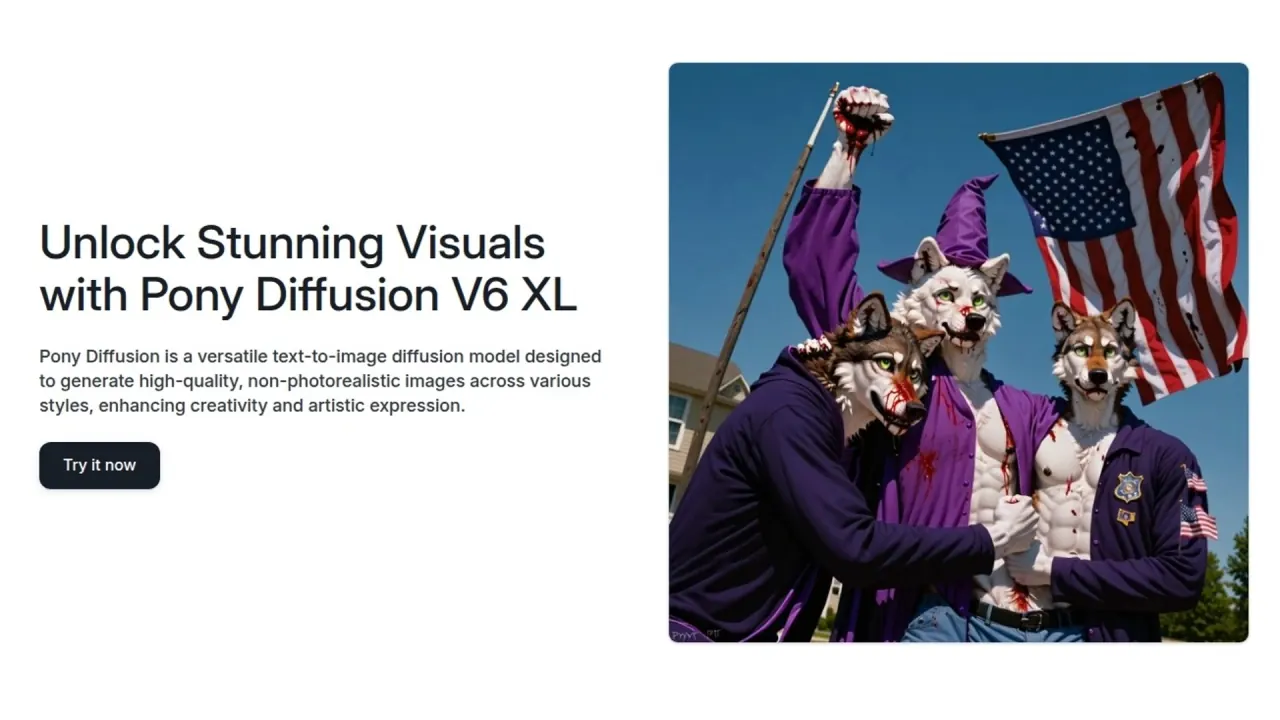
The model behind the name is distributed separately from the website. The homepage describes Pony Diffusion as a versatile text-to-image diffusion model that generates high-quality, non-photorealistic images across various styles. Its V6 release is an SDXL fine-tune that its authors describe as able to produce both SFW and NSFW images of anthro, feral and humanoid characters from simple natural language prompts.
The website does not say who operates it. Its terms state that Pony Diffusion and related files are published by their authors on public model hubs under their own licenses, and that third-party trademarks, including model names, belong to their owners. The V7 article on the same site, however, is written in the first person and talks about "our progress" and "our dataset" when describing V7 development. The site does not state whether it is run by, affiliated with, or authorized by the model's authors, so model files, version news and license terms are best confirmed on the authors' own release pages.
Image generation on the website happens only inside embedded demos. The playground page can embed four third-party Hugging Face Spaces and lets you switch between them with tabs.
Each tab shows its own Space's interface, so controls change between tabs: batch size and JSON input appear in the high-definition demo but not in the V6 XL free demo.
The model uses score tags such as score_9 so that a prompt can specify the desired output quality. For Pony Diffusion V6 XL, the authors' default template begins with score_9, score_8_up, score_7_up, score_6_up, score_5_up, score_4_up, followed by a plain description and optional tags, and the model must be loaded with clip skip 2 or it produces low-quality blobs. Further selection tags steer content: source_pony, source_furry, source_cartoon and source_anime pick a data source, while rating_safe, rating_questionable and rating_explicit set the content rating. Anime styles have always been a significant focus of the model family, and the site's V7 article lists broader anime support as a V7 goal.
Pony Realism is a community checkpoint that keeps the Pony Diffusion prompt style, with score tags, Clip Skip 2 and Danbooru tags, while aiming for cleaner lighting, skin and photo-like detail. Its playground page switches between two third-party demos, and no local GPU install is needed to start.
The homepage says the model was fine-tuned on approximately 80,000 pony images, without naming a version. The V6 XL model page gives a different picture: about 2.6M images with roughly 1:1 ratios across anime, cartoon, furry and pony data and across safe, questionable and explicit ratings, with about half of the images carrying detailed captions. Because the two figures do not match and the homepage does not say which release it describes, the 80,000 figure should not be read as a V6 XL specification.
The homepage reduces the workflow to three steps:
Good Pony Diffusion prompts follow the model's own conventions. For V6 XL, the authors recommend Euler a with 25 steps at a resolution of 1024px. The site's Pony Realism guide suggests a slightly different recipe: start positive prompts with score_9, score_8_up, score_7_up and describe the subject after BREAK, keep Clip Skip at 2 because wrong settings often look soft or messy, and try 30 or more steps, CFG around 6 to 7, a resolution above 1024 and samplers such as Euler A or DPM++ SDE Karras variants.
In the playground, both V6 demos expose the sampler, guidance scale and step count as controls, so step count and guidance can be adjusted without a local install.
The site positions the model for creative and entertainment work. Typical uses include:
These examples share one pattern: a character or scene described in words and generated as a still image. The site shows no video or photo-editing workflow.
The website suits people who want to see what the model does before committing to a local setup, and it is a weaker fit for commercial or privacy-sensitive work.
Good fit
Weaker fit
The website runs in a web browser, and all image generation happens inside the embedded demos.
To try Pony Diffusion online without installing anything, open the playground and pick a tab; local tools give full control over weights and settings.
The website has no price list because it offers no paid products. The site does not currently offer user accounts, paid plans, credit wallets or checkout, and it does not sell model weights.
The homepage also says Pony Diffusion is open access and can be used for free, subject to a CreativeML OpenRAIL-M license. That statement concerns the model, not the website, and it conflicts with the V6 model page's license text (see Limitations).
The website still carries commercial elements. Depending on deployment settings, the site may load privacy-oriented page analytics and, if their IDs are configured, Microsoft Clarity or Google Analytics, while Google AdSense loads only if a publisher ID is configured. Site pages also carry a banner promoting a separate AI image and video generation service with a Try for Free button.
The playground is a convenient first look, but several other routes give more control or a newer model.
None of the four embedded Spaces is described as a V7 demo. V7 also brings trade-offs: it does not support text generation, and its special tags, including quality tags, perform much more weakly than in V6, so score_9 does not necessarily yield better results on some prompts.
Most limits come from the fact that the website depends on third-party demos and on a model whose files it does not host.
The Pony Diffusion license is the most important open question. The homepage says you can use the model commercially as long as you follow the CreativeML OpenRAIL license. The V6 model page tells a different story in its description: it names a modified Fair AI Public License 1.0-SD, forbids running inference of the model on websites or applications with any form of monetization, including paid inference or faster tiers, extends that rule to derivative models and merges, and says explicit permission for commercial inference has been granted to two platforms. The same model page shows CreativeML Open RAIL++-M in its license field. These pages disagree, and the website does not resolve the conflict.
For V7, the authors' Pony License allows commercial use of the model and its outputs unless you provide an inference service or application, have a company with over 1M revenue or use it in professional video production, and asks commercial users to contact them. The license summary gives no currency for the 1M figure. Those restrictions do not apply when you use the authors' first-party commercial APIs.
The playground is the part of the site that sends the most data to outside parties.
The website does not say so, and its own pages point in different directions on authorship. Confirm releases and licenses on the authors' own pages.
No. The site has no accounts, paid plans, credits or checkout, and the demos run on third-party infrastructure.
It depends on which license text applies: the homepage names CreativeML OpenRAIL, while the V6 model description names a modified Fair AI Public License 1.0-SD. Read the model page before any commercial project.
Not as a listed option. The four tabs are two V6 demos, a multi-task generator and a Pony Realism demo. V7 base weights are available from the authors for local use.
Check clip skip and the quality tags first: V6 needs clip skip 2 and a prompt that starts with the score_9 through score_4_up chain.
They are handled by Hugging Face and the operator of the selected Space under their policies. Skip the playground if you want to avoid that processing.
