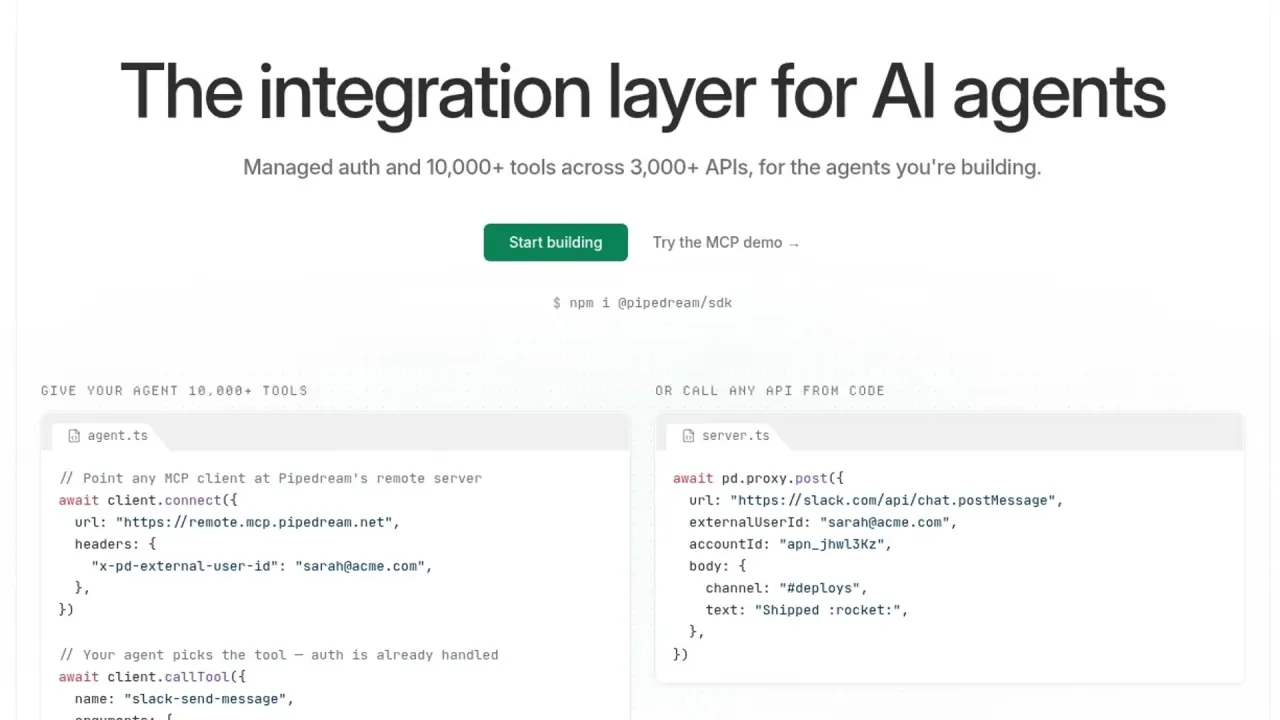

Add user-authorized tools, triggers and API requests to your app with Pipedream Connect. Conduit gives organizations a gateway for controlling access from AI assistants.
Used this tool? Rate it
Used this tool? Rate it
Pipedream is an integration platform for developers building apps and AI agents. Pipedream Connect combines managed auth, 10,000+ prebuilt tools and triggers, and a raw API proxy.
Connect provides a developer toolkit for adding 3,000+ integrations to an app or AI agent, with code-level control over how those integrations behave inside a product.
The product family has an important lifecycle boundary. Workflows and String are scheduled to shut down on March 31, 2027, while Connect API, MCP Servers and API Proxy remain supported and actively developed. Pipedream also offers Conduit for organizations connecting their AI assistants to company systems, with centralized access controls.
The proxy also has account-dependent routing rules. For dynamic-domain apps such as Zendesk, Zoho and GitLab, relative paths let Pipedream resolve the correct domain from the connected account.
MCP tools expose the integration catalog to an agent through the Model Context Protocol. Requests identify the Pipedream project, environment, external user and app; an optional account ID can select a particular connected account.
Conduit is positioned for company-wide assistant access through a shared gateway. It combines SSO with groups and policies that govern which connectors and individual tools people can use; calls are authenticated, authorized and logged. Its access grants can apply to a workspace, a group or a single person, and a member receives the union of the grants that apply to them.
Conduit also records sign-ins, policy changes and tool calls, with filters by actor, event or date and access to the recorded payload.
The Connect quickstart uses the Pipedream CLI to authenticate an account and initialize a Connect project. It offers a Next.js starter application or an SDK playground, and creates a local .env file containing the project ID and OAuth client credentials.
The managed-auth flow has a specific division between the application's server and browser:
tokenCallback to obtain tokens from the backend on demand, then call connectAccount. The SDK opens a Pipedream iframe for account connection and refreshes connection tokens as they expire.Connect tokens are single-use and expire after four hours. They are scoped to both the end user and the environment, and a successfully connected account is saved under that combination.
Developer API authentication uses a separate credential chain. Server-side OAuth clients exchange a client ID and secret for a short-lived access token; the developer access token expires after one hour and can be revoked. The client credentials are not tied to an individual end user, and their access tokens must remain on the server.
OAuth clients can also authenticate with a public key instead of a shared secret. Pipedream stores the public key, while the application server signs a short-lived, single-use JWT for each token request. The private key can remain in the application's key-management service. This route changes how the developer authenticates to Pipedream, while Connect tokens continue to scope the user account-connection flow.
App-based triggers run automatically when something happens in a third-party service, such as a new file or contact. They require the customer's connected account. Some triggers poll rather than receive webhooks, and their polling interval is configurable.
Native triggers do not require account authentication from end users. Their deployment and management APIs differ from app-based triggers because there is no customer account to bind.
Pipedream Connect is aimed at developers embedding customer-facing API integrations inside their own products.
There is still a server-side application responsibility. Pipedream's integration guidance keeps secrets on the server, places requests to Pipedream and third-party APIs in server code, and calls for secure session-based authentication between client and server.
Pipedream's integration interfaces include TypeScript, Python and Java examples, REST API access and MCP. The browser SDK supports an embedded authorization experience, while the application backend uses its own Pipedream API authentication. The hosted Connect Link is another account-connection entry point when a product does not embed the frontend flow.
Development is a constrained testing environment, even though it exposes the Connect feature set. It permits at most 10 distinct external user IDs, requires signing in to pipedream.com in the same browser when connecting an account, and is intended for the developer's own accounts rather than real end users.
Pipedream's current Connect pricing separates free development from production access. In the public pricing HTML captured on November 1, 2026, annual billing is selected, with separately labeled annual and monthly Startup prices.
| Plan | Published price | Included access and resources | Support and organizational features |
|---|---|---|---|
| Free | $0; no credit card required | Every feature in development; 3,000+ connectors; 10,000+ tools and triggers; unlimited team members | Community support |
| Startup | $99/month billed annually, or $150/month billed monthly | Production; 100 external users; 10,000 usage credits | Email support |
| Business | Custom price; annual billing | Volume pricing for users and usage; dedicated static egress IPs | SSO, SCIM, HIPAA, SLAs and dedicated Slack support |
An external user is a distinct user ID supplied by the application that connects at least one account through Connect. One person connecting five apps counts once; connected accounts are not individually counted as five external users. After the 100 included users, Startup charges $2 per additional user per month.
Credits measure Connect API usage. Running an action, calling a tool through MCP, sending a proxy request and emitting an event from a deployed trigger each consume one credit per 30 seconds of compute. Listing apps or accounts, configuring components and other management calls do not consume credits. Startup includes 10,000 credits each month, followed by $0.012 per additional credit, with lower rates described at higher volume.
Development includes API, SDK and MCP access for free building and testing; serving real external users in production requires Startup. Cancellation or downgrade is self-service in workspace billing settings. Before confirmation, those settings show whether the change takes effect immediately or at the end of the billing period.
For embedded integrations and agent tools, the relevant comparison is the connection and execution layer that a product needs. Alternatives that primarily replace an older visual workflow builder address a different part of Pipedream's history.
Workflows are in maintenance mode: new signups and subscriptions are no longer accepted, no new Workflows features are planned, and existing workflows continue through March 31, 2027.
All Workflows data, including connected-account credentials and OAuth tokens, is scheduled for permanent deletion by April 30, 2027. Connect settings and credentials are excluded from that automatic deletion. Existing Workflows subscriptions remain active until March 31, 2027, when Pipedream says they will be cancelled automatically with a prorated refund.
Retry-After and rate-limit headers; Pipedream also applies per-IP limits.rate_limit_token in subsequent Connect requests. This is an application-defined user-usage control alongside the platform's own endpoint limits.emit_on_deploy to false avoids emitting those historical events.Pipedream states that Connect via API or MCP does not store or log request payloads or response bodies: it processes the request and returns the response without persisting that content. Conduit separately describes audit records with payload inspection for its sign-ins, policy changes and tool calls.
Pipedream states that credentials and tokens are transmitted over HTTPS and encrypted at rest. Its security documentation places the platform on AWS in the us-east-1 region. Pipedream states that it undergoes annual third-party audits and makes a SOC 2 Type 2 report available on request.
The terms say users retain rights and intellectual property interests in User Data as provided to Pipedream, while granting the company a license to use it to the extent necessary to deliver the service. For software code in User Data made visible to other users, the default is the MIT License unless another offered license is selected; these public-sharing permissions do not apply to private User Data. Separately, Pipedream may retain technical Service Data about interactions with the service and use it for internal analysis, improvement and development.
HIPAA-related availability also has a contractual condition: the terms make business-associate status applicable only when Pipedream agrees to a separate Business Associate Addendum with the user.
Deleting an OAuth grant inside Pipedream does not itself revoke Pipedream's access at the original provider. Revocation also takes place wherever OAuth grants are managed in the third-party application.
Yes. Custom tools published to the Pipedream workspace can be used with its MCP server, adding functionality that is not available in the public registry.
A failed MCP tool call returns a result with isError: true, including an error object that identifies an origin such as tool code, an upstream API or the network. Action error attribution is best-effort and can be incorrect, including when an upstream SDK makes extra calls after a failure or several calls reach the same host.
