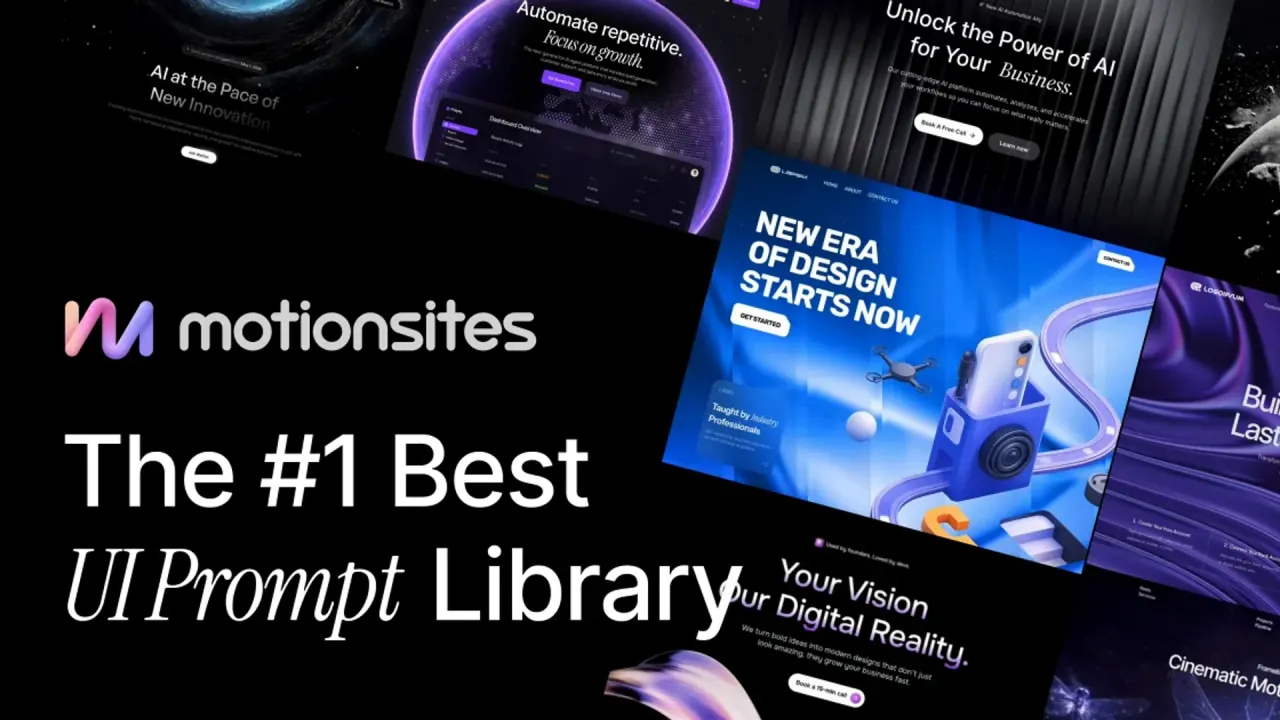

MotionSites AI is a library of 500+ prompts for animated landing pages and hero sections that you paste into Lovable, Bolt, Cursor, Claude or another AI builder, plus an MCP server that lets coding agents fetch them directly.
Used this tool? Rate it
Used this tool? Rate it
MotionSites AI (its own pages also write it as MotionSites and Motionsites) is a browser-based library of AI website prompts: long, ready-made text instructions that recreate a specific animated web design when you paste them into an AI coding tool or site builder. It does not generate or host the website itself. The site's own page description sums up the offer as "Beautiful Website Prompts for Lovable, Bolt, Cursor, and Claude," followed by the promise that you can build 3D websites with AI and "just copy, paste, and launch."
Each prompt reads like a build specification rather than a one-line idea. According to the company, its prompts contain the layout, styling, fonts, animations, responsive behavior, dependencies and exact content needed to recreate the design. The AI builder therefore receives a complete brief instead of improvising the visual direction.
The product already draws a sizeable audience: a third-party AI directory estimated about 1.3M monthly visits for March–August 2026 (an estimate, as captured on September 28, 2026). No operating company name or address appears on the homepage, pricing page, sitemap or footer checked; the product is presented only under the MotionSites brand.
The main library lists complete pages and single sections side by side, and each card carries a type label such as Landing Page, Agency or Hero Section. That lets you use animated website prompts at two scales: drop one polished hero into an existing site or rebuild a whole landing page, depending on how much of the design you want the builder to own.
The prompts target a modern front-end stack. The example in the official tutorial asks for a hero section built with React, TypeScript, Vite, Tailwind CSS, Framer Motion and lucide-react, so the output is a code project rather than a page inside a proprietary editor.
A separate collection offers animated video backgrounds that the site describes as "designed to convert, impress, and amaze." Every tile on the backgrounds page carries a Copy URL action rather than a prompt, so what you take away is a URL for your builder to use.
MotionSites also runs an MCP (Model Context Protocol) server so that an AI agent can request designs directly. The setup is described as one command with no API key, and the server works with Claude, Cursor and Codex. For people who already build inside Claude Code or Cursor, this removes the copy-and-paste step: the agent looks up a matching design and receives the full prompt in the same session.
If the design you want is not in the library, MotionSites sells custom prompts made from a reference you supply. Each custom order is described as a full prompt that works in Lovable, Cursor, Claude, Codex and Google AI Studio, with all project files included — videos, animated images, fonts and assets.
The Academy is a set of short video builds, each published with the prompt used in the video so you can copy and remix it.
claude mcp add command run in a terminal; Cursor and Claude Desktop use a configuration entry or custom connector instead.The official tutorials and service pages show the kinds of projects the prompts are written for. They are examples chosen by the vendor, not independent case studies.
One tutorial builds a cinematic portfolio homepage with a background video, animated typography, a liquid-glass button and a responsive mobile menu. This is the typical MotionSites pattern: a visually heavy first screen that would take many hours to hand-animate, generated from one prompt and then rewritten with your own work.
Another tutorial prompt builds only the navbar and hero section of a luxury real estate landing page, showing how a section-level prompt can give an existing site a new first impression without rebuilding everything below it.
The custom service accepts any website, Dribbble shot, Pinterest board or screenshot link and translates its layout, motion and brand direction into a MotionSites prompt. This suits teams that already have a visual reference from a client or an internal designer and want a prompt that an AI builder can reproduce.
The pricing page frames the lifetime plan against freelance rates, stating that a single freelance landing page typically costs $500–$2,000. That comparison is the vendor's own framing rather than a measured saving, but it shows the intended buyer: people who deliver landing pages to clients and want premium-looking starting points.
MotionSites is a weaker fit if you want a hosted website builder with its own editor, templates and domains in one place, or if your organisation must review a privacy policy and terms of service before buying, because none were found on the pages checked (see Limitations).
Membership billing is in USD. The self-serve options shown on the pricing page as captured on September 28, 2026:
| Option | Price shown | What it covers |
|---|---|---|
| Free account | Free | Free accounts can open three free prompts, while paid plans unlock all 500+ prompts. |
| Prompt pack | $49 at the default selection | Prompt packs are sold for one-off website and app builds, with 2–10 prompt downloads and no commitment. |
| Yearly Access | $279 per year | Yearly Access costs $279 per year and can be cancelled anytime. |
| Lifetime Access | $399 one-time | Lifetime Access is a one-time payment of $399, displayed next to a higher $759 figure. |
The pack selector offers 2, 5 and 10 downloads, and $49 is the price displayed in the default view; prices for the other sizes are not shown there. The page does not explain what the $759 figure next to the lifetime price refers to.
Both memberships list unlimited prompt access, access to apps, animated backgrounds, sections, 40+ Lovable templates, the MotionSites MCP and community access, and both add priority support. The MCP server is included in all paid plans. Lifetime Access additionally lists lifetime updates and early access.
Custom private prompts are priced separately: a hero section (one section) is listed at $99 next to $599, and a landing page of 5–6 sections at $249 next to $1499, both as one-time payments, without an explanation of the higher figures.
No refund policy was found on the pricing page, sitemap or footer checked.
AI tool directories place MotionSites next to component libraries that also target AI builders. They differ in what you copy: MotionSites sells whole-page design prompts and video backgrounds, while these alternatives centre on individual React components.
| Alternative | What you get | Free access |
|---|---|---|
| 21st.dev | Community registry of React and Tailwind components that ship as prompts | Browsing is free with 2 free component copies per day |
| Magic UI | 150+ open-source animated components for React, TypeScript, Tailwind CSS and Motion | Free and open source |
| Aceternity UI | Copy-paste components, blocks and templates, plus an MCP server for AI agents | Free component set, plus a paid All-Access Pass |
MotionSites supplies the brief, but the builder writes the code, so quality varies with the tool and model you use. Even the official tutorial notes that the prompt already includes desktop, tablet and mobile instructions, yet you should still test every screen size.
Prompts are highly literal. The tutorial prompt tells the builder to use an exact, pre-set video source URL for the background. Unless the prompt is edited, the generated site keeps that sample media, and a site that links to a video file hosted elsewhere depends on that file staying online.
The DESIGN.md area of the site listed entries marked "Coming soon" as captured on September 28, 2026, so not every section named in the navigation is fully stocked.
Custom prompts are delivered to the email you provide, usually within a few business days, so they do not suit same-day deadlines.
No product-level reviews with a usable sample were found on the review platforms searched, one major launch platform blocked automated access, and no independent tech-media coverage turned up as of September 28, 2026. Current judgements about output quality therefore rest mainly on the vendor's own tutorials.
No. It supplies prompts, backgrounds and templates; an AI builder such as Lovable, Bolt, Cursor or Claude Code generates the code, and you publish it on your own host, for example via GitHub and Vercel.
A free account can open three prompts. The full library of 500+ prompts is unlocked by paid plans, which also list the backgrounds, sections and MCP server; prompt packs sell a set number of downloads without a subscription.
Both paid memberships are listed as covering personal and client work. No separate license document or terms of service was found, so the plan description is the only stated usage right.
The vendor names Lovable, Bolt, Cursor, Claude, v0 and Replit for library prompts, and adds ChatGPT, Codex and Google AI Studio for custom prompts. The MCP server supports Claude, Cursor and Codex.
A pack suits a one-off project that needs only a few designs. The $399 Lifetime Access plan adds unlimited prompts, the extra collections, MCP access, lifetime updates and early access, which matters mainly if you build pages regularly.
A Lovable prompt is text you paste into Lovable's chat so that it generates the design. The 40+ Lovable templates are listed as a separate item in both paid memberships, and the pricing page does not describe them further.
