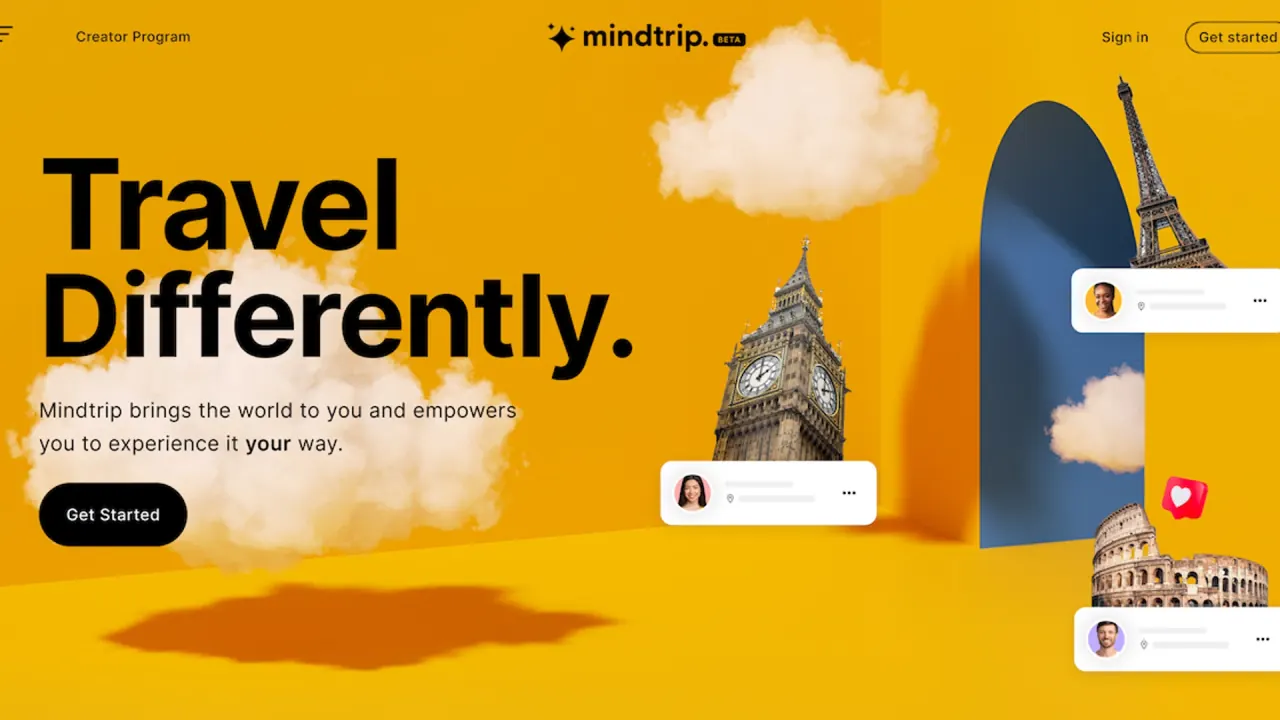

Mindtrip is a free AI trip planner on the web and iPhone that turns chats, links and photos into editable itineraries, shared group plans and links to partner bookings.
Used this tool? Rate it
Used this tool? Rate it
Mindtrip is an AI trip planner that runs in the browser and as an iPhone app, where you chat about a destination and get back recommendations, maps and an editable itinerary. The company pitches it this way: "Get personalized and actionable travel recommendations — destinations, hotels, flights, restaurants and attractions — and organize everything all in one place."
The service is operated by Mindtrip, Inc., which its privacy policy identifies as a Delaware corporation. The same policy describes the service as an AI-powered platform for vacation and travel planning, recommendations, and booking. On its about page, the company says Mindtrip scours thousands of data sources and uses conversational AI to produce personalized suggestions and shareable itineraries.
Two facts from outside coverage frame the product's origin. The company raised $7 million in seed funding from Costanoa Ventures in 2023. In a July 2024 news report, the company said it combines proprietary knowledge of more than 6.5 million places with OpenAI technology for itinerary building.
Mindtrip plans and organizes trips but does not sell travel itself: reservations go through outside booking partners, which shapes pricing, cancellations and responsibility.
As an AI travel assistant, Mindtrip pairs chat with trip-planning tools that keep what the AI suggests in a visual, shareable form.
These inputs set Mindtrip apart from a general chatbot: a post, video, screenshot or saved map list becomes the starting point, and the places stay attached to a trip rather than a single chat reply.
For group trip planning, work happens in real time: members can add ideas, comments and likes, chat as a group within the trip, and tag @Mindtrip to ask for suggestions that balance everyone's preferences.
The homepage's "How it Works" section outlines this flow:
In 2023, reporting described Mindtrip as aimed at travelers inspired by TikTok and Instagram, at people who plan every detail, and at anyone who loves an adventure but likes it planned. Current product pages add two other groups.
Who it is not for:
As captured on September 28, 2026, the App Store listing showed an average of 4.7 out of 5 from 807 ratings. That score measures overall app satisfaction and is not broken down by feature.
Mindtrip itself is free to use for trip planning. The App Store description says the app is "totally free," and no paid subscription tier appeared on the official pages checked this round. Costs arise when you book travel through partners.
Booking categories on the homepage include real-time airfares, restaurant tables and experiences. The terms say the prices of products and services shown in Mindtrip are provided by Booking Partners, travel suppliers or other third parties and are subject to change. They add that displayed prices may not include all applicable taxes, fees, charges or other amounts payable by you.
Cancellation terms also belong to the partner. According to Mindtrip's terms, "Booking Partners may charge you fees for cancelling (in full or part) or changing a booking."
The first-booking promotion has specific conditions. Eligible users may receive a one-time $30 cash back reward in the form of a virtual gift card from a third-party vendor. It applies only to hotel bookings equal to or greater than $100 (excluding taxes and fees). The hotel must be booked through Mindtrip's Booking Partners, which the terms list as including Priceline, Expedia, Agoda, VRBO, Hotels.com, Nuitée, Trip.com and Vio.com. Booking directly with a hotel does not qualify.
How Mindtrip earns money matters for reading its recommendations. A 2024 news report stated that the company gets a cut when users book trips through the travel search engines and aggregators it works with. The terms of service and privacy policy checked this round do not say whether commissions or partnerships affect which places are recommended or in what order; on that point the company's documents are silent. No published price for the business (partner website) offering was found in the pages retrieved this round.
Several AI trip planners and chat assistants cover similar ground, and the differences mostly concern how results are organized and where booking happens.
Mindtrip's distinguishing points are map-based place cards, group planning and imports from links, photos and Google Maps; a general chatbot covers a quick outline, and a booking-site assistant suits someone who already knows where to book.
The terms disclaim any warranty that results obtained from the service will be accurate or reliable. In 2024, reporting on the Start Anywhere feature noted that it only worked with TikTok videos that have text overlays, and that for YouTube it relied on transcripts; this may have changed since. In a May 2025 hands-on test by one travel writer, the chatbot wrongly said the trip dates were in the past, and it repeatedly failed to find a stay that was both downtown and under $300 a night. These are single-reviewer observations, not a measured error rate. The terms also note that Mindtrip may terminate accounts that are inactive for an extended period of time.
Yes for planning; no paid subscription tier was found on the official pages checked. You pay booking partners for whatever you reserve, and their prices may exclude some taxes and fees.
No. Reservations are made with outside booking partners, whose terms govern payment, changes and refunds; Mindtrip disclaims responsibility for those bookings.
The official pages checked link only an iPhone app; Android users can plan in the web version. A similarly named Google Play app comes from a different developer.
The privacy policy says identifiable personal data is not used to train or fine-tune AI models, but the terms grant Mindtrip a broad license to user content, including for enhancing its own AI.
Yes. Invite people to a trip, chat as a group, add comments and likes, and tag @Mindtrip for group suggestions.
