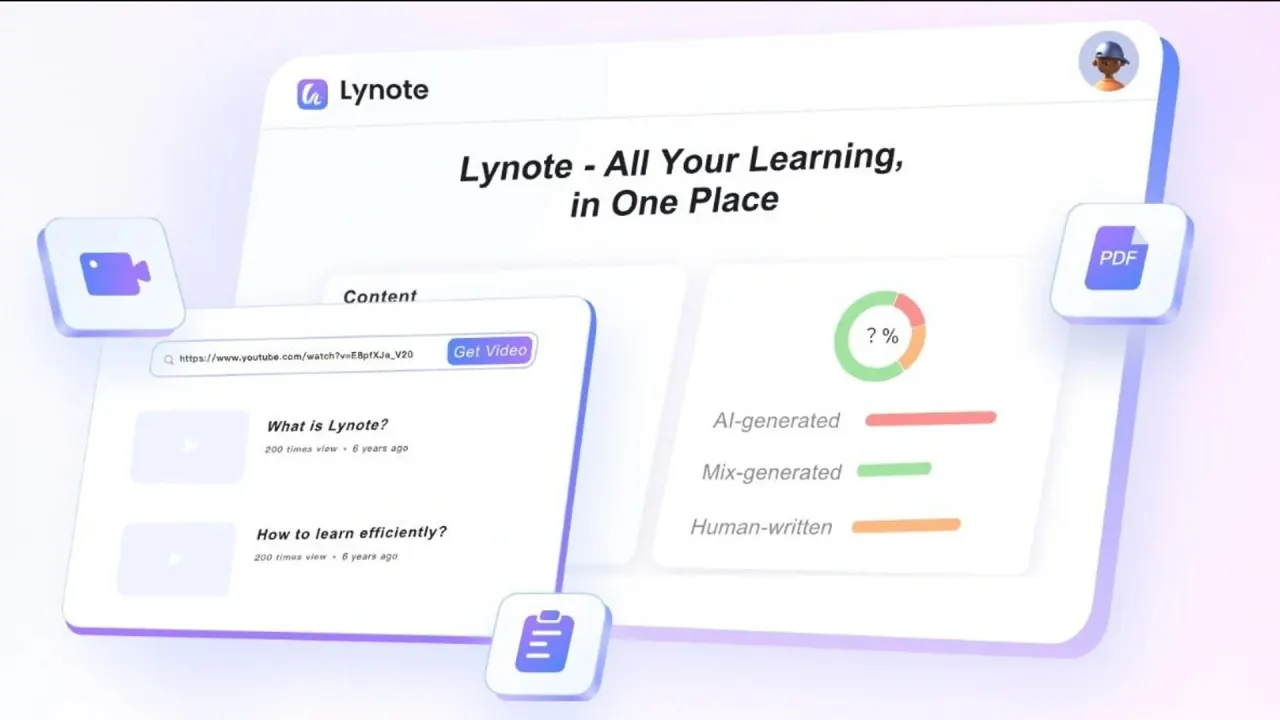

Lynote pairs an AI humanizer with a sentence-level AI detector and adds YouTube summaries, transcripts, notes and flashcards, aimed at students, writers and marketers who work with AI drafts.
Used this tool? Rate it
Used this tool? Rate it
Lynote is a browser-based AI humanizer and AI detector that also bundles study tools for videos, documents and notes. The company frames it as "the AI writing confidence workspace": you paste an AI-assisted draft, rewrite it so it reads more naturally, and then check the result with AI scores and highlighted sentences before you publish, submit or share it.
The toolset goes well beyond those two headline features. Lynote lists an AI Humanizer, AI Detector, AI Translator, YouTube Transcript Generator, Video Summarizer, Audio to Text, Video to Text, AI Note Generator, AI Flashcard Generator, PDF tools and AI Chat among its tools. That breadth reflects its origins: the about page says the product started as a study companion that could watch videos, read documents and listen to podcasts, then hand back the key points.
A few facts shape how much weight to give the marketing:
The Lynote AI humanizer rewrites text produced by ChatGPT, Claude, Gemini, DeepSeek and similar models so that it reads less mechanically. Its main controls:
The humanizer is marketed aggressively against detection tools. Lynote says it is trained against GPTZero, Originality.ai, Turnitin, Copyleaks and Sapling, and the page advertises 10M+ words humanized and a 99% bypass rate. Both numbers are vendor claims with no published test method on the page, and the company's own terms decline to guarantee how any detector will classify the output (see Limitations).
The AI detector returns three scores rather than one percentage. You get AI-generated, human-written and mixed (blended) scores, plus sentence highlighting that marks the lines most likely to be AI-written or AI-edited.
The detector page claims a 99% accuracy rate and a 4.9 rating from 12,589 users. The same page's FAQ is more cautious: it says no detector is perfect and that false positives can happen, especially with short, formal, technical or highly structured writing.
The original study features share the same credit pool:
Lynote also publishes code. Its GitHub organization hosts an open-source humanization pipeline that the team describes as an early-2026 exploration, and the README says the hosted Lynote.ai service now runs proprietary detect and humanize models instead. The open-source chain is therefore a reference implementation, not the same engine you use on the website.
The steps below follow Lynote's product pages for its two main tools.
Humanizing an AI draft
Checking text for AI
Cancelling a subscription
Typical jobs the product pages describe fall into three groups. For SEO specialists, Lynote targets blog posts, landing page copy, product descriptions and category text while keeping keywords and semantic intent. Students and researchers turn YouTube lectures and PDFs into notes, action guides and flashcards, then export summaries to Markdown for a notes app. For educators, the detector page describes reviewing student writing with sentence-level highlights combined with drafts, context and classroom judgment.
Lynote says it is built for students, writers, marketers, educators, researchers and teams. Matching that list against the plan limits and legal terms gives a sharper picture.
Reasonable fits
Weaker fits
Lynote bills its AI features through Study Credits: every AI feature, including the humanizer, translation, summarization, Q&A and detection, draws from the same credit pool. For the core tools, 3,000 credits equal 30,000 words of humanizing or detecting. Prices below are in USD from the pricing data served to a US visitor on September 22, 2026.
| Plan | Monthly | Yearly | Study Credits | Words per humanize/detect request |
|---|---|---|---|---|
| Free | $0 | $0 | 50 anonymous, or 100 one-time after sign-up | Humanize up to 300; detect up to 500 |
| Starter | $12.99 | $59 | 3,000 per month | Up to 3,000 |
| Pro | $29.99 | $129 | 10,000 per month | Up to 3,000 |
On Starter and Pro, each detect or humanize request can run up to 3,000 words. The pricing toggle advertises savings of up to 64% on yearly billing, which matches Pro at $129 a year against twelve months at $29.99. Starter includes 3,000 credits per month (30,000 words of humanize or detect) and Pro 10,000 credits per month (100,000 words). All AI tools are open to free users, subject to study credits, so plans change how much you can use rather than which tools unlock.
Rules that the table cannot show:
The free allowance is described inconsistently. The homepage offers humanizing 300 words and detecting 500 words for free, which matches the plan comparison. The humanizer FAQ says free humanizing allows up to 2,000 words per run with no sign-up. The pages disagree; the table above follows the plan comparison.
Lynote competes in two overlapping categories: AI humanizers and AI detectors. Independent AI tool directories place it among these names:
GPTZero and Undetectable AI appear on both lists. Lynote's difference is combining detection and rewriting with study tools under one credit balance. These are directory groupings, not head-to-head accuracy tests.
Draft legal documents. The published terms page is marked "DRAFT — FOR LEGAL REVIEW ONLY", states it has not been reviewed or approved by a licensed attorney, and shows a placeholder effective date. The published privacy policy is also marked as a draft not yet finalized or adopted, with bracketed placeholders. Every legal commitment below comes from these draft texts.
Detection is probabilistic. Beyond the detector FAQ's warning about false positives, the terms say that for the API, detector results are probabilistic estimates, not proof of authorship, and humanizer output carries no guarantee of how any detector classifies it. The 99% accuracy and 99% bypass figures on the product pages are not backed by a published method.
Academic use. The terms prohibit using the AI Humanizer or its output to evade academic-integrity or plagiarism-detection systems, even though the humanizer page promotes passing Turnitin to students. The refund policy also excludes outputs that fail academic or third-party requirements.
Privacy and data. Lynote says it does not use consumer content or API text and output to train its models by default, only with opt-in consent, and that it does not sell personal information. Retention is less clear-cut:
Rights and disputes. Users keep ownership of their content, and Lynote assigns its rights in the output to the user. Disputes go to binding individual arbitration under Delaware law with a class-action waiver.
Independent coverage. In the major tech outlets and review platforms checked for this review, no independent product test of Lynote was found.
Yes, with small limits. Anonymous users get 50 credits and registered free users get a one-time 100 credits; free requests are capped at 300 words for humanizing and 500 words for detecting on the plan comparison, though the humanizer FAQ cites 2,000 words per run.
Starter costs $12.99 monthly or $59 yearly with 3,000 credits a month, and Pro costs $29.99 monthly or $129 yearly with 10,000 credits a month (USD, US pricing data as captured on September 22, 2026).
No. The marketing promotes passing Turnitin, but the terms give no guarantee of how any detector classifies output and prohibit using the humanizer to evade academic-integrity systems.
Its privacy policy says content is not used for training by default and only with opt-in consent. Note that the policy is marked as a draft.
Subscription fees are non-refundable except where the law requires otherwise; the $1.95 trial fee is non-refundable, and EU and EEA consumers may have a 14-day withdrawal right.
