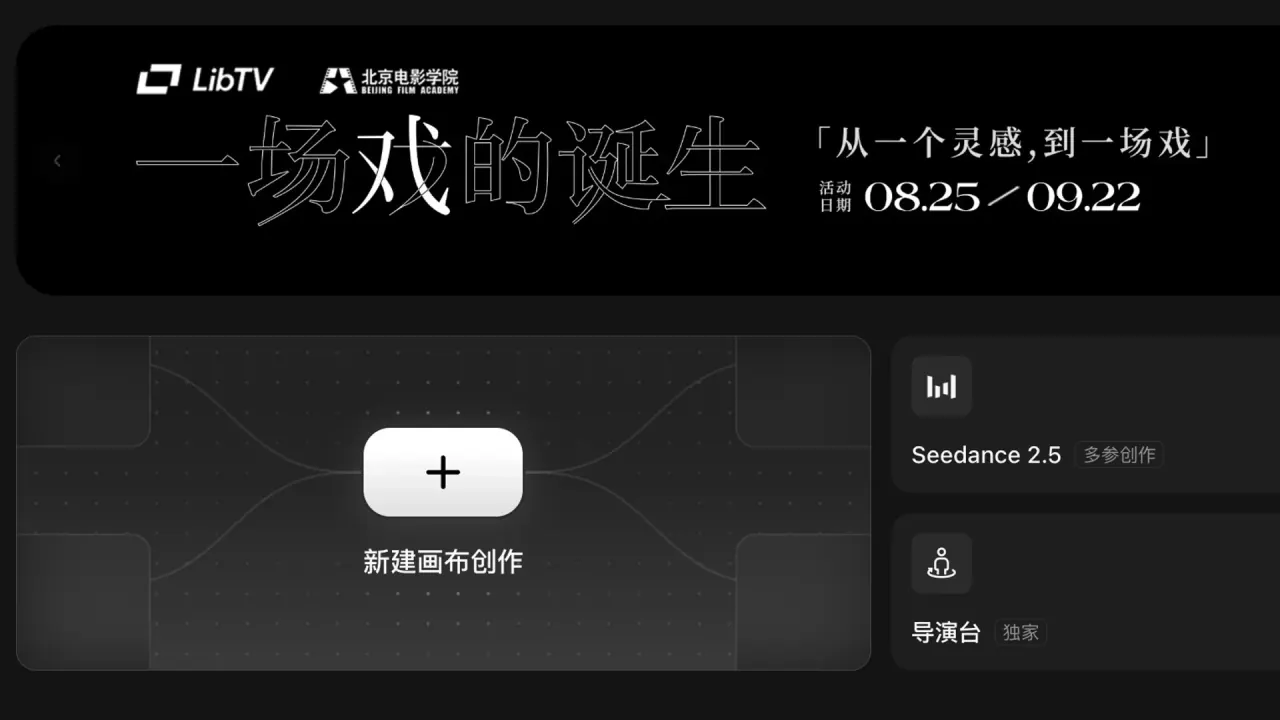

LibTV is LiblibAI's AI video creation platform that puts scripts, storyboards, and image, video and audio generation on one node-based canvas, with Skills that let AI agents run the same workflow.
Used this tool? Rate it
Used this tool? Rate it
LibTV is a browser-based AI video creation platform that organizes scripts, storyboards, image and video generation, audio and editing as connected nodes on one infinite canvas. LibTV describes itself as built for professional AI video work, with a large pool of top models and an exclusive toolset covering the full chain from generation to editing.
LibTV's launch announcement calls it LiblibAI's first professional AI video product and positions it as a system designed for both human creators and AI agents. In practice that means two entry points: a visual canvas for people who want to control each step, and a Skill interface that lets an external agent send a request and receive finished images or clips.
The LiblibAI user agreement names Beijing Yanyu Technology Co., Ltd. (北京演语科技有限公司) and its affiliates as the operator of LiblibAI and its affiliated platforms LibTV and XingLiu (星流). A June 2026 business column lists LibTV, launched in March 2026, among the core products of Evoken (演语科技) alongside the Liblib AI creation community, the XingLiu design agent and Lovart.
LibTV is a separate product from the Liblib AI creation community, although the two share one account system; the plans and credit rules below are the ones LibTV itself displays.
LibTV advertises more than 20 exclusive professional features, more than 50 aggregated top models and more than 100 "AI director" Skills for agents; all three counts are vendor figures.
The homepage creation menu lists video, image, audio and script generation plus smart editing, and its "recently added" row flags script writing and adaptation, director-guided direction, a character styling room and creative title sequences as exclusive features. Models surfaced on the homepage at capture included Minimax H3 Max, Wan 3.0 and Seedance 2.5.
For agent use, the Skill documentation lists text-to-image, text-to-video, image-to-video and video extension under generation, and local edits, element replacement, shot adjustment and style transfer under editing.
The launch announcement lists more than 20 exclusive controls, including character three-view sheets, 360-degree angle views, a multi-camera nine-panel grid, focus close-ups, lighting and camera control, master camera moves, multi-shot and multi-frame generation, multimodal reference generation and precise video editing.
Member plan cards add their own list of exclusive features: a full-capability video Agent, a 3D director console, script planning, smart storyboarding with Kling 3.0/O3, 9/4/25-panel grid generation and splitting, shot focus, a multimodal subject library, video editing and 720-degree panoramas.
Three-view sheets and the subject library target character consistency, while grid generation offers several framings of one moment to choose from.
LibTV's open-source Skill package lets agents that follow the same skill convention call LibTV directly:
The Skill tells the calling agent to relay the user's request unchanged and not to expand, polish or translate prompts, because LibTV's back-end agent handles storyboarding, workflow orchestration, model selection and prompt writing. The calling agent polls the session every 8 seconds and treats the task as done when an assistant message contains an image or video URL; after three minutes without a result it stops polling and points the user to the project canvas instead.
LibTV's showcase frames its range as running from cinematic short films to TVC ads that rival live-action footage, with a music short and a cyber-wuxia narrative among the featured projects.
A June 2026 business column reports that short-drama producers are LibTV's core customer group, and that 4A agencies and brand creative departments needing high-volume visual and marketing content are also among its main customers.
Good fit
Poor fit or check first
No desktop or native mobile app download was found on the pages checked for this review.
LibTV pricing is built on credits: every generation consumes credits at model-specific rates, and memberships add a monthly credit allowance plus speed, storage and concurrency benefits. The membership panel shows Creator and Team memberships, annual, quarterly and monthly auto-renewal tabs, enterprise purchasing and a credit store.
The table reflects the Creator membership's annual auto-renewal tab as captured on September 28, 2026. The first-year price on each card is drawn as an animated number that did not resolve to text in the capture, so it is not listed.
| Tier | Renewal from year two | Per-month figure shown | Price per credit | Credits per month | Concurrent tasks | Cloud storage |
|---|---|---|---|---|---|---|
| Standard | CNY 599 / year | CNY 47 | CNY 0.032 | 1,500 | 8 | 60GB |
| Advanced | CNY 1,799 / year | CNY 100 | CNY 0.022 | 4,600 | 12 | 100GB |
| Premium | CNY 5,099 / year | CNY 333 | CNY 0.02 | 11,700 or 16,300 | 20 | 300GB |
| Deluxe | CNY 7,399 / year | CNY 583 | CNY 0.018 | 32,800 | Unlimited | 600GB |
| Supreme | CNY 10,999 / year | CNY 858 | CNY 0.017 | 50,500 or 66,000 | Unlimited | 1000GB |
Every paid tier also lists removal of the brand watermark ("commercial use worry-free"), unlimited member speed-ups and 20 credits for each daily login. Free users receive 20 credits for each daily login and 3GB of cloud storage. Quarterly and monthly prices, Team edition prices and credit-store packs were not displayed in the captured view.
Standard's 1,500 monthly credits are presented as enough for at most about 6,000 images or 187 videos. The per-model table shows far smaller video numbers: Seedance 2.5 at 720p works out to about 33 seconds a month on Standard and 1,435 seconds at the highest Supreme level. LibTV labels every figure a single-model estimate that varies with parameters, and Premium members choose their credit level with a slider; the captured card does not say which slider position its price refers to.
Credits labeled as LibTV-exclusive can only be used in LibTV, so they do not carry over to LiblibAI's other platforms.
Promotional pricing changes often and differs between pages. The homepage banner advertised annual memberships with up to CNY 1,000 off and Seedance 2.5 at 720p from CNY 0.36 per second. The mobile landing page at the same time advertised memberships at as low as 40% of the regular price and Seedance 2.5 from CNY 0.4 per second.
A June 2026 business column reports that after Jimeng (即梦) raised prices three times in April, nearly sextupling video generation costs, many AI video practitioners treated LibTV, which also offers Seedance 2.0, as a lower-cost substitute. The comparison reflects prices at that time and moves whenever either side changes its rates.
The user agreement says generated content cannot be guaranteed to be true, accurate, reliable or unique, and that results for the same or similar inputs may vary. Under the same agreement, a penalty imposed in LiblibAI for breaking the law or the agreement may also affect use of LibTV, and vice versa.
AI labeling and watermarks are described differently in two places. The user agreement says AI-generated content receives explicit and implicit AI-generation labels as required by law, and users must not obscure, alter or delete them. LibTV's own AI watermark setting says that once it is switched on, newly created and generated content no longer gets an AI-generated watermark added.
No. LibTV is LiblibAI's AI video creation platform on its own domain, while Liblib AI is the company's AI creation community. Both are run by the same operator and share one account, but LibTV has its own plans, credits and tools.
Free users receive 20 credits each day they log in, usable that day only, plus 3GB of cloud storage.
In principle, no refund is offered without cause once a membership or credit purchase is active, and installment purchases are not refundable. Duplicate charges or system errors go to customer service, and credits for failed tasks are returned within 2 hours.
The user agreement assigns ownership of generated content to the user and intellectual property rights to the user or the relevant rights holder, but it also grants the company a broad license to inputs and outputs, including for model improvement.
Yes. LibTV provides open-source Skills and a Remote MCP connection route, so an external agent can send requests, upload images or videos under 200MB and download results; the output also appears as a canvas project for manual edits.
The privacy policy allows de-identified data and generated content to be used for model optimization, and the user agreement's license covers improving AI models. Users can object by email to support@liblib.ai or through the feedback page.
