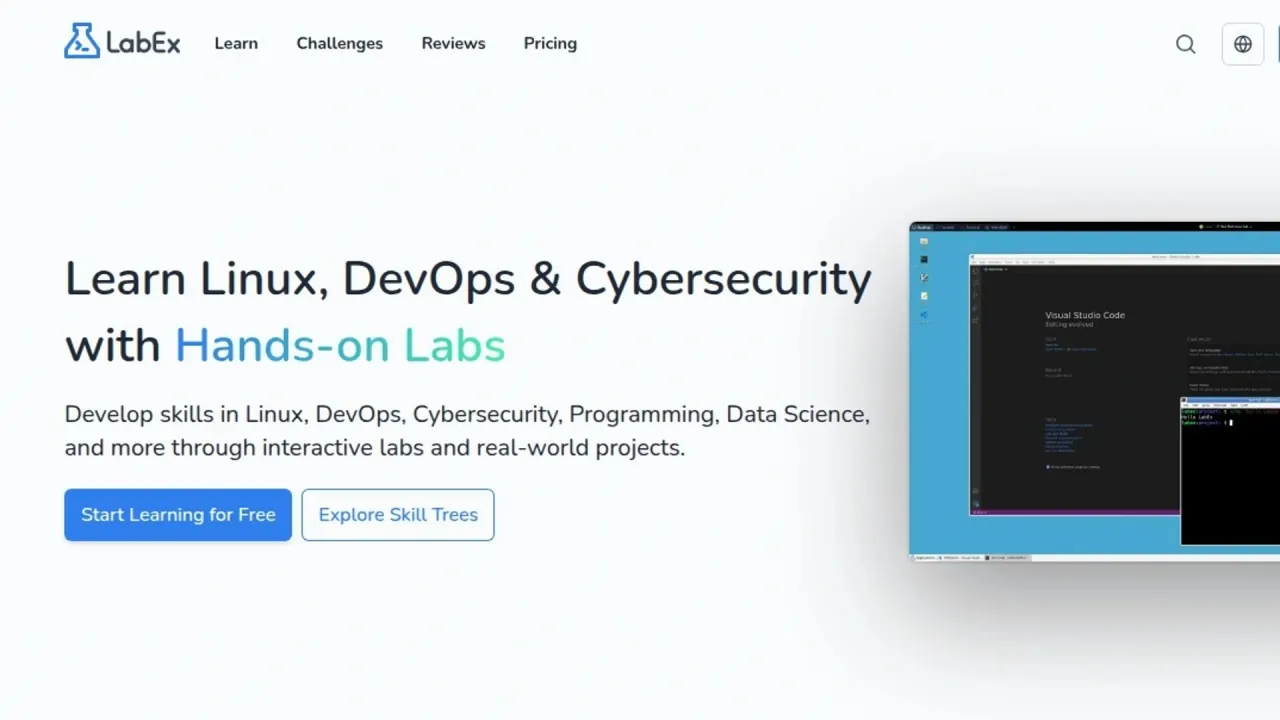

LabEx is a no-video learning platform where each lab opens a browser-based Linux machine with step checks and the Labby AI assistant. A free plan allows 3 lab starts a day; LabEx Pro removes the cap and adds certificates.
Used this tool? Rate it
Used this tool? Rate it
LabEx is a browser-based learning platform for Linux, DevOps, cybersecurity, programming and data science in which every lesson is a hands-on lab rather than a video. Each lab starts a virtual machine in the browser, Skill Trees organise the labs by topic, and an AI assistant called Labby checks your steps.
LabEx's terms name the company as LabEx Technology Limited with an address in Wan Chai, Hong Kong, and state that the laws of Hong Kong SAR China govern the terms. The pricing page states 9+ years as a platform, 6,000+ hands-on labs and 1,200,000+ active learners; these are the vendor's own figures. LabEx also now hosts Linux Journey, the free beginner course Cindy Quach created in 2015; linuxjourney.com redirects to labex.io/linuxjourney.
In short, the free plan is a real way to try hands-on Linux labs but is rationed by a daily lab-start quota; certificates, unlimited machines and full Labby access need LabEx Pro, sold as an annual or two-year purchase.
The homepage says Labby is powered by ChatGPT and helps debug code and answer technical questions. In a lab it covers four jobs:
The free pricing card does not mention Labby, the Pro card lists full access to it, and the pricing page publishes no free-tier Labby allowance.
A Skill Tree maps a topic such as Linux, Python, Docker, Git or SQL into practical skills, and completing labs and challenges updates the related skills. Guided Labs teach step by step, while Challenge Labs give a goal and check whether you can apply the skill independently. The Linux Skill Tree, for example, lists 86 skills, 8 courses and 24 projects, beginning with a ten-lab Quick Start with Linux course.
The homepage lists lab environments for 10 Linux and DevOps certifications: RHCSA and RHCE, CompTIA Linux+, A+, Network+ and Security+, CKA, CKAD and CKS, and LFCS. The RHCSA path targets exam EX200 on Red Hat Enterprise Linux 10 and currently lists an RHCSA Prep course with 32 guided RHEL labs plus two practice exams of 16 independent challenges each, with more content promised over time. An older RHCSA exercise course adds 58 challenges with 170 automated checks and a reference solution per task.
On the free plan, repeating a lab also uses one of the daily starts.
LabEx suits people who learn better by typing commands than by watching lectures, and who want a disposable machine for each exercise.
In the app, VMs expire after a scheduled time. Pro users may be offered a session extension near expiry, while free users are pointed to pricing, and hitting a VM quota limit opens the pricing screen.
The web pricing page shows three options and no monthly toggle.
| Plan | Listed price | What the page lists |
|---|---|---|
| Free | Free | Free hands-on labs; 3 virtual machines per day |
| Pro | $99.9 / year (≈ $0.27/day, billed annually) | 6000+ hands-on labs, unlimited virtual machines, 2000+ challenge solutions, 400+ real-world projects, certificates of completion, full access to the Labby AI Assistant |
| Pro 2 Years | $149 one-time (next to a struck-through $199), marked LIMITED | Everything in Pro; "Save 25% on two years of access" |
The page is not fully consistent: its banner reads "Only $99 Annual Access", while the Pro card shows $99.9 per year. The two-year card carries a LIMITED badge, and the page does not say what the struck-through $199 represents or when the offer ends.
LabEx advertises 1000+ free interactive labs across 30+ tech fields, against 6000+ labs listed for Pro. Free users can start labs up to 3 times per day, and repeating a free lab still counts. The quota resets 16 hours after you last used a VM rather than at midnight, three uses a day is not guaranteed, and free quotas may be temporarily reduced when load is high because Pro users are prioritised. LabEx Pro removes the daily start limit and its benefits list adds unrestricted internet access, but the same list says Cloud Lab is not included.
Renewal, cancellation and refunds
Discounts, payment and teams
On a third-party review platform, the labex.io profile lists KodeKloud under "People also looked at"; as captured on September 21, 2026, KodeKloud showed 4.7 from 486 reviews against LabEx's single review. Two other lab platforms illustrate the main trade-offs:
| Platform | Free access | Paid access and billing | Refund terms |
|---|---|---|---|
| LabEx | Free labs, 3 lab starts per day | Pro $99.9 / year or $149 for two years; no monthly option on the pricing page | 7-day window, no more than 10 labs completed |
| KodeKloud | Not compared here | Annual and monthly billing; Standard includes 1,280 hands-on labs plus certifications and mock exams | 30-day money-back guarantee |
| Killercoda | Free scenarios as much as you want (excluding courses) | PLUS raises scenario time to up to 4 hours instead of one; a COURSE membership adds CKA and CKAD scenario courses | Not compared here |
Choose LabEx if you want broad topic coverage with Labby-guided steps and certificates at a low annual price. KodeKloud is the closer fit if you prefer monthly billing or a longer refund window, and Killercoda suits Kubernetes learners who mainly want unmetered free scenarios.
LabEx certificates are completion certificates issued by LabEx. The pages checked in this round do not state that Red Hat, CompTIA, CNCF or the Linux Foundation recognise them or are affiliated with LabEx, so they are not industry certifications. The practice content has caveats too: the older RHCSA exercise course says it should not be treated as a complete or current objective map and is not a timed mock exam.
The privacy policy, last updated December 25, 2023, lists email address, first and last name, and usage data such as IP address, browser and pages visited. LabEx also tracks inputs and operations in the lab VMs, records inputs and clicks in Labby conversations, and collects AI-generated responses, which it says helps fine-tune its AI.
Personal information may be shared with service providers, affiliates including a parent company, and business partners. It may also be processed and stored outside your own jurisdiction, where data protection laws may differ. The CCPA disclosure states that LabEx does not sell personal information. EEA and UK residents can request access, correction, deletion, restriction, objection and portability, though some data may be kept for backups, fraud prevention or legal reasons. You can delete your account from Settings, and a deleted account cannot be recovered.
Searches up to September 2026 turned up no independent media review of LabEx, and its only review-platform profile had one review when captured on September 21, 2026, so most facts here come from LabEx's own pages and terms.
Partly. Free labs, playgrounds and Linux Journey cost nothing, but free users can start labs only up to 3 times per day, and that quota can shrink at busy times.
The pricing page lists $99.9 per year, billed annually, or $149 one-time for two years under a LIMITED badge.
The Pro FAQ allows a full refund within 7 days if you have completed no more than 10 labs, excluding voucher or coupon purchases. The terms of use describe refunds as discretionary.
They are LabEx's own certificates of completion for Pro members. The pages checked do not claim recognition by any certification body, so they do not replace official exams.
