Toolso.AI
Toolso.AI
All ToolsCategoriesTrendingLatest ToolsPricingBlog
Toolso.AI
Toolso.AI
Toolso.AI
Toolso.AI

Discover the best AI tools to boost your productivity

GitHubGitHubTwitterX (Twitter)YouTubeYouTubeTikTokEmail

Popular Categories

  • AI Writing
  • AI Image
  • AI Video
  • AI Coding
  • More Categories

Explore

  • Latest Tools
  • Popular Tools
  • More Tools
  • Submit Tool
  • Pricing

About

  • About Us
  • Contact
  • Blog
  • Changelog

Legal

  • Cookie Policy
  • Privacy Policy
  • Terms of Service
  • Refund Policy
© 2026 Toolso.AI All Rights Reserved
Limited timeLimited-time offerFeatured Listing24h priority review · No backlink · 30 days featured$29.90then $59.90Price rises to $59.90 after Oct 31Ends in--:--:--Submit now
  1. Home
  2. All Tools
  3. Lifestyle
  4. Japanese Names
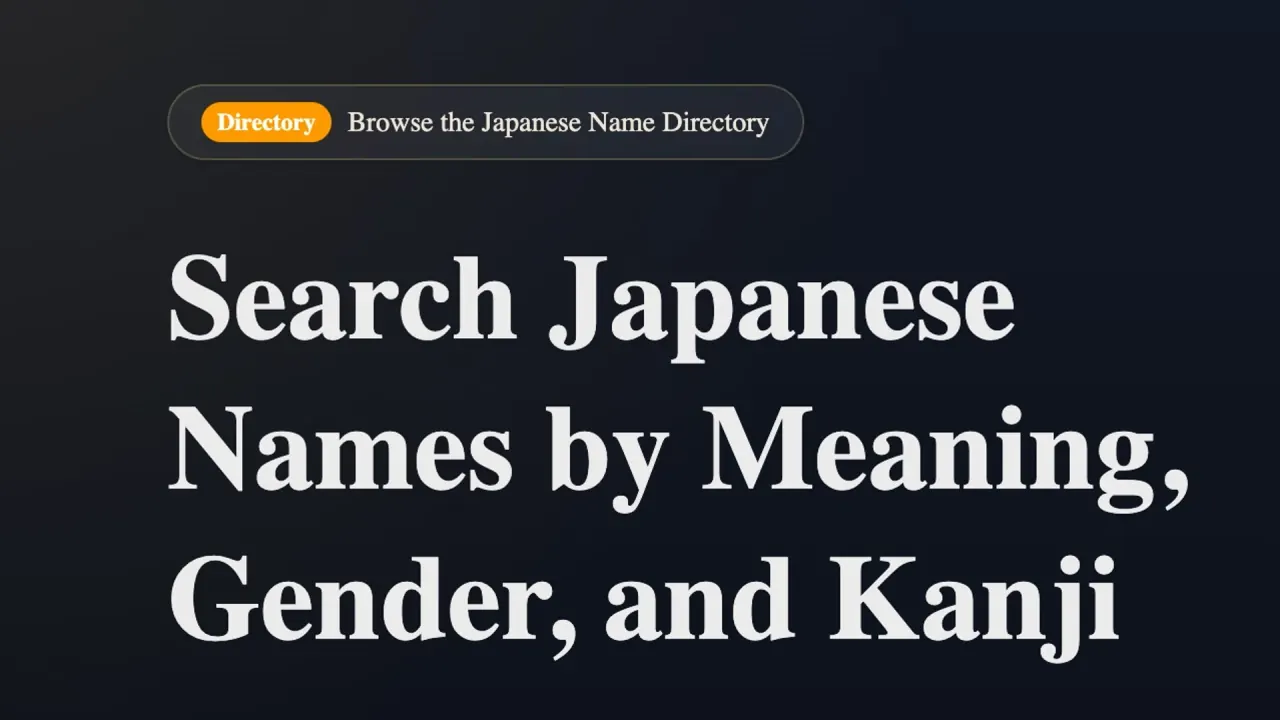
Japanese Names interface preview
Japanese Names logo

Japanese Names

Partner Listing

Japanese Names is a web resource for browsing 3,000+ Japanese given names and surnames by gender, meaning theme, style, and letter. Its free name generator draws on the site's name database and shows kanji, readings, and meanings.

LifestyleEducation#Language Learning#Worldview Creation#Random Generator
Try for Free
Saves
Visits
Views
Pricing
Freemium
Published
Sep 17, 2026
Domain
japanese-names.net

Japanese Names Product Information

Try for Free
Tool Information
Saves
Visits
Views
Pricing
Freemium
Published
Sep 17, 2026
Domain
japanese-names.net

Featured Tools

Related Tools

Try for Free

What is Japanese Names?

Japanese Names is a web resource for discovering Japanese given names and surnames, with more than 3,000 entries across its current collections. Visitors can browse boy names, girl names, gender-neutral names, and Japanese last names, open meaning pages built around themes such as fire, moon, or wisdom, and use a name generator that returns kanji, readings, and meanings. The Japanese Names editorial team publishes and maintains the content for educational and discovery purposes.

The generator is the feature most easily mistaken for an AI product. It draws suggestions from a database of Japanese names that already carry kanji, readings, and meanings, and a fully random run simply pulls names from that database. The pages reviewed for this profile do not describe the generator as using an AI model, so it works best as a filtered name library with a randomizer, not as a system that writes new names from a prompt.

Core features

Each entry point is tied to one search intent: gender browsing, surname discovery, meaning themes, tools, or guides. Related lists link to each other, so a search that starts with flower names can continue into names meaning beautiful or nature-themed girl names.

Name collections

  • Gender lists: hubs for Japanese boy names, Japanese girl names, and gender-neutral names, with A–Z browsing and links to meaning, kanji, and pronunciation notes.
  • Japanese last names hub: a surname list covering over 800 common Japanese family names, from the most frequently used to lesser-known options. Quick picks include Sato (佐藤), Suzuki (鈴木), Takahashi (高橋), Tanaka (田中), and Watanabe (渡辺).
  • Style filters: lists can be narrowed to common, cool, strong, cute, unique, beautiful, dark, or nature-inspired options.
  • Kanji-first page: names with clearer kanji presentation, stronger reading support, richer meaning detail, and better full-name compatibility are surfaced more prominently.

Meaning hubs

Meaning pages group names around one idea, such as fire, moon, water, love, strength, beauty, wisdom, light, nature, or flowers, and mark whether a kanji carries the meaning directly or a name is only culturally associated with the theme. On the fire page, the quick picks are Homura (焔, blaze) and Kaen (火炎, flame), while Akari and Hikaru appear as softer, light-adjacent choices. A reader after a literal fire name and a reader after a warm, bright mood therefore land on different parts of the same page.

Japanese name generator

  • Use-case presets: Baby, Anime Character, Cat, Dog, Warrior, and Elegant, from soft, readable names for baby-name shortlists to distinct names for fictional and anime-style roles.
  • Gender and theme controls: Any Gender, Boy Names, Girl Names, or Unisex, plus optional themes including Nature, Strength, Beauty, Love, Wisdom, Dark, Light, Fire, Water, Moon, and Flower.
  • Optional English name field: personalized suggestions based on sound, meaning, and character traits.
  • Result details: each generated name lists romaji spelling, kanji characters, a hiragana reading, and a meaning explanation; only some names add popularity rankings and cultural context.

The Japanese name generator and the landing pages work as a pair: the generator supplies quick candidates, and the category and meaning pages hold the explanations needed to check whether a candidate fits.

Name conversion and phrase guides

  • My name in Japanese converter: keeps two outputs apart. Foreign names are normally transliterated by sound into katakana, while a Japanese given name with a similar meaning or impression is treated as a separate creative choice.
  • "What is your name" phrase guide: covers asking and answering politely with お名前は何ですか, 私は…です, and the humbler と申します, including formal and casual variants. It does not convert a foreign name into katakana or kanji.

Place-name generator

A separate generator builds Japanese-style country, town, and village names for stories and games. Each result shows kanji, a reading, the assembled meaning, and the naming pattern. It does not translate real-world countries into Japanese and does not invent personal names.

Blog

The blog covers Japanese baby names, pet names, anime character names, and cultural naming traditions, with lists such as 100 Japanese cat names and 80 Japanese dog names.

Guide

The homepage lays out a step-by-step method for choosing a name, and the individual pages repeat the same checks.

  1. Choose one intent first. Start with boy names, girl names, last names, or gender-neutral names. If the feeling of the name is already clear, a meaning page such as fire, moon, or wisdom is a faster start.
  2. Compare within the same intent. Keep given names, surnames, and generated ideas in separate groups, then compare reading, kanji spelling, meaning layer, and style notes side by side.
  3. Refine by style. Use style filters when sound and overall impression matter as much as literal meaning.
  4. Use the generator for a faster start. Treat generated results as a shortlist, then verify kanji, pronunciation, and cultural context on the related landing pages.
  5. Check reading and kanji together. The same reading can map to several kanji spellings and meanings, so romaji alone is not enough. Yuki, for example, can be written 雪 (snow), 悠希 (distant hope), or 勇気 (courage).
  6. Confirm cultural context. Check whether the spelling is established, whether the meaning is direct or interpretive, and how the full name sounds with a surname before real-world use.

Running the name generator

  1. Choose a gender: male, female, or unisex.
  2. Pick themes, or leave them empty and generate several times for fully random results.
  3. Click generate to get names with kanji, readings, and meanings.
  4. Heart favorite names to save them and review the collection later.

Naming a fictional place

  1. Pick the scale: country mode for a realm or island nation, town or village mode for a settlement.
  2. Generate, then keep names whose meaning fits the climate, coast, or politics of the story.
  3. Search any flagged result before copying the shortlist from the page.

Use cases and examples

Japanese Names separates real-world naming from creative naming, because a name that works for a fictional character or pet may not be suitable for a real child.

  • Baby-name shortlists: parents choosing baby names with meaningful kanji are a stated audience, and the site recommends researching cultural significance and the fit with the family name. A 2026 popularity page offers boy names such as Haruto, Minato, Asahi, Hinata, and Yuto as starting points.
  • Novels, scripts, anime, and games: named uses include writers creating characters, game developers naming avatars or NPCs, cosplayers, and anime fans. An anime-names page organizes ideas by archetype: Hero, Villain, Warrior, Mystic, and Gentle.
  • Dark and mythic themes: a death-meaning page presents Shi (死), Yomi (黄泉), and Shinigami (死神) as material for fiction, games, mythology, or research, not as common real given names.
  • Pets: a pet-name hub splits cat and dog ideas and stresses names that are easy to say, pleasant when repeated, and clear for everyday calling.
  • Worldbuilding: country, town, and village names are meant for fiction, games, and worldbuilding, with Japanese last names as the suggested next stop when a character needs a family name.
  • First conversations: the phrase guide serves people who need a usable line for class, travel, or a first meeting.

Who is it for

Japanese Names is built for parents, writers, game creators, and curious learners who want to move from a broad "Japanese names" search into narrower paths by gender, meaning, style, or tool.

Good fit

  • Parents building a shortlist before checking spellings with a native speaker.
  • Fiction writers and game designers who want character or place names with visible kanji and meaning notes.
  • Learners who want a practical guide to introducing themselves in Japanese.

Less suitable

  • Anyone who needs an authoritative spelling for official documents.
  • Users who expect an AI tool that writes new names from a free-text prompt.
  • Parents drawn to literal death-related kanji: for real naming, the site advises staying conservative and asking a native speaker when social impression matters.

Platforms

  • Web only: Japanese Names runs in the browser. An App Store search in this round found no app linked to the site, and the pages checked mention no mobile app or browser extension.
  • Languages: the main site is in English, with a Chinese version under a separate path. On the Chinese generator page, the surrounding text is Chinese but the generator widget still shows English labels. No Japanese, Korean, French, German, or Spanish version was found at the language paths checked in this round.
  • Accounts: a sign-in page asks for an email and password and links to sign-up. The terms say certain features require an account without listing which ones.
  • Result sharing: place-name results stay on the generator page and are not separate URLs, so a shortlist has to be copied out.
  • Support: the contact page handles content corrections, product feedback, partnerships, and general questions, and aims to review messages within a few business days.

Pricing

ItemWhat the site statesWhat it means for a visitor
Japanese name generatorFree to use, as many runs as neededGenerating names needs no payment
Name lists, meaning pages, guidesNo paid tier on the pages checkedNo visible paywall for browsing
Pricing pagePlans for a SaaS boilerplate productNot Japanese Names subscriptions
Terms of servicePurchases final and non-refundable unless the law requires otherwise; prices can change with noticeApplies only if something is bought
Privacy policyPayment and billing information listed among collected dataPayment handling is described although no name-service plan was found

The free status is stated for the generator itself; the pages checked show no separate price list for the name pages. Anyone who meets a checkout on the site should read the no-refund clause first, since refunds are left to what the law requires.

Japanese Names alternatives

The comparison below uses each resource's own description.

ResourceInterfaceCoverageBest for
Japanese NamesEnglish, with a Chinese version3,000+ names and surnames grouped by gender, meaning, and styleGuided shortlists with explanations
JishoJapanese–English dictionaryNames search backed by a large database of Japanese proper namesLooking up the reading of a known name or kanji
名付け事典オンラインJapaneseAbout 140,000 names searchable by kanji, reading, stroke count, and character countNative-language baby-name research

Jisho is a general dictionary, so it helps most when a reader already has a name or kanji to check. 名付け事典オンライン is far larger than Japanese Names and adds stroke-count search, but it assumes a reader comfortable with a Japanese interface. It also does not list names or readings it considers inappropriate for naming, whereas Japanese Names keeps dark and death-themed pages and labels them fiction-first.

Limitations

Accuracy and verification

  • The editorial note asks users to verify critical real-world naming choices with native speakers or official records.
  • The terms disclaim any warranty about the accuracy, reliability, or availability of the service.
  • Kanji suggestions for a foreign name are interpretive options, not official spellings.
  • The 2026 popularity list is framed as names that recur in modern baby-name discussions; the page text cites no official registration dataset.

Inconsistent generator details

The generator's name count is described three ways. The on-page control reads "Select 1–10 names", the options text on the same page lists 5–50 names, and the homepage guide says the generator can produce 5–20 candidates quickly. Because the pages disagree, the visible control is the most reliable indicator of what one run returns.

Pages about a different product

  • The pricing page advertises plans for a SaaS boilerplate product rather than any Japanese Names service.
  • A showcases page lists AI SaaS startups built with that boilerplate instead of name-related content.

Place-name collisions

  • A generated place name can resemble a real Japanese place or surname, and the page makes no claim that any name is unused.
  • Game use is presented as fictional inspiration, provided the exact kanji and romaji are not already a real municipality, a trademark, or another game's setting.

Privacy and legal terms

The privacy policy covers account, usage, device, cookie, and payment data, while the terms of service set the rules for disputes, suspension, and content ownership.

  • Data collected: account information, usage details, device information, cookies, and payment and billing information.
  • Sharing: personal information is not sold or traded, except for legal obligations, protecting rights or safety, and trusted third-party partners under confidentiality agreements.
  • Security: no method of transmission over the Internet, or method of electronic storage, is 100% secure.
  • Gaps: the privacy policy, dated October 24, 2025, gives no retention period, does not separately address the optional name typed into the generator, and names the site's domain rather than a company as copyright owner.
  • Governing law: the terms apply the laws of the jurisdiction where the site operates without naming it, and send disputes to binding arbitration.
  • Suspension: access can be terminated or suspended at the operator's sole discretion, without notice.
  • Rights: the copyright clause covers templates, code, infrastructure setup, and documentation, with no clause specifically about reusing generated names.

FAQ

Q1. Is Japanese Names an AI name generator?

The generator is described as drawing from a database of Japanese names with kanji, readings, and meanings. The pages checked for this profile do not say that an AI model generates the names.

Q2. Is the Japanese name generator free?

Yes. The generator is stated to be free to use and can be run as many times as needed.

Q3. Can a generated name be used for a baby?

The site says many parents use the generator for baby names and recommends researching the cultural significance and checking the fit with the family name first.

Q4. Can the site write my name in Japanese?

The my name in Japanese converter suggests Japanese-style names based on sound, meaning, and use case, and treats kanji versions of foreign names as interpretations rather than direct translations.

Q5. How can I report a wrong kanji or meaning?

The contact page accepts content corrections for kanji, reading, meaning, and cultural context. Including the page URL and a specific example is recommended for faster replies.

Know a Similar Tool?
If you know other great AI tools, feel free to submit them to us