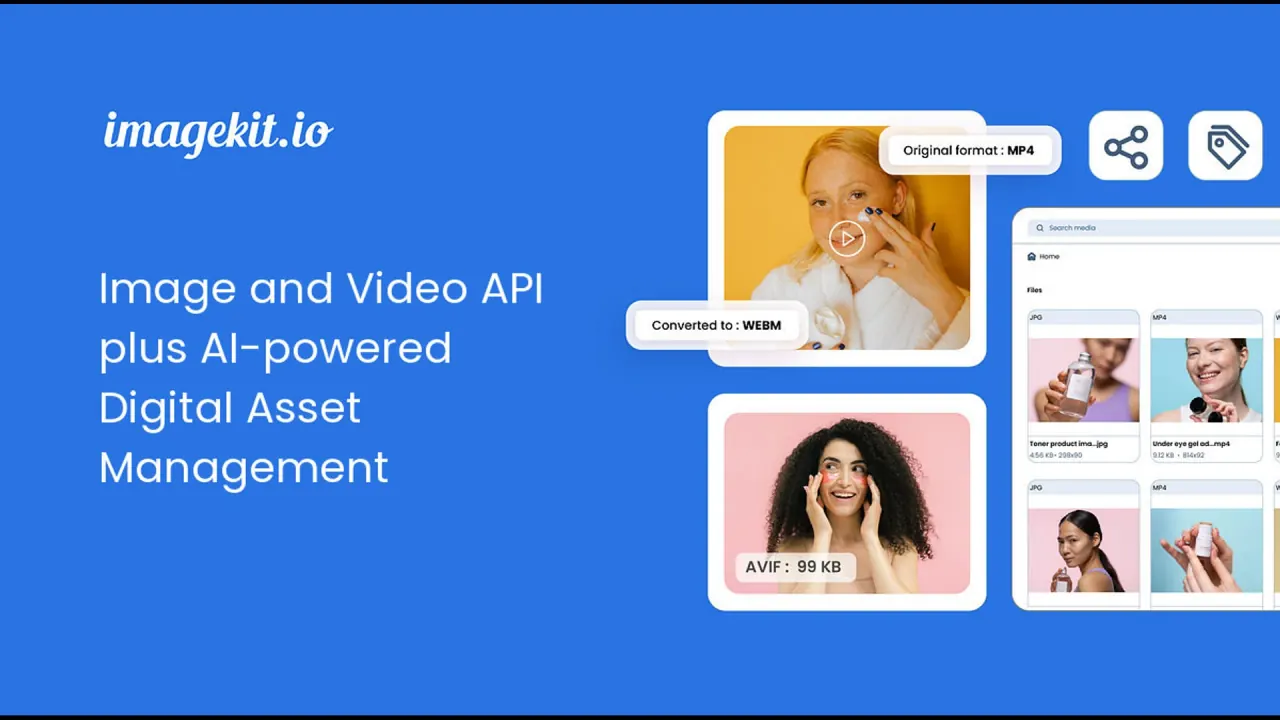

ImageKit.io optimizes, transforms and delivers images and videos through URL-based APIs and a CDN, and adds a digital asset management library with AI tagging, an asset agent and template-based banner automation for marketing and product teams.
Used this tool? Rate it
Used this tool? Rate it
ImageKit.io (also branded simply as ImageKit) is a cloud platform that optimizes, transforms and delivers images and videos in real time, stores and organizes assets in a DAM with its own AI agent, and generates on-brand creatives from templates. At its core it works as an image CDN with a processing layer: you request a file with transformation parameters in the URL and receive a resized, compressed and format-converted version from the edge.
The service is operated by ImageKit Private Limited and its subsidiary ImageKit Inc. The company says the platform is used by 300K developers and more than 3,000 high-growth businesses in 85 countries; that is the vendor's own figure rather than an independently audited count.
Three constraints stand out: most AI transformations and the video player are labelled beta, the free plan stops features instead of billing overages, and paid costs depend on several separately metered units.
Images are automatically served as AVIF or WebP depending on the viewer's device, and more than 50 URL-based transforms cover resizing, cropping, overlays and AI edits. In this image transformation API, one master file can yield thumbnails, product zooms and social crops just by changing URL parameters.
The video API handles optimization, transformations and thumbnails through URL parameters, supports adaptive streaming with HLS and DASH, and pairs with a player that offers automatic subtitles, chapters, shoppable overlays and analytics. That player is built on Video.js 8.20.0 and is wired directly into ImageKit's own video delivery and transformation pipeline, so player-level transformations apply to every video it plays.
AI transformations cover background removal, drop shadows, retouching, upscaling, object-aware cropping, text-to-image generation and image variations, all requested as URL parameters. Their outputs are cached permanently so repeat requests do not spend extension units again, although purging a URL still clears every cached entry for it.
For digital asset management, the Media Library adds a permission-aware DAM Agent that finds assets, manages metadata and taxonomy, enforces governance policies and runs multi-step bulk workflows inside the DAM.
Creative Automation templates let designers decide which layers and inputs other team members may edit while everything else stays fixed, so fonts, colors, logos and layouts cannot drift.
All modules share one set of meters: AI edits, auto-tagging, AI Tasks and banner variations draw on extension units, and video work on video processing units.
When you connect external storage, ImageKit.io acts as a proxy between the CDN and your bucket or server: it fetches the original on request, processes it in real time and serves the optimized result. Supported origins include S3-compatible object storage such as Amazon S3, Wasabi, Alibaba OSS, DigitalOcean Spaces, Azure Blob Storage and Google Cloud Storage, along with web servers and a web proxy type that can read files from any public URL.
Files kept in connected external storage do not count toward ImageKit storage usage, and cached transformation variants are not billed either; only uploads to the Media Library count as storage.
ImageKit's migration documentation says you can move over from services such as Cloudinary, Imgix or Akamai without changing the URLs in your application. The mechanism is a URL rewriter set on a URL endpoint under its Advanced settings tab, which translates incoming URLs into ImageKit's own format.
The Restrict Unsigned URLs setting can be switched on or off specifically for AI transformations and is off by default so the features are easy to try; the documentation strongly recommends turning it on in production to prevent unauthorized access to AI transformations.
ImageKit pricing pairs a fixed monthly base with metered usage, billed monthly in arrears: each invoice covers the plan's included quota plus any metered overages. The table shows the Complete Media Processing + DAM plans as captured on September 28, 2026; a separate DAM-only plan family is also offered.
| Plan | Monthly price | Bandwidth | DAM storage | Video processing units | Extension units | Users |
|---|---|---|---|---|---|---|
| Forever free | $0 | 20 GB, monthly limit | 3 GB, fixed limit | 500, monthly limit | 650, monthly limit | 2 |
| Lite | $9 plus pay-as-you-go | 40 GB, then $0.5/GB | 10 GB, then $0.1/GB | 500, monthly limit | 650, monthly limit | 3 |
| Pro | $89 plus pay-as-you-go | 225 GB, then $0.45/GB | 225 GB, then $0.09/GB | 5,000, then $9 per 10,000 | 4,000, then $9 per 5,000 | 5, then $9 per user |
| Enterprise | Custom | Custom | Custom | Custom | Custom | Custom |
The free tier is described as suited to low-traffic websites and apps, side projects and testing, with access to all essential features. Lite is pitched at sites that need image optimization, transformation and storage without hard caps, yet on Lite only bandwidth and storage can go into overage. Pro is the first tier where video and extension units can exceed the allowance and be billed. Enterprise adds custom limits, on-call support and other features by agreement.
Per-operation costs vary widely. The remove.bg background removal costs 130 extension units, ImageKit's own background removal 10, change background 60, edit image 50, generative fill 90, text-to-image generation 65, upscale and retouch 5 each, and drop shadow 1.
Bandwidth, video processing units and extension units reset to zero on the first day of each calendar month. On Pro, the extension-unit default cap is 8000 units and can be adjusted. A paid plan always bills its minimum monthly fixed cost, whatever the month's consumption.
Two discounts are published. Prepaying any amount between $500 and $5,000 gives an instant 15% discount. The Startup Program replaces the monthly base with completely usage-based pricing at discounted unit rates.
A tech-media profile of the company named Cloudinary, Imgix, Sirv and Gumlet as its competitors in image and video optimization and delivery. ImageKit itself publishes step-by-step migration guides for moving from Cloudinary, Imgix and Akamai Image Manager, which indicates the services it most often replaces for media delivery.
For the DAM side, ImageKit publishes a head-to-head comparison with Bynder covering digital asset management and brand portal features, alongside comparisons with other DAM and storage tools. Those comparison pages are written by ImageKit, so they show how the vendor positions itself rather than an independent assessment.
You keep ownership of uploaded content, and ImageKit claims none. The license you grant ImageKit covers hosting, processing, transforming, caching and displaying content solely to provide, secure and improve the service; neither the privacy policy nor the GDPR page states whether uploaded content is used to train AI models. After the terms end, stored content remains downloadable for 30 days at no cost before it may be deleted. The privacy policy says content is deleted after account deletion and that ImageKit is not responsible for backups.
Under GDPR, ImageKit acts as a data processor for customer content. It says it will never sell or rent personal data. Its subprocessor list names Photoroom for background change and Canva's Remove.BG for background removal, both used only on customer demand. OpenAI and Google Cloud are listed for AI image and video editing and generation, likewise only on demand. Stability AI handles upscaling, retouching and background extension on demand. Bria AI is scheduled to be added for background extension, used on customer opt-in, on or after October 15, 2026.
ImageKit also certifies to the EU-U.S. Data Privacy Framework for personal data from the EU and UK. It reports ISO 27001 and SOC 2 Type II compliance with independent audits. It also offers a near real-time backup of Media Library assets to an AWS S3 bucket you own.
Yes. The Forever free plan has no time limit, but it has no overage billing either: a feature stops once its monthly allowance runs out, until you upgrade.
No. Only files uploaded to the Media Library count as storage; you still pay for the bandwidth of optimized files delivered from your bucket.
Apart from face, automatic and object-aware cropping, the AI transformations are labelled beta, as is the video player.
Only for duplicate charges or demonstrable billing errors, requested within 30 calendar days; other charges are non-refundable. Returning from a paid plan to the free plan requires cancelling the subscription.
Yes. A URL rewriter on the endpoint translates the previous provider's URL format into ImageKit's own.
