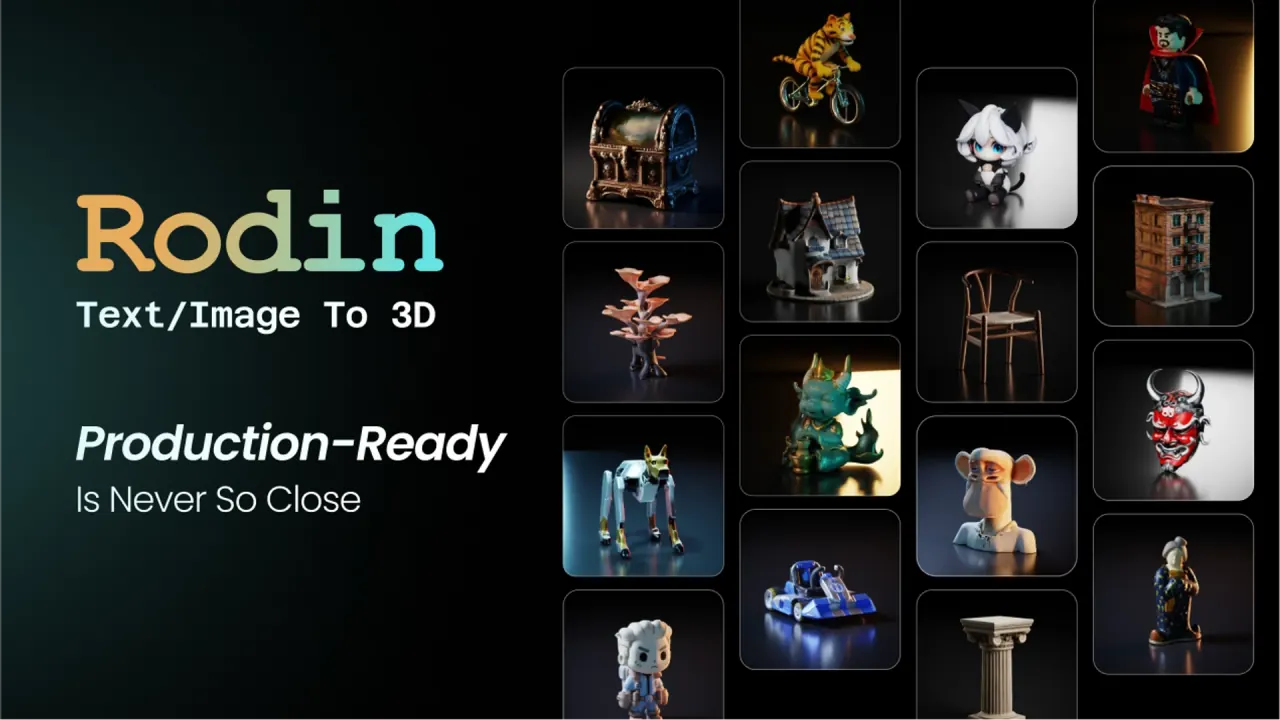

Hyper3D's Rodin model turns one image or a text prompt into a textured 3D model you can export as STL, GLB, FBX, OBJ or USDZ. Previews are free, credits are spent only when you confirm a result, and commercial rights depend on your plan.
Used this tool? Rate it
Used this tool? Rate it
Hyper3D is a browser-based AI 3D model generator whose flagship model, Rodin, turns text prompts or images into detailed 3D assets in seconds, with no 3D modeling experience required. The site is operated by Deemos Corporation, registered in Wilmington, Delaware, and the same platform also hosts ChatAvatar for 3D characters and OmniCraft, a set of browser 3D utilities.
Independent Chinese technology media reported in June 2026 that the company was founded in 2020 by a team from ShanghaiTech University, has about 60 people, and earns roughly 80% of its revenue outside China. The product pages advertise 10M+ users, a vendor figure rather than an audited one, and a company announcement lists its CAST paper as Best Paper at SIGGRAPH 2025.
One naming caution: an iOS app called "Hyper3D: AI 3D Model Generator" is listed on the App Store under an individual developer's name rather than Deemos, so the name alone does not identify this product.
Prompt wording and technical output are separate controls. Terms such as "game-ready" in a prompt only steer the visual direction; polygon count, effort level and file format are set in Rodin's generation and export settings.
STL, FBX, OBJ, GLB, GLTF and USDZ are the common formats, mapped to jobs: STL for 3D printing, GLB/GLTF for web and AR, FBX for game engines, OBJ for general editing and USDZ for Apple AR. The image-to-3D FAQ adds 3MF and DXF, while text-generated models list only STL, GLB, OBJ and FBX.
ChatAvatar builds a character package from a text prompt or reference image: a detailed head and face, a matching body mesh, PBR materials, facial controls, blendshapes, ARKit-compatible expressions, visemes, lip-sync and expression presets. Its licensing differs from Rodin's.
Text-to-image and image-to-video tools are positioned for making 3D reference images and short motion previews. Creator includes Seedream and default models, while Business adds Nano Banana 2, Veo 3.1 and Seedance.
The Rodin add-on for Blender requires Blender 4.0 or later and Google Chrome 116 or later, and it works alongside the Rodin webpage rather than replacing it.
An MCP server is documented for Kimi Code CLI, Codex and Claude Code. The client opens a browser where you log in, pick a billing workspace and approve access; the agent can then generate with Gen-2.5-Medium or Gen-2.5-Extreme-Low, check progress and return a download link.
Hyper3D fits people who need editable 3D files regularly and will pay for the rights and refinement features production use requires.
Good fit:
Less suitable:
Hyper3D sells monthly and yearly subscriptions plus direct credits; the Yearly toggle is labeled "Save 20%". The table shows each plan's entry tier in US dollars.
| Plan | Monthly billing | Yearly billing | Estimated output | Main inclusions |
|---|---|---|---|---|
| Free | $0 | $0 | Pay per confirmed result; direct credits cost $1.5 each | 10 private assets, public gallery publishing, export from legacy models |
| Creator | $30 per month | $24 per month, $288 charged at purchase | About 60 models | Multi-image to 3D, Smart Low-Poly, HD and custom texture, redos of Geometry x20 and Material x6, unlimited export and any use |
| Business | $120 per month | $96 per month, $1,152 charged at purchase | About 416 models | Full API access, high-resolution textures and High-Poly Quads, redos of Geometry x50 and Material x15, ChatAvatar commercial license |
| Enterprise | Custom | Custom annual agreements | Custom | On-premise deployment, custom LoRA and fine-tuning, volume discount |
| Education | Not listed | Not listed | Not listed | Creator tier benefits after verification |
Sliders raise volume: Creator runs from $30 to $240 a month (about 60 to 480 models). Business runs from $120 to $1,200 a month (about 416 to 4,160 models).
Credits granted with a subscription expire at the end of the subscription period, while directly purchased credits cost more but stay valid until used. On the API, a generation costs from 0.5 credit, HighPack adds 1 credit and Gen-2.5 Extreme-High costs 1 credit.
Free downloads are described two ways. The Free card lists export from legacy models and the image-to-3D FAQ says free credits let you export real models, yet the CTO summed the model up in a sponsored interview as "free to generate, but it's paid to download".
A software review directory names Meshy, Tripo AI and Luma AI Genie as Rodin alternatives. Meshy publishes the clearest comparison points:
Pick Hyper3D when geometry controls, a 10-million-polygon ceiling and DCC add-ons matter; weigh Meshy when a written free-tier license and self-service cancellation matter more.
A September 21, 2026 capture of a third-party review platform shows the company averaging 3.0 from 61 reviews, with 34% five-star and 39% one-star ratings. The platform's AI-generated summary of 60 reviews says reviewers value quick model creation and clean meshes, while complaints center on subscription management, unexpected charges, difficulty stopping automatic renewals, and charges after trying to cancel free trials.
Yes, to start. The Free plan costs $0, generation is pay by result, and direct credits cost $1.5 each, but pages disagree on how much free exporting is included.
On paid plans, yes. For the free tier the terms and pricing pages differ, and unlicensed ChatAvatar output is limited to personal, non-commercial use.
STL, FBX, OBJ, GLB, GLTF and USDZ, with 3MF and DXF on the image-to-3D page.
Not mid-term: a paid plan cannot be cancelled during its period, and payments are non-refundable except where law requires.
Yes. Official add-ons cover Blender, Godot, Unity, Unreal, C4D, Maya, 3ds Max and Omniverse.
