
Toolso.AI
Toolso.AI
All ToolsCategoriesTrendingLatest ToolsPricingBlog
Toolso.AI
Toolso.AI
Toolso.AI
Toolso.AI

Discover the best AI tools to boost your productivity

GitHubGitHubTwitterX (Twitter)YouTubeYouTubeTikTokEmail

Popular Categories

  • AI Writing
  • AI Image
  • AI Video
  • AI Coding
  • More Categories

Explore

  • Latest Tools
  • Popular Tools
  • More Tools
  • Submit Tool
  • Pricing

About

  • About Us
  • Contact
  • Blog
  • Changelog

Legal

  • Cookie Policy
  • Privacy Policy
  • Terms of Service
  • Refund Policy
© 2026 Toolso.AI All Rights Reserved
Limited timeLimited-time offerFeatured Listing24h priority review · No backlink · 30 days featured$29.90then $59.90Price rises to $59.90 after Oct 31Ends in--:--:--Submit now
  1. Home
  2. All Tools
  3. Model Library
  4. Tencent Hunyuan
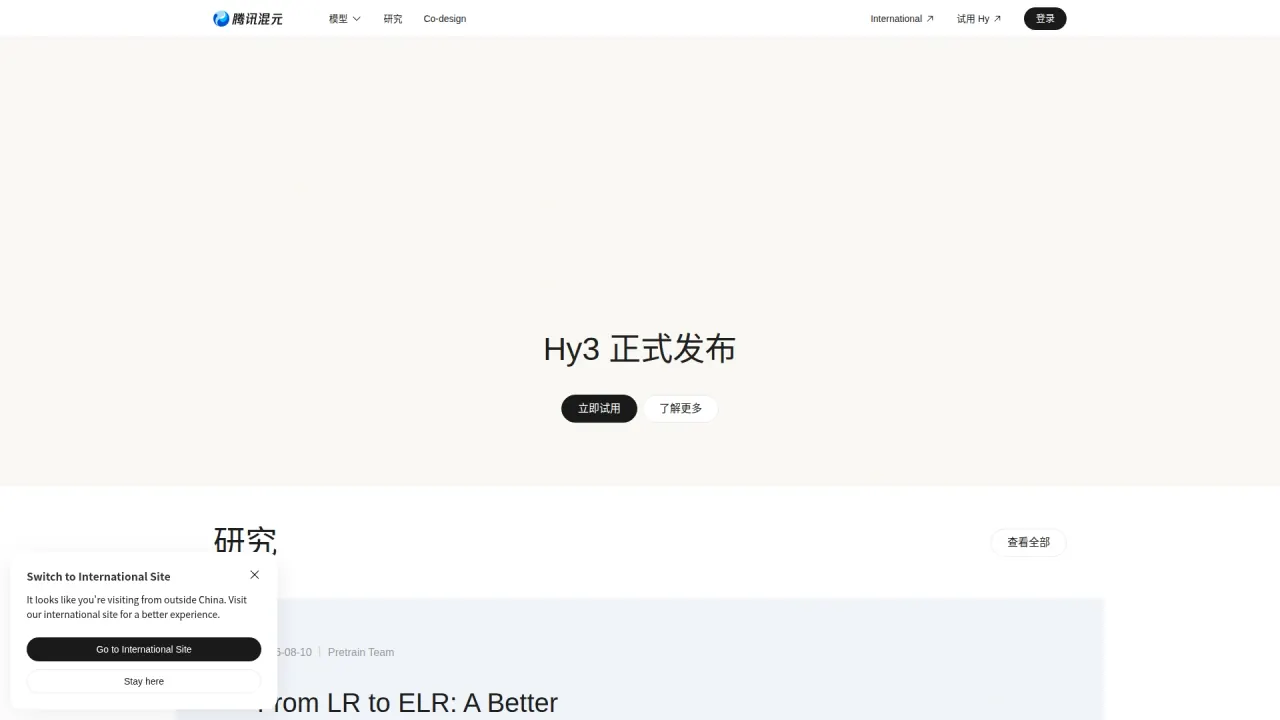
Tencent Hunyuan interface preview
Tencent Hunyuan logo

Tencent Hunyuan

Tencent Hunyuan is Tencent's official hub for its Hunyuan (Hy) large models, covering language, vision, image, video, 3D and speech models, open-weight downloads, a free trial website for users in mainland China and paid API access through Tencent Cloud.

Model LibraryOpen Source AIAI Development#Open Source#Translation#Api Available
Try for Free
Saves
Visits
Views
Pricing
Free
Published
Sep 28, 2026
Domain
hunyuan.tencent.com
Community rating

Used this tool? Rate it

Rate this tool

Tencent Hunyuan Product Information

Try for Free
Tool Information
Saves
Visits
Views
Pricing
Free
Published
Sep 28, 2026
Domain
hunyuan.tencent.com
Community rating

Used this tool? Rate it

Rate this tool

Featured Tools

Related Tools

Try for Free

What is Tencent Hunyuan?

Tencent Hunyuan (腾讯混元; newer model names on the site use the shorter "Hy" prefix) is Tencent's official website for its Hunyuan family of large models. The privacy policy names Shenzhen Tencent Computer Systems Company Limited as the provider and describes a product built on Hunyuan and other large language models, covering text-to-text, text-to-image, text-to-video, image-to-text, image-to-image, image-to-video, video-to-video and audio-driven lip-sync video generation, plus tools and API access for creation, design, product development and content generation.

In practice the site is a catalog rather than a single app. The user agreement describes it as a place to try Hunyuan model features, read model news, and jump to other Hunyuan-based products and to API access. Each model has its own page, open-weight models link to their download repositories, and paid API use happens on Tencent Cloud.

This page covers the China site at hunyuan.tencent.com. Visitors from outside China are shown a prompt that suggests switching to a separate international site, which is not described here.

Core features

The catalog splits into models Tencent serves through its own products and API, and models it publishes as open weights. Several appear in both roles, so the same name can mean a hosted API, a downloadable checkpoint or both.

Language and translation models

  • Hy3: a Mixture-of-Experts language model with 295B total and 21B active parameters, a 256K context window and three thinking modes.
  • Hy4 preview: a 770B-parameter model with 49B active parameters and a 1M-token context window, which Tencent calls its most capable model to date.
  • Hy-MT2 (Hy Translation 2.0): an open-source translation family focused on mutual translation across 33 languages.

Vision, image, video and speech models

  • Hy Vision 2.0: a fast-thinking vision-understanding model built on the HY-2.0 LLM and positioned for general image-to-text tasks.
  • HunyuanImage 3.0: a native multimodal image generator with 80 billion parameters, described by Tencent as the largest open-source image generation model.
  • HunyuanImage 3.0-Instruct: an editing variant that first analyzes the uploaded image and the instruction, then applies a chain-of-thought step before editing.
  • HunyuanVideo 1.5: an 8.3B-parameter open-source video generator that Tencent says runs smoothly on consumer-grade GPUs.
  • HunyuanVideo 1.5 inputs: Chinese and English prompts for both text-to-video and image-to-video generation.
  • HunyuanVideo 1.5 upscaling: a super-resolution stage lifts low-resolution results to 1080p.
  • HunyuanOCR: an end-to-end OCR model with about 1 billion parameters built on the Hunyuan multimodal architecture.
  • Hy ASR 3.0 preview: a speech recognition model built on the Hy3 base, with claimed gains in context awareness, robustness and dialect coverage.

3D, motion and world models

  • HY-Motion 1.0: a billion-parameter text-to-motion model that turns natural-language descriptions into 3D character animations for standard animation pipelines.
  • Hunyuan 3D Omni: listed with an open-source date of September 26, 2025, alongside HY-World 2.0 in the 3D and world-generation part of the catalog.

Most of these checkpoints link to download repositories from their model pages, but they do not share one license. Hunyuan open-source models range from Apache-2.0 releases to community licenses with territorial and user-count conditions, so the model choice and the license choice are made together (see Limitations).

Guide

Trying a model on the website

  1. Register or sign in. Users can register and sign in with WeChat or QQ authorization plus a bound phone number, or with a phone number or email verification code.
  2. Open a model from the home page, Model Square or creator community. Users send text, images, audio, video or button actions, are taken to an experience page for the text, image or video output, and can copy or regenerate the result until satisfied.
  3. Use AI Studio for deeper evaluation. The site's FAQ says Hy models can be tried at aistudio.tencent.com before deciding to integrate them into a business.

Getting API access on Tencent Cloud (China site)

  1. Complete verification. Using Hunyuan models on Tencent Cloud requires Tencent Cloud enterprise or individual real-name verification.
  2. Activate the service in the console to receive the one-time free token package described under Pricing.
  3. Enable postpaid billing manually in the console settings if usage should continue after free or prepaid packages run out.

Tencent Hunyuan use cases and examples

The site's solutions section documents Hy inside Tencent's own products. These are vendor-published case descriptions, not independent audits, but they show where the models are deployed in production.

  • Document drafting: in Tencent Docs, Hy takes a topic, materials and requirements and generates an editable first draft.
  • Browser assistance: in QQ Browser, Hy reads the page, search context and likely next action, such as writing, asking, summarizing or calling a tool.
  • Input-method editing: in Sogou Input Method, Hy follows the typing flow to recognize, rewrite, judge and translate during speech input, candidate selection and correction.
  • Audio from articles: AI Podcast in WeChat Official Accounts uses Hy to turn articles, web pages and documents into conversational audio, and listeners can ask questions during playback.
  • Game companions: in Game for Peace, the AI teammate Xiao Tian combines real-time battlefield state, team communication, player habits and long-term memory.

Product leads quoted on the site also give figures. WorkBuddy's context engineering lead reports that internal task success rose from 72% with Hy3 Preview to 90% with Hy3, with average completion time down 34%. A WeGame engineering lead reports that the Hy3-based Path of Exile 2 assistant reached 92% success on multi-turn reasoning and tool orchestration, with hallucinations falling from 4.5% to 2.8%. Both are internal measurements by Tencent teams.

Who is it for

  • Developers with a single workstation GPU: HunyuanVideo 1.5 lists an NVIDIA GPU with CUDA support and a minimum of 14 GB of GPU memory with model offloading enabled.
  • Teams running multi-GPU servers: the Hy3 README recommends serving the 295B-parameter model on 8 GPUs such as H20-3e or larger-memory cards.
  • Businesses buying API capacity in China: real-name verified Tencent Cloud accounts can call Hy3, Hy4 preview and older Hunyuan models by token.
  • Individuals testing models for free: the website suits users in mainland China who want to compare Tencent's models before paying.
  • Not aimed at minors: the privacy policy says the service is mainly for adults and that users under 18 need prior consent from a parent or guardian.

Location changes the fit: the website and several model licenses carry geographic limits, which are listed under Limitations.

Platforms

  • Website: hunyuan.tencent.com hosts model pages, research posts, solutions and trial entry points in a browser.
  • Open-weight hubs: Hy3 is open-sourced under the Apache 2.0 license on GitHub, Hugging Face, ModelScope and AtomGit.
  • Tencent apps and API resellers: a trade-press report says Hy4 preview is available in the Chinese and international versions of WorkBuddy and CodeBuddy, in Yuanbao and ima, with API access through Tencent Cloud TokenHub and OpenRouter.
  • Shared Tencent account: a phone number or email also registered with Tencent Yuanbao, Tencent Yuanqi, Hunyuan image generation or Hunyuan AI Video is linked, with avatar and nickname synced, although assets and conversation records are in principle not synced between products.
  • Tencent Cloud TokenHub: Hunyuan model functions are moving to TokenHub, and the original Tencent Cloud platform adds no new model capabilities and takes no new purchases, while existing purchases keep working.

Pricing

The website itself is currently free to use, with a cap on trial requests and possible queues when resources are tight; linked products and API access are charged according to their own pages.

API prices are published on the model pages and in Tencent Cloud's China documentation. Hy3 API pricing and Hy4 preview pricing are listed per million tokens:

  • Hy4 preview, Chinese-language page (Tencent Cloud China console): 0.3 RMB cached input, 6 RMB input and 18 RMB output per million tokens.
  • Hy4 preview, English-language page (Tencent Cloud international console): $0.042 cached input, $0.834 input and $2.501 output per 1M tokens.
  • Hy3: 1 RMB input, 4 RMB output and 0.25 RMB cached input per 1M tokens.
  • Other Tencent Cloud list prices: Hunyuan-a13b costs 0.5 RMB input and 2 RMB output per million tokens, Hunyuan-translation 1.2 RMB and 3.6 RMB, and Hunyuan-embedding 0.7 RMB for both.

The two Hy4 preview rows come from different language versions of the same model page and point to different Tencent Cloud consoles, so they are separate price lists rather than a currency conversion. On first activation, Hunyuan-a13b receives a one-time free package of 1 million tokens that expires one year after activation. Billing is by token usage, failed calls are not billed, and service does not switch to postpaid automatically when free or paid packages run out or expire.

Tencent Hunyuan alternatives and comparisons

Tencent names its own comparison models on the Hy4 preview and solutions pages. In a vendor-run blind test of 203 engineering tasks rated by 163 internal experts, Hy4 preview averaged 2.99 out of 4, against 2.92 for GLM 5.3 and 2.94 for Kimi K3. WorkBuddy reports that Hy3 used 47.4% fewer tokens than GLM-5.2 for document processing and 49% fewer for presentation creation.

Both comparisons are published by Tencent or its product teams. The directory and review-platform pages checked for this round offered no independent head-to-head comparison of these model families, so the practical differences to weigh are price per token, license terms and the hardware each option needs.

Limitations

  • Mainland China only: the user agreement states that the Tencent Hunyuan website currently provides service only to users in mainland China.
  • Not professional advice: generated content does not represent the provider's position and cannot replace professionals in legal, medical, financial and similar high-impact fields.
  • Preview model caveats: Tencent says Hy4 preview ships with known issues, including reasoning longer than necessary on complex tasks and a tendency to over-verify its own work.
  • Heavy image models: the HunyuanImage 3.0 README recommends at least 3 × 80 GB of VRAM for the base model and at least 8 × 80 GB for HunyuanImage-3.0-Instruct.

Open-source licenses differ by model

Three checkpoints use Apache-2.0: Hy3 (see Platforms), Hy4 preview and Hy-MT2. Tencent Hy4 preview is licensed under Apache-2.0. Hy-MT2 is licensed under the Apache License, Version 2.0.

Other checkpoints use a Hunyuan community license that does not apply in the European Union, United Kingdom and South Korea and adds a monthly-active-user threshold, measured on the model's release date, above which a separate license must be requested from Tencent:

  • HunyuanImage 3.0 (released September 28, 2025): the Tencent Hunyuan Community License carries the EU, UK and South Korea exclusion and a 100 million monthly-active-user threshold.
  • HunyuanVideo 1.5 (released November 21, 2025): its community license keeps the same exclusion with a 100 million threshold.
  • HunyuanOCR (released November 25, 2025): this community license also pairs the exclusion with a 100 million threshold.
  • Hy3 preview (released April 23, 2026): the Tencent Hy Community License uses the same exclusion and 100 million threshold, unlike the Apache-2.0 Hy3 release.
  • Hunyuan 3D Omni (released September 26, 2025): its community license pairs the exclusion with a much lower 1 million threshold.
  • HY-World 2.0 (released April 15, 2026): the world-model license applies the exclusion and a 1 million threshold.
  • HY-Motion 1.0 (released December 30, 2025): the motion-model license applies the exclusion and a 1 million threshold as well.

The HunyuanImage 3.0 license also prohibits using the model or its outputs to improve any other AI model other than Tencent Hunyuan or its derivatives.

Privacy and content rights

  • Inputs are recorded: during model trials the service automatically receives and records text, images, audio, video and button actions, and collects clipboard content when users paste from the system clipboard.
  • Face and voice features: for the voice-driven digital-human feature Tencent says it does not extract voiceprints, and for portrait features it does not retain facial features from uploaded images or videos.
  • Data location: personal information collected in the People's Republic of China is stored in the PRC and is not provided abroad without separate consent or another stated legal basis.
  • Output ownership: rights in uploaded content and in content generated with the service belong to the user or the lawful rights holder.
  • Model training: Tencent will not use uploaded or generated content for model optimization unless the user actively submits it through a feedback channel.

FAQ

Q1. Is Tencent Hunyuan free?

The website is currently free, with a cap on trial requests and possible queues. API calls on Tencent Cloud are paid by token after any free package, for example 1 RMB input and 4 RMB output per 1M tokens for Hy3.

Q2. Can I use the website outside mainland China?

The user agreement says the site currently serves users in mainland China only. Visitors from outside China are prompted to switch to a separate international site.

Q3. Which Hunyuan models are released under Apache 2.0?

Among the licenses checked, Hy3, Hy4 preview and Hy-MT2 are Apache-2.0. HunyuanImage 3.0, HunyuanVideo 1.5, HunyuanOCR, Hy3 preview, Hunyuan 3D Omni, HY-World 2.0 and HY-Motion 1.0 use community licenses that exclude the EU, UK and South Korea.

Q4. Does Tencent use my prompts and outputs to train models?

The user agreement says uploaded and generated content is not used for model optimization unless you actively submit it as feedback. Inputs are still recorded to deliver the service.

Q5. What hardware do the open-weight models need?

It depends on the model: HunyuanVideo 1.5 lists 14 GB of GPU memory with offloading, HunyuanImage 3.0 recommends at least 3 × 80 GB, and Hy3 is recommended for 8 GPUs such as H20-3e.

Know a Similar Tool?
If you know other great AI tools, feel free to submit them to us