
Branded runs two connected businesses at gobranded.com: a market research operation selling targeted audience samples to companies, and Branded Surveys, a rewards panel where members earn points for completing surveys at 100 points per dollar. The company was acquired by Dynata in 2022.
Used this tool? Rate it
Used this tool? Rate it
The most useful thing to establish first is what this is not. Despite appearing in AI tool directories, gobranded.com is not an AI tool in any meaningful sense. It is the web presence of Branded Research, a market research company, and the single mention of artificial intelligence on its homepage describes an internal quality-control process rather than a capability offered to users.
What the domain actually houses is two connected businesses aimed at opposite audiences.
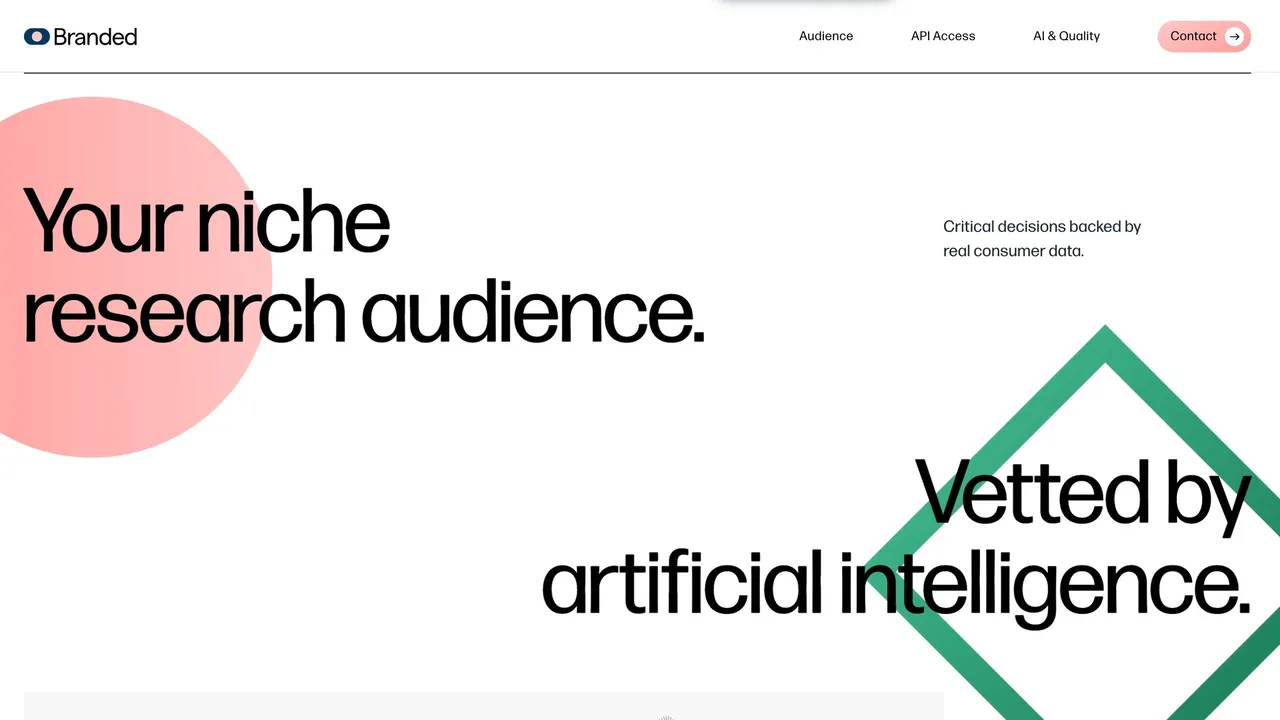
The first is the corporate research operation at gobranded.com itself, which sells access to survey audiences. Its homepage states the proposition plainly: your niche research audience, critical decisions backed by real consumer data, vetted by artificial intelligence. The customers here are companies commissioning research.
The second, and the one a general reader is far more likely to encounter, is Branded Surveys at surveys.gobranded.com. This is a consumer rewards panel, described on its own homepage as the free, fun way to earn rewards by taking surveys, trying apps, playing games and discovering products. The customers here are ordinary people earning small amounts of money.
Both sides depend on each other: companies pay for access to the panel, and panel members are paid for their responses. Understanding which side of that exchange you are on determines everything about whether this is relevant to you.
There is a fact displayed at the top of every page on the corporate site that materially changes how you should read it: "Branded Research has been acquired by Dynata! Click here to learn more."
That acquisition is verifiable from the acquirer's side. Dynata's own press release, dated 8 June 2022, announced its acquisition of Branded Research Inc., describing it as an industry-recognized provider of proprietary panel communities whose audience-on-demand platform generates nearly 15 million high-quality completed surveys annually. The release quotes Matt Gaffney, identified as Branded Research CEO and co-founder.
So the corporate site is describing a company that has been part of a larger organisation since 2022. Its footer copyright reads 2024, meaning the site was maintained for a period after the acquisition but appears to have been static since. The About page still presents the leadership as an independent company's team without explaining the post-acquisition structure. None of this makes the information wrong, but it does mean you are reading a snapshot rather than a current statement of how the business is organised.
The About page states that Branded was founded in January 2012 in San Diego, and names four people: Matt Gaffney as CEO and co-founder, John Ackerman as President and co-founder, Kristen Miles on insights and marketing, and Allen Kan on product and analytics. The San Diego location is independently corroborated by the company's Trustpilot business profile, which lists a San Diego address and a company contact email.
The company also lists memberships in three industry bodies: ESOMAR, Greenbook and the Insights Association. These are recognised market research industry organisations, which is consistent with the business being what it says it is.
The member-facing product is straightforward. You build a profile, get matched to survey opportunities, complete surveys, and redeem points.
The conversion rate is published clearly, which is more than many panels do: 100 points equals one dollar, and the minimum payout is $5. Individual surveys pay in a stated range — some pay out 50 points, while longer surveys could pay out as much as several hundred points, with loyalty program members earning more. At the published rate, a 50-point survey is worth 50 cents.
Redemption options are broad. The site advertises more than 300 rewards, spanning prepaid cards, bank transfers and a range of gift cards, with an option to donate earnings to non-profits instead.
Three supplementary earning routes exist beyond standard surveys: weekly bonus points through the Branded Elite loyalty program, referral rewards where inviting a friend earns both parties up to 500 bonus points, and quick polls and short questionnaires.
The commercial side sells access to specific consumer segments. The company states it recruits from more than 100 different consumer segments and industries, and its homepage illustrates this with concrete examples: millennial homeowners, tech-savvy baby boomers, LGBT parents, new vehicle buyers, Hispanic Gen Z, expectant mothers and luxury travellers.
The research methods supported span both qualitative and quantitative work — the site names webcam studies, emotional AI and surveys — and clients may use their own research tools or a third-party service rather than being locked into a proprietary platform.
The industries served are listed as technology and telecom, academic, consumer goods, financial, retail and restaurants, healthcare, and research agencies.
For programmatic access there is a documented API with its own developer subdomain. The developer hub identifies the product as the Branded Supply API and showed version 2.0 at the time of checking, with guides and an API reference behind it. This is the route through which client systems connect to audience samples in real time.
Since the AI framing is what likely landed this listing in an AI directory, it deserves a precise answer. The company's stated use of AI is response verification for fraud control: using AI to verify participant responses, it says it can remove poor actors with 95%+ accuracy. That accuracy figure is self-reported and has not been independently audited.
This is a real and worthwhile application — panel fraud is a genuine problem in market research — but it is an internal quality process. There is no AI feature that a member or a client operates.
Earning small supplementary income. The realistic framing for the member side. At 100 points per dollar with surveys paying 50 points and up, this is pocket money for time otherwise spent idle, not a meaningful income source.
Redeeming for gift cards rather than cash. With 300-plus reward options, some members use panels primarily to accumulate credit toward specific retailers rather than taking bank transfers.
Companies needing a specific consumer segment. The business case is reaching narrow audiences — the site's own examples like expectant mothers or new vehicle buyers illustrate the kind of targeting that general survey distribution cannot achieve.
Product development and concept testing. The company positions its insights work around understanding consumer needs and purchase drivers before bringing new products to market.
Programmatic research at scale. For organisations running continuous research, the API allows connecting to respondents in real time rather than commissioning individual studies.
Academic research recruitment. Academic institutions appear in the served-industries list, and panels of this type are commonly used for recruiting study participants.
Step 1 — Work out which side you are on. Members go to surveys.gobranded.com; companies commissioning research start at gobranded.com. These are genuinely different products and the rest of this guidance splits accordingly.
Step 2 (member) — Sign up and build a profile. Registration is free, with a 100-point welcome bonus advertised. The profile matters more than it appears: matching to surveys depends on it, and thorough completion is what reduces the disqualification problem discussed below.
Step 3 (member) — Set expectations before investing time. Understand the arithmetic first. At 100 points per dollar, and with the $5 minimum payout, you need 500 points before you can withdraw anything at all. Knowing this up front prevents the most common disappointment with panels of this kind.
Step 4 (member) — Learn where the issue-reporting tool is. This matters, because disqualification partway through a survey is the single most common complaint. The company's own guidance is that members should use the "Report Issue" tool, reached from My Points on the dashboard, to have specialists review the survey and credit points — particularly on surveys where significant time was invested. Knowing this exists before you need it is worth more than any other tip here.
Step 5 (member) — Be prepared for identity verification at cashout. As documented below, some members have encountered an ID verification requirement when withdrawing. Decide in advance how you feel about that, because discovering it at the point of cashing out is what has generated the most friction.
Step 6 (business) — Start with the audience page, then request a quote. Pricing is not published; the site routes commercial enquiries through a quote request based on your requirements.
Step 7 (business) — Check the developer documentation early if integrating. The Supply API has its own documentation site, and reviewing what it offers before scoping a project is more efficient than doing it afterwards.
Complete your profile thoroughly and keep it current. Matching quality depends directly on profile data. A thin profile produces more mismatches, and mismatches are where members lose time.
Do the arithmetic before committing an evening. With 50 points typical for a short survey and 100 points to the dollar, calculating your effective hourly rate on the first few surveys tells you quickly whether this is worth your time. That number, not the platform's marketing, should drive the decision.
Report problem surveys rather than absorbing them. The company publishes a specific process for this and states that specialists can credit points for surveys where you invested significant time. Members who do not use it simply lose that time.
Expect the screening questions. Every survey begins with qualifying questions, and members have complained about the repetition. It is inherent to how the panel matches respondents to client criteria rather than a fault to be fixed.
Treat vendor-published totals with caution. As documented below, the site's own figures for total payouts contradict each other by a factor of four on a single page. Where self-reported numbers matter to your decision, weigh them accordingly.
For businesses: read the acquisition banner before assuming currency. The corporate site describes an organisation as it stood some time ago. Confirm current capabilities and contracting arrangements directly rather than relying on the published pages.
People wanting small supplementary earnings. The honest description of the member audience. If your expectation is pocket money for downtime, the platform matches it; if you are expecting meaningful income, it does not.
Members happy to share detailed profile data. The entire matching mechanism runs on personal attributes, and the value you get is proportional to what you disclose.
Market researchers needing niche segments. The business case is strongest where the required audience is specific enough that general recruitment fails.
Product and insights teams. Concept testing and product development are the use cases the company positions around most directly.
Organisations wanting programmatic access. The documented API suits teams integrating respondent access into their own systems.
Who this is not for. Anyone looking for an AI tool has arrived at the wrong listing — there is no AI product here to use. Anyone hoping to replace meaningful income with survey earnings will be disappointed by the arithmetic. And anyone unwilling to provide identity documentation should read the limitations section before accumulating a balance they may struggle to withdraw.
The member-facing platform is a web application at surveys.gobranded.com, with native mobile applications on both major platforms — the site links directly to listings on Apple's App Store and Google Play.
The business-facing side is the corporate website plus the Branded Supply API, documented on a separate developer subdomain.
Support infrastructure includes a help centre hosted on Zendesk and a dedicated system status page, both linked from the member site footer.
For US members, the site provides jurisdiction-specific privacy routes: a California privacy rights page and a separate "Do Not Sell My Personal Information" request channel.
Pricing works in opposite directions on the two sides of this business, which is worth stating plainly.
Participation is free and members are paid rather than paying. The economics are published:
Redemption spans more than 300 options including prepaid cards, bank transfers and gift cards, plus non-profit donation. The company states that once you reach the payment threshold you can cash out immediately, with earnings reaching your bank account within a day or two — though as noted in the limitations, at least one member reported a considerably longer wait.
No pricing is published for the research side. The site routes commercial interest through a quote request based on your requirements, which is standard for custom research work where cost depends on sample size, targeting difficulty and methodology.
The site's self-reported totals do not agree with each other. Its paid-surveys page states in body text that the company has already paid users over $20 million, while a counter further down that same page and on the homepage displays $91,434,720.95. These figures differ by more than fourfold on a single page.
The likely explanation is stale body copy alongside a live counter, but both are published as current. Where a total-payouts figure factors into your assessment of a panel's scale, this inconsistency is worth knowing about.
The comparison set here is other survey panels, and helpfully the same Trustpilot page carrying Branded's rating also lists what visitors compare it against, with ratings and sample sizes. Prolific scores 4.5 from around 15,000 reviews; UserTesting also 4.5 from around 4,000; Earn Haus 4.1 from around 5,000; TopSurveys 4.0 from around 7,000; and Survey Junkie 3.4 from around 45,000. Branded Surveys sits at 4.2 from 122,806 reviews — a rating in the upper-middle of that group, on by far the largest sample.
Two caveats on reading those numbers. They come from a single platform and reflect its particular reviewer population. And sample sizes vary enormously, from 4,000 to 122,000, so the ratings are not equally robust.
For businesses the comparison set is different again: the acquiring company, Dynata, is itself among the largest players in this market, and its press release describes itself as the world's largest first-party data platform for insights. Where the acquisition leaves Branded's independent offering is exactly the question the static corporate site does not answer.
Stated plainly because it is the most useful thing a reader can learn here: if you arrived expecting AI software, this is not it. The company's single stated AI application is verifying participant responses to remove poor actors with a claimed 95%+ accuracy — an internal fraud-control process, not a feature anyone operates.
The stored directory metadata reinforces how little was originally captured. Every language's stored title is a placeholder greeting and every description follows a "Branded | Welcome" pattern, meaning the original crawl retrieved only the page title tag and nothing about the product. The stored name, "Branded", also differs from the domain "gobranded".
The acquisition banner points to a 2022 event, and the footer copyright stops at 2024. Meanwhile the About page still presents the leadership as an independent company's team, with no explanation of the post-acquisition structure. Nothing here appears false, but the corporate pages are a snapshot rather than a current statement, and the self-reported scale metrics — over 2 million people in the audience, over 3 billion global reach, over 4 million surveys completed "this year" — carry a date ambiguity that makes them hard to interpret.
This is the single most common criticism in negative reviews, and it is worth understanding because it is structural rather than incidental.
One member describes the pattern precisely: getting up to 90%-plus completion before being told the survey is not a match and receiving one point, with attempts to contact the company proving fruitless.
The company's public response explains the mechanism rather than disputing it. Despite pre-qualification efforts, a respondent may still be deemed "not a match" if they do not fit the exact criteria a client is looking for, and survey invitations can attract more members than planned so that quotas fill quickly. The response also directs members to the Report Issue tool to have specialists review and credit points — which is the practical remedy, and the reason it is highlighted in the usage steps above.
A second recurring theme concerns verification at cashout. One member describes attempting to withdraw and being asked for ID verification for the first time, having previously only needed phone and email, and reports the account being suspended after declining to provide identity documents — with the funds still unwithdrawn.
The company's public reply acknowledges the frustration and confirms that this was a new requirement for that member, apologising for the distress, but does not explain in the reply what triggers the requirement or who it applies to. For anyone accumulating a balance, this is worth factoring in before rather than after.
Members have reported surveys switching to Spanish after the first page, pages freezing or failing to load partway through, being told a survey is full after answering seven to ten questions, and having to repeat the same introductory questions on every survey despite a profile already existing.
The company states earnings reach your bank account within a day or two of cashing out. At least one member reported not having received a payout requested more than a week earlier. One report is not a pattern, but it sits against a specific published promise.
Branded Surveys carries a 4.2 rating from 122,806 reviews on Trustpilot, with 11,135 in the previous twelve months. That is an unusually large sample and supports meaningful conclusions. The distribution is 62% five-star, 19% four-star, 9% three-star, 4% two-star and 6% one-star — positive overall, with roughly a fifth of reviewers in the middle-or-below range.
However, three selection-bias signals apply simultaneously and all point the same direction. The profile is claimed by the company (since July 2016), the company holds a paid Trustpilot subscription, and the platform explicitly notes that this company invites their customers to review. Actively soliciting reviews tends to lift ratings relative to profiles where only spontaneously motivated users write — and motivated users skew negative. The rating should be read with that in mind.
Trustpilot also records that the company replied to 99% of negative reviews and typically responds within 48 hours, while flagging that it may use AI assistance with replies. The response rate is genuinely high; the AI-assist note is relevant context when reading the sometimes formulaic structure of those replies.
The corporate site features a named client testimonial from the CEO of Metrigy praising responsiveness and data integrity. Named attribution makes it more credible than an anonymous quote, but a vendor-selected testimonial on a vendor's own site is marketing material and should not be weighed as independent assessment.
The company's own FAQ is clear about the exchange: profile information is used to match you to survey opportunities, and your responses provide feedback to its partners and their clients, used to shape new products and business ideas. This is the entire point of the arrangement rather than a hidden term, but members should understand that the product being sold is their opinions and profile attributes.
No. Despite appearing in AI tool directories, gobranded.com is the site of a market research company. Its only stated use of AI is internal: verifying participant responses to filter out poor-quality actors, at a self-reported accuracy above 95%. There is no AI feature that a user operates. If you came looking for AI software, this listing is miscategorised.
Two connected businesses on one domain. The corporate site sells access to targeted research audiences to companies, recruiting from more than 100 consumer segments and offering a programmatic API. The consumer side, Branded Surveys, is a rewards panel where members complete surveys in exchange for points redeemable for cash or gift cards.
The published rate is 100 points to one dollar, with a $5 minimum payout, meaning you need 500 points before withdrawing anything. Short surveys pay around 50 points, or fifty cents; longer ones can reach several hundred points, and loyalty program members earn more. Realistically this is supplementary pocket money rather than meaningful income, and calculating your effective hourly rate on the first few surveys is the fastest way to judge whether it suits you.
Redemption options exceed 300 and include prepaid cards, bank transfers and a range of gift cards, with an option to donate to non-profits. The company states you can cash out immediately on reaching the threshold, with funds arriving within a day or two. Note that at least one member publicly reported a payout still outstanding more than a week after requesting it.
This is the most common complaint and the company addresses it directly. Despite pre-qualification, you may be deemed "not a match" if you do not fit a client's exact criteria, and popular surveys fill their quotas quickly. The important practical detail is that a remedy exists: use the Report Issue tool from My Points on your dashboard, which lets specialists review the survey and credit points, particularly where you invested significant time. Many members complaining about lost time appear not to know this exists.
Possibly, and it can happen at cashout. At least one member reported being asked for ID verification when withdrawing, having previously only provided phone and email, and had their account suspended after declining. The company's public reply acknowledged this was a new requirement for that member and apologised, but did not explain what triggers it. If providing identity documents is unacceptable to you, weigh that before building up a balance.
The evidence supports that it is a real, established company rather than a scam. It was founded in San Diego in 2012, its acquisition by Dynata in June 2022 is documented in the acquirer's own press release, it holds memberships in ESOMAR, Greenbook and the Insights Association, and it has 122,806 Trustpilot reviews averaging 4.2. Legitimacy is not the concern here; realistic expectations about earnings and the disqualification experience are.
The sample is very large — 122,806 reviews, with 11,135 in the last twelve months — which makes it more informative than most. But three bias signals apply together: the profile is company-claimed, the company holds a paid Trustpilot subscription, and the platform notes that it actively invites customers to review. Solicited reviews generally skew more positive than spontaneous ones. Read the rating as directionally favourable rather than precise. For comparison on the same platform: Prolific 4.5, UserTesting 4.5, Earn Haus 4.1, TopSurveys 4.0 and Survey Junkie 3.4.
Dynata acquired Branded Research Inc., announced on 8 June 2022 in Dynata's own press release, which described the platform as generating nearly 15 million completed surveys annually and quoted co-founder and CEO Matt Gaffney. The corporate site still carries the acquisition banner, but its content — including a leadership page presenting the team as an independent company — appears to have stopped being updated, with a footer copyright of 2024.
The site gives two conflicting answers on the same page. Its paid-surveys page states in body text that it has paid users over $20 million, while a counter on that page and on the homepage displays $91,434,720.95. Both are published as current and differ by more than fourfold; the likely explanation is outdated body copy beside a live counter, but this article reports both rather than choosing between them. The company separately states its community exceeds 3 million members.
