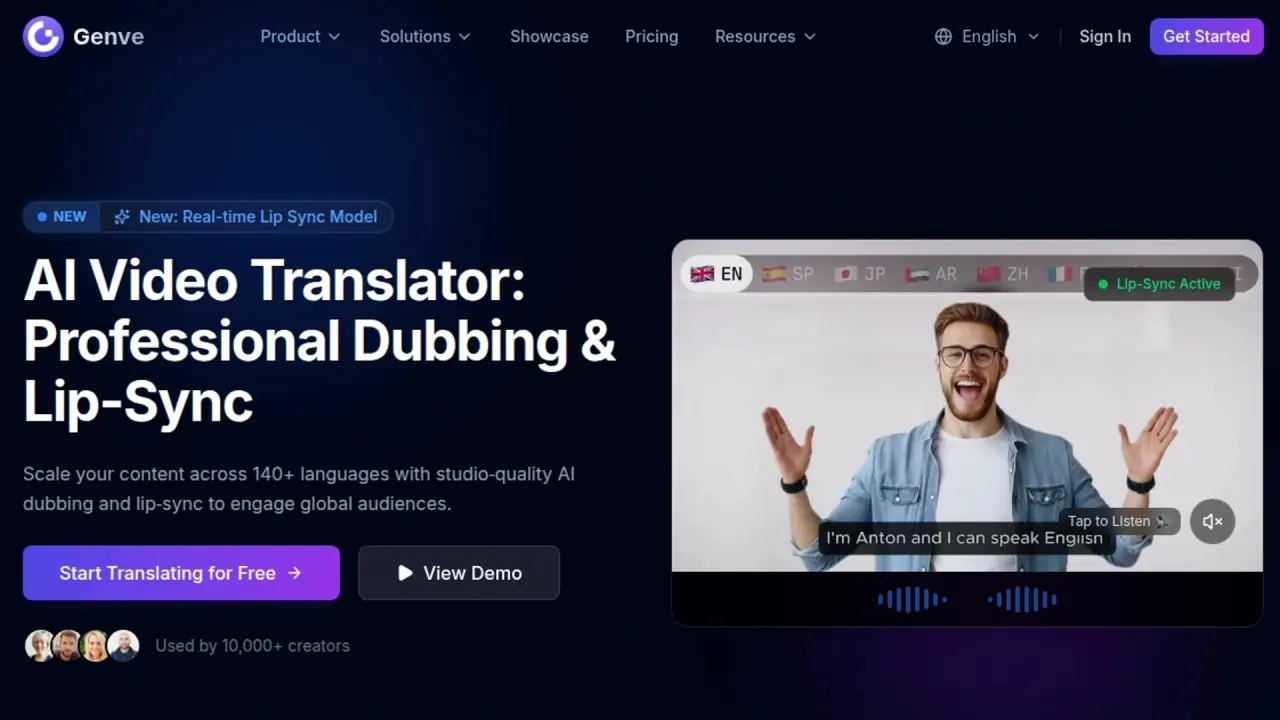

Genve AI is a browser-based AI video translator that transcribes, translates and re-voices videos with a clone of the original speaker, then adjusts lip movements to the new audio. It sells minute-based credits on monthly or yearly subscriptions to creators, sellers and training teams.
Used this tool? Rate it
Used this tool? Rate it
Genve AI is a browser-based AI video translator that transcribes the speech in a video, translates it, re-voices it with a cloned version of the original speaker and then adjusts the speaker's mouth movements to fit the new audio. The Terms of Service describe Genve as a service of APPWELL LIMITED and state that the terms are governed by the laws of the State of Delaware, United States.
Genve is a young product, and its terms state that the service is currently in beta. One large AI tool directory records Genve AI as added on Jan 23 2026, and another lists it in its database since Mar 2026.
Two points shape most comparisons: the site quotes three different language counts, and plans are subscriptions whose credits are measured in minutes of processing, charged per target language.
The homepage FAQ describes one automated chain: the system transcribes the speech, translates it into the target language, generates a cloned version of the original voice, and its lip-sync engine then adjusts the speaker's mouth movements to match the new audio. Translation, dubbed voice and lip-sync are steps of a single job rather than separate tools.
AI voice cloning is presented both as part of dubbing and as a standalone feature. The voice cloning page describes an instant clone made from a 30-second audio sample, while its three-step walkthrough asks for a clear 30–60 second recording. The same page says a cloned voice can speak 30+ languages with the speaker's own timbre, and it describes voice prints as encrypted, with only the account owner permitted to use the cloned voice. It also describes typing text to get audio in the cloned voice.
In lip-sync video translation the picture changes, not only the soundtrack: the AI adjusts mouth movements to match the translated audio. All three paid plans include AI Lip Sync, and at the time of capture the homepage flagged a new real-time lip sync model. The showcase page advertises 98% lip-sync accuracy and gives no measurement method.
Genve's pages give three language figures without labelling them as different sets:
The pages checked this round do not say whether 140+ refers to translation targets, dubbed voices or accents, and they give no separate list of languages supported for lip-sync.
The translator page and the FAQ describe this flow:
Each extra target language is billed as a separate translation of the full length, so a video sent to three languages uses three times the credits of a single-language job.
The voice cloning walkthrough has three steps:
Genve's solution pages group its use cases by industry. The examples below are the scenarios the company itself describes; no independent case study was found this round.
Several of these pages attach performance figures, such as localized product videos converting "3.5x better than subtitled ones". These are the company's marketing numbers; the pages give no method or sample for them.
The homepage says Genve is used by creators, marketers, educators and enterprise teams, and the three plans are pitched at different scales: Starter for individuals and hobbyists, Creator for growing channels and stores, and Scale for larger global production.
A good fit:
A weaker fit:
The API evidence is thin. The blog post's code sample loads a package named @genve/sdk, but the public npm registry listed no packages under the @genve scope on September 23, 2026, and the site map checked this round contains no API documentation page.
Genve sells subscriptions paid in credits, and credits are measured in minutes of video processing. The pricing FAQ sets the rate at 0.5 credit for every 30 seconds of video per target language, with time rounded up to the next 30-second block. Its own examples: a 1 minute 25 second video into one language costs 1.5 credits, and a 2-minute video into two languages costs 4 credits.
The pricing page opens on yearly billing. The monthly figures below come from the pricing data behind the page's Monthly toggle, and the yearly figures match what the page renders.
| Plan | Monthly billing | Yearly billing | Resolution | Speed | Credit rollover (plan card) |
|---|---|---|---|---|---|
| Starter | $19/month, 30 credits | $12/month billed annually ($144), 360 credits/year | 1080P HD | Standard | 1 month |
| Creator | $49/month, 120 credits | $29/month billed annually ($348), 1,440 credits/year | 4K Ultra HD | 2x Turbo | 1 month |
| Scale | $119/month, 360 credits | $79/month billed annually ($948), 4,320 credits/year | 4K Ultra HD | 3x Max | 2 months |
Every plan also lists AI Lip Sync, Multi-File Processing, No Watermark, automatic speaker detection and Cancel Anytime. The yearly toggle carries a "Save 40%" label.
Each plan also has larger credit options; for Scale's yearly 7,200 and 12,000 credit options, the pricing data lists $229 and $369 per month, billed $2,748 and $4,428 a year, the same per-month price as its 600- and 1,000-credit monthly options.
The pricing FAQ gives every new user 3 complimentary trial opportunities to translate 3 videos. The terms add that free or promotional credits are granted at Genve's sole discretion and may be revoked at any time.
Prices may be shown in local currency, but all transactions are charged in USD. Cancellation stops future charges while access continues to the end of the current billing cycle. The terms state that all subscription fees are non-refundable except where required by applicable law, and that Enterprise or custom agreements are not eligible for refunds under any circumstances. The one automatic remedy is technical: if a translation fails because of a system error, the deducted credits are returned to the account balance.
Two independent AI tool directories place Genve AI among different sets of video translation tools, which is a practical starting list for comparing alternatives:
Genve's own blog also publishes a comparison of AI video translators that ranks Genve first and covers HeyGen, Rask AI, Synthesia and Kapwing. It is written by the vendor, so it shows which products Genve positions itself against rather than an independent ranking.
The voice cloning walkthrough asks for a recording of your own voice or of a voice you have rights to, and the acceptable use policy's deepfake clause is worded around consent "for deceptive purposes" rather than around cloning in general. The pages checked this round do not describe a verification step, such as a spoken consent statement, before a voice is cloned. How long a cloned voice or voice print is kept is not stated: the privacy policy's retention table has no row for voice clones. None of the pages checked encourage cloning celebrities or other people's voices.
The site gives three figures, 140+, 30+ and 60+, on different pages, and none of the pages checked says which number applies to lip-sync.
Yes. Every new user gets 3 complimentary trial opportunities to translate 3 videos, and the homepage FAQ says no credit card is required to start.
Not for subscription fees, except where applicable law requires one. Credits for a translation that fails because of a system error are returned automatically.
The terms allow anonymized, aggregated data to improve its models except under an Enterprise data processing agreement; the enterprise page says data is never used for model training. Neither page addresses cloned voices specifically.
