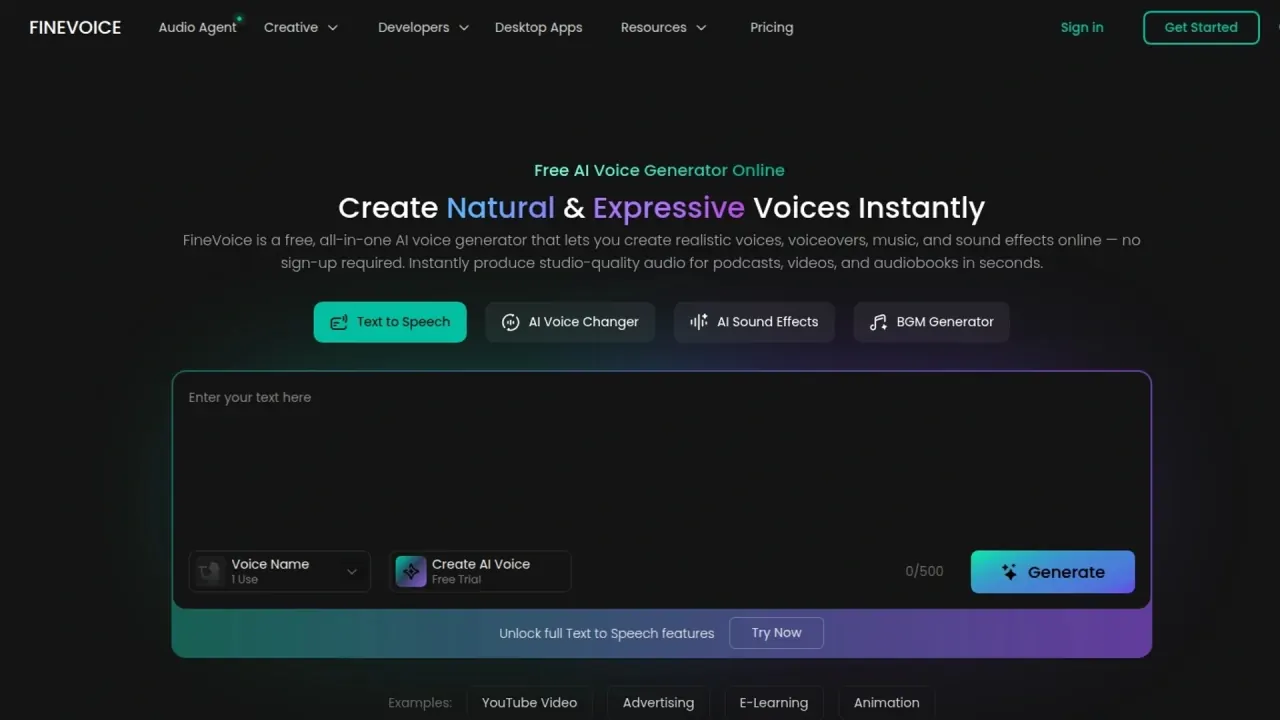

Create narration with text-to-speech, clone or transform voices, and produce sound effects in FineVoice's browser studio. It also offers desktop access and a separate API.
Used this tool? Rate it
Used this tool? Rate it
FineVoice is an AI voice generator for turning scripts into speech, cloning or transforming voices, and creating audio for videos and other media. Its browser studio combines text-to-speech with voice enhancement, dubbing, sound effects and talking-photo tools. The company advertises more than 2,700 voices, support for 154+ languages, and MP3 or WAV exports for video editors.
FineVoice continues the service previously offered through the Fineshare ecosystem. Its migration statement identifies the current domain as the successor to the earlier FineVoice service and says accounts, paid entitlements and ownership continue through that move.
Browser plans and API packages have different pricing. Free output has non-commercial restrictions. Public pages give inconsistent quotas and separate statements about Community availability and model-specific permissions.
The studio also includes voice enhancement, multilingual dubbing, photo animation and background music. Characters, minutes, clone quantities and feature credits have separate allowances.
(break) where a pause is needed.FineVoice positions its educator tools around narrated course scripts, multilingual lessons and dialogue examples. It describes converting written material to audio, or audio to text, for students with reading or hearing challenges. Editing the underlying script is also presented as a way to refresh lesson narration when the course changes.
The cloning feature is positioned for audio dramas, podcasts and audiobooks, including multi-character and multilingual production. A reusable voice can provide continuity across recorded material, while different voices support dialogue and character roles. FineVoice also places these uses alongside brand-voice and entertainment projects.
The browser Pro plan has an interactive-use restriction; the public API is the stated route for programmatic use.
FineVoice TTS is available through phone and tablet browsers, with desktop downloads for Windows and Mac. The mobile description concerns browser access, rather than establishing a separate native phone app.
As captured on October 27, 2026, the visible paid offers used annual billing and USD pricing. The monthly equivalents below are the displayed annual-plan rates, not verified month-to-month prices. The page carried a savings promotion of up to 57% and noted that sales tax may apply according to residence.
| Plan | Displayed monthly equivalent | Annual bill | TTS conversion allowance | TTS input per submission |
|---|---|---|---|---|
| Free | $0 | $0 | 1,000 characters per day | 1,000 characters |
| Basic | $5.99 | $71.99 | 100,000 characters per month | 5,000 characters |
| Pro | $8.33 | $99.99 | 300,000 characters per month | 5,000 characters |
| Ultra | $10.83 | $129.99 | Unlimited, as listed | 5,000 characters |
TTS downloads are listed as unlimited across the plans. Download limits and generation allowances are separate; characters are the text unit, rather than words or finished audio minutes.
| Other resource in the comparison | Free | Basic | Pro | Ultra |
|---|---|---|---|---|
| Instant voice clones | 3 | 50 | 100 | Unlimited |
| Professional voice clones | 0 | 5 | 10 | Unlimited |
| Uploaded voice models | Unlimited | Unlimited | Unlimited | Unlimited |
| Voice changing | 3 minutes per day | 24 hours | Unlimited | Unlimited |
| Voice enhancer package per month | 5 minutes | 40 minutes | 60 minutes | Unlimited |
| Speech-to-text conversion | 30 minutes per day | 120 minutes | 240 minutes | Unlimited |
Speech-to-text submissions are capped at 30 minutes in every column. The comparison does not explicitly label a reset period beside every clone count or voice-changing quantity. Unused characters and minutes do not carry into the next month.
The public quota descriptions are inconsistent. The TTS FAQ describes up to 2,000 free characters per month. The pricing comparison gives 1,000 per day. The sexy-voice category lists Ultra with 600,000 monthly TTS characters, 300 Instant clones and 15 Professional clones. The main comparison labels these Ultra resources unlimited. The capture does not resolve the different published allowances.
API packages have their own character quantities, custom-model counts and simultaneous-generation limits:
| API package | Displayed price | Characters | Custom voice models | Concurrent generations |
|---|---|---|---|---|
| Creator | $90 | 6,000,000 | 500 | 5 |
| Pro | $135 | 9,000,000 | 500 | 5 |
| Scale | $156 | 12,000,000 | 1,000 | 10 |
| Business | $195 | 15,000,000 | 1,000 | 10 |
The API cards include commercial voices. The captured API description does not establish a recurring billing interval or an expiry date for these packages, and the API concurrency figures are not a concurrency promise for the web plans.
FineVoice says a monthly or yearly subscription can be cancelled at any time to stop further recurring payments. Cancellation and a refund are separate provisions. Its direct-purchase refund policy has a 15-day window following purchase and excludes requests after that window.
The policy includes specific accepted circumstances: a duplicate purchase, a missing license key after 24 hours together with no timely support response within 48 hours, and a wrong-product purchase supported by evidence of buying the correct product from the same site. An unnotified auto-renewal has its own seven-day request period after renewal. Technical problems qualify when support cannot resolve them within seven days and the customer is unwilling to wait for an upgrade or fix.
Refund exclusions include refusing to give a reason or cooperate with troubleshooting, deliberate repeat purchasing to obtain refunds, misunderstanding the product description, and merely waiting several hours for a delayed license key. Purchases through another platform fall under that platform's refund process. The request procedure asks for the product, transaction reference, purchase email and reason; the headline guarantee is therefore not an unconditional refund promise.
A separate follow-up rule concerns an existing refund case. After FineVoice responds to a refund request, no further customer response within 14 days may close the case; silence is treated as no additional questions or requests at that time. If contact resumes more than 90 days after closure, FineVoice may decline to reopen it because of elapsed time, particularly where the customer did not answer its previous communication within the follow-up period.
FineVoice's cloning descriptions use different sample lengths. The opening Instant card mentions 10 seconds of audio, the upload instructions say 10–45 seconds, and the comparison specifies 30 seconds for Instant and 10 minutes for Professional cloning. The public text does not establish one universal recording minimum across those modes.
Community availability and model-specific permissions receive separate descriptions. The TTS FAQ says Community voices have been removed, permits commercial use of Commercial or Custom AI voices, and excludes copyrighted voice models from commercial generation. The sexy-voice FAQ permits commercial use with official models, but says that if a voice uses a community model, it is for personal use only. These statements do not establish that community voices remain available or that every voice has a commercial license.
Free Plan output is licensed only for personal, non-commercial and internal evaluation purposes. Its terms prohibit selling, sublicensing, redistributing or monetizing that output, including use for advertising, client work and revenue-generating products or services. A free download is therefore not a blanket commercial-use grant.
For Basic, Pro, Ultra and Aunio Pro users, the terms state that users own their input and output as between themselves and FineVoice and may use output for their own purposes, including commercial purposes, subject to the stated termination provisions. Users remain responsible for third-party rights. Output may not be unique, and the assignment does not cover similar output independently generated for another customer.
Uploading another person's recording requires permission from that voice owner to clone and synthesize the voice; the terms place responsibility for obtaining that permission on the uploader. The cloning feature separately describes its use as authorization-first. These are the vendor's requirements, rather than independent confirmation of consent for any particular voice in the library.
FineVoice also markets a named Donald Trump-style voice generator for parody, satire, memes and sketch comedy. Its FAQ states that every clip is AI-synthesized, not recorded, approved or endorsed by Donald Trump or any affiliated organization. It describes parody, satire and creative projects as the intended uses and recommends labeling outputs as AI-generated. The terms' third-party-rights conditions still apply.
FineVoice's terms grant the company a royalty-free, transferable, sublicensable, worldwide and irrevocable license to uploaded and generated content. The stated purposes include operating, improving and promoting the service, developing new products, and improving or modifying its AI and machine-learning models. This license survives termination of the terms.
That broad license sits alongside narrower feature-page statements. The cloning page says audio is used only to deliver the requested cloning and text-to-speech results and that custom models and data are accessible only to their user. The TTS page says generated audio can be managed, downloaded or deleted. Those feature descriptions and the terms have different scopes; the public material does not resolve them into a universal no-training promise.
The privacy policy's explicit exclusion of generalized AI or machine-learning training concerns Google user data. It also describes deletion of stored Google data after account deletion or permission revocation. This is a Google-data commitment, not a stated exclusion covering all uploaded recordings, scripts and generated content.
Personal data is retained for as long as necessary for the policy's purposes, including legal obligations, disputes and enforcement. Usage data is generally retained for a shorter period, with exceptions for security, service functionality or legal requirements. In its GDPR section for European Economic Area residents, the policy describes Account Settings access, updates and deletion requests where available, and contact with support when users cannot perform those actions themselves; these passages give no fixed universal deletion deadline.
The terms' automated-use restriction includes an exception for the public API. They specifically prohibit using the web-based Pro plan beyond the user's own interactive use, including scraping or calling interfaces, relaying requests, or wrapping the service as an API for others. They also prohibit embedding an API key directly in client-side or mobile applications. The stated consequence for these violations may include immediate suspension or termination without a refund.
