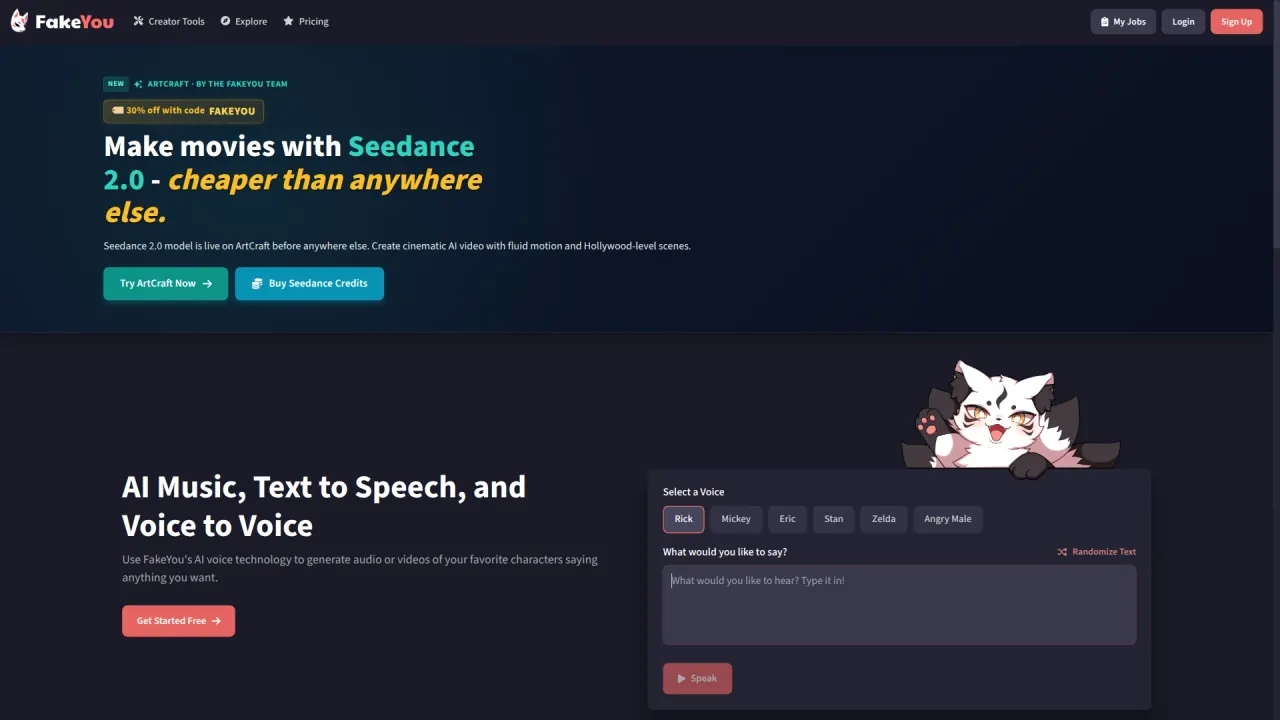

Turn written lines into speech or explore voice conversion, voice design and zero-shot cloning tools. Community voices and private models have distinct access and usage conditions.
Used this tool? Rate it
Used this tool? Rate it
FakeYou is an AI voice website for turning supplied material into character speech, with text-to-speech, voice conversion, voice design and cloning entry points. Its terms identify Learning Machines, Inc, doing business as Storyteller, as the company contracting for use of Fakeyou.com.
The product presents its voice technology as a way to generate audio or videos of favorite characters saying supplied lines. Its public catalogue contains community-submitted models, while paid plans also advertise private model features. A recognizable voice name identifies a catalogue entry; it does not, by itself, establish the original speaker's permission or the rights to use that voice commercially.
FakeYou exposes several routes rather than a single voice-generation mode:
The public model catalogue contains entries titled Bill Gates and Judi Dench, each marked public. These are examples of named models returned by the site's catalogue, rather than evidence that the named people contributed or approved them. The terms describe models and content as user-submitted and provide a takedown route for original speakers and rights holders.
Model records include a language tag alongside the title. For example, the Bill Gates entry is tagged en. Language metadata belongs to that particular model record; it is not a statement that every catalogue voice can speak every language. Choosing a recognizable character and choosing a language-compatible model are different parts of the voice-selection question.
FakeYou's TTS guide provides specific ways to shape the text sent to a voice model. It also distinguishes an occasional incoherent-output problem from ordinary pronunciation preferences.
Some, but not all, models incorporate emotional samples transcribed with an emphasis mark, typically an exclamation mark. The distinction is model-specific: a punctuation mark is not a universal control that makes all voices produce the same emotion or delivery.
Text to Speech generates audio from text. This route starts from written material, with the voice model supplying the spoken rendition. FakeYou places this capability within its character-voice offering; the guide then provides the model-dependent pronunciation and conditioning controls described above.
The subscription cards distinguish unlimited generation from the length of each TTS result. Those are separate limits: a plan can advertise an unrestricted number of generations while retaining a maximum duration for an individual audio output. The published-use and commercial-use conditions still apply to the resulting material.
Voice to Voice is presented as a way to speak in another voice. It provides a different input route from typing a line for TTS. Its paid-plan audio limits are listed separately from TTS, so a duration allowance for voice conversion cannot be read as the maximum length of a text-generated clip.
FakeYou provides a web interface with Creator Tools, Explore, Pricing and My Jobs, alongside Login, Sign Up, Upload Models, a community leaderboard and a guide. The speech-generation navigation separates Text to Speech, Voice to Voice and Voice Designer. These are public product entry points; account and model-management functions have their own places in that interface.
The homepage also promotes ArtCraft as a product “by the FakeYou Team” and advertises Seedance video creation there. That is a separately branded promotion alongside the FakeYou voice interface.
The public pricing page captured on November 1, 2026 displays monthly Plus, Pro and Elite cards. FakeYou says its features are free to use and markets premium access as faster and better quality. That is the company's description of the subscription benefit, rather than an independently measured comparison of output quality or waiting time.
Model handling is part of the subscription distinction: the paid cards separate private uploads from private sharing, as well as audio duration and processing priority. This makes access to a community voice, bringing a private model and sharing that private model different access requirements within the same pricing comparison.
| Plan | Displayed monthly price | Processing priority | Text to Speech | Voice to Voice | Private model handling |
|---|---|---|---|---|---|
| Plus | $12/month | Normal | Unlimited generation; up to 30 seconds audio | Up to 4 minutes of audio | Not listed on the Plus card |
| Pro | $25/month | Faster | Unlimited generation; up to 1 minute audio | Up to 5 minutes of audio | Upload private models for both tools |
| Elite | $40/month | Fastest | Unlimited generation; up to 2 minutes audio | Unlimited audio | Upload and share private models for both tools |
The terms allow sales tax to be added where the company considers it required, reserve the ability to change prices, and authorize recurring charges until cancellation is notified. The card price and the complete amount charged are therefore different parts of the published billing terms. The priority labels do not give a fixed processing-time commitment.
A subscription can be cancelled by contacting the service, and cancellation takes effect at the end of the current paid term. That condition concerns the end of the paid subscription period; the pricing cards do not turn cancellation into an immediate reduction of an already completed charge.
Private model access is also distinct from commercial permission: paying for an upload or sharing feature does not replace the voice-specific usage conditions in the terms.
ElevenLabs offers text-to-speech conversion and describes multilingual speech, conversational agent voices, game voiceovers and audiobooks as uses. Its published product description emphasizes converting written material into spoken audio across these applications. That provides another text-driven speech-creation route, rather than establishing that it contains the same community character models as FakeYou.
VoiceCraft provides speech editing and zero-shot text-to-speech from reference speech, with documented Colab, Docker, local-environment and standalone-script inference routes. It is a model/project approach that includes editing existing speech, as well as synthesizing new speech from a reference. Its deployment instructions and reference-audio workflow differ from selecting a voice through FakeYou's hosted website.
These alternatives describe different ways of obtaining or controlling speech. Their publishers' capability descriptions establish those approaches, rather than an independent ranking of FakeYou's voice quality, the rights attached to a catalogue model or the reliability of any particular generation job.
FakeYou's guide says some of its earliest models were built with limited data and sometimes produce babbling or incoherent vocal convulsions. It explicitly calls this not a typical problem. The statement is narrower than saying all voices suffer the same defect or that every generation is unstable.
The guide also describes external audio editing when incoherent material occurs at the end of an output. Its pronunciation and punctuation suggestions address model behavior; they do not establish a successful result for a particular requested line.
The usage terms prohibit unlawful activity and attempts to impersonate a person, company or other entity. Published usages must be labeled as deep fake. The prohibited-activity list also forbids impersonating other people without labeling the outputs as parody. A model carrying a recognizable person's name does not remove those publication and conduct conditions.
The usage overview says generated audio is watermarked and describes a verification-and-traceability tool as forthcoming.
FakeYou describes the technology as research for fun and restricts commercial use of its deepfakes unless otherwise stated, and only with specially designated commercial voices. This is a voice-specific exception, rather than a general commercial-use right attached to every paid subscription or every public model.
The terms describe models and content as user-submitted and provide takedown requests for copyright holders, original speakers and voice actors. The public catalogue's names and visibility fields are not documentation of an individual speaker's permission. The fact that a model appears in a catalogue and the fact that a rights holder has authorized its use are separate questions.
Contributors must own or have the necessary licenses, rights, consents and permissions for their contributions. They must also have written consent or permission for the name or likeness of every identifiable individual included. These are responsibilities assigned to contributors by the terms, not a statement that every community model has passed an independently verified consent check.
The terms say contributions may be viewable by other users and through third-party websites, and may be treated as non-confidential and non-proprietary. That disclosure concerns material contributed to the service. It does not turn an advertised private model feature into a universal confidentiality promise for every item a user posts elsewhere on the site.
Posting contributions, or making them accessible through linked social accounts, grants the company a worldwide, perpetual, irrevocable, transferable and sublicensable license. The listed uses include commercial and advertising purposes and cover contributions containing a person's image or voice. This is a substantial license grant even though the same terms say users retain their ownership.
The company does not assert ownership over contributions and says users keep their associated intellectual property rights. Retaining ownership and granting the company a broad license are separate contractual provisions; neither provision establishes that generated material is free of third-party rights or that the original speaker approved a model.
FakeYou reserves the right to edit, recategorize, pre-screen or delete contributions without notice. Content rules prohibit obscene, lewd, violent, harassing or otherwise objectionable contributions, privacy or publicity violations, and material violating laws intended to protect minors. Those are the published conduct rules; they do not document the outcome of every moderation decision.
The terms describe the site as intended for people at least 13 years old. Users who are minors in their jurisdiction must have parental or guardian permission and direct supervision, and their parent or guardian must agree to the terms.
The privacy notice separately says the service does not knowingly collect data from or market to under-18s. It describes users as at least 18 or a parent or guardian consenting to a minor dependent's use, and says discovered under-18 data leads to account deactivation and prompt deletion measures. These provisions use different age and consent framing; the terms' access language and the privacy notice's collection language are retained in their respective scopes.
The privacy introduction describes a service that accepts uploaded voice data and lets people share results. It says audio is not analyzed to identify or sell it, or used beyond providing and improving the service. That limited-purpose statement is not an explicit promise that user content will never be used in model training; no such undertaking was found in the captured terms and privacy texts.
The privacy notice lists provided account, contact and payment details, as well as automatically collected device and usage data. Its examples include identifiers and account information supplied during registration, alongside technical records of interactions with the service. Audio processing and ordinary website/account data collection are therefore different parts of the published privacy description.
All payment data is stated to be stored by Stripe. The policy also permits data sharing with service vendors, during business transfers and with affiliates.
Personal information is retained for the purposes described in the notice, subject to longer periods required or permitted by law. The notice says no stated purpose requires keeping personal information longer than the period in which a user has an account, while retaining the separate legal-retention exception. When an ongoing legitimate business need ends, information is deleted or anonymized; if deletion is not possible because it is in backups, it is securely stored and isolated from further processing until deletion becomes possible. This is a purpose-based retention description, rather than a fixed number of days for every uploaded file or generated result.
Account termination requests lead to deactivation or deletion from active databases, while some information may be retained for fraud prevention, troubleshooting, investigations, enforcing terms or legal requirements. The active-account deletion process therefore has stated exceptions and is not a promise that every record disappears immediately from every system.
The terms state the site is hosted in the United States and describe international access as transferring and processing data there. The privacy notice describes regional rights that may include access, correction or erasure, and withdrawal where processing relies on consent. The rights available and their conditions depend on the notice's regional and legal framing.
The terms also say routine backups are performed while assigning users responsibility for transmitted data and disclaiming liability for loss or corruption. A backup statement does not provide a particular recovery period, an export guarantee or a promise that an individual generation result will remain retrievable forever.
