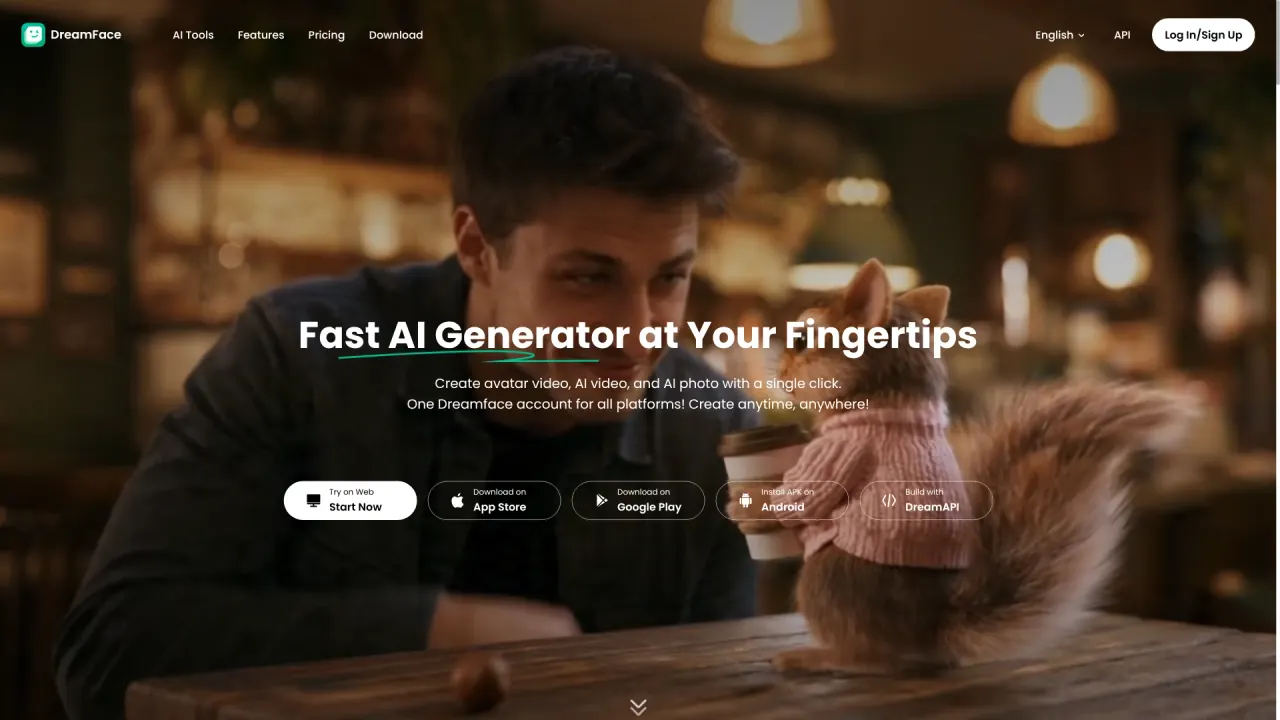

Turn text, audio and photos into speaking portraits, template videos and styled images. Dreamface offers Web tools and advertises mobile access, with subscriptions and credit packs.
Used this tool? Rate it
Used this tool? Rate it
Dreamface (also styled DreamFace) is an AI creation service for talking avatars, generated videos and photos. It is operated by New Port LLC. Its central avatar workflow combines a photo with text or audio, while separate tools handle image generation, photo effects and image-to-video templates.
Avatar Video accepts text or audio and is described by Dreamface as producing videos with realistic avatars and voices. The realism claim comes without a measured lip-sync accuracy figure.
The public Web avatar form includes photo/video and background inputs, Text and Audio modes, Bulk Mode, AI Script, Translate, a voice selector, Video Lipsync and Resolution controls. A voice-cloning suggestion appears beside the voice control. These controls do not establish paid entitlements or batch limits.
The AI video generator catalogue advertises more than a hundred templates. Its described template workflow starts from a single image, generates a video and supports downloading and sharing the result.
AI Real-time Video is separately described as rendering an interactive world that reacts continuously to prompts and instructions. This is a distinct capability from a finished template clip, with no response-time guarantee in the description.
AI Photo is positioned around changing everyday photos into images with different styles and scenes, alongside creative templates, background removal and enhancement. Dreamface also names several focused tools:
The wider catalogue describes Voice Studio for voice transformation, Advanced Avatar for video creation, Video Enhance for quality improvement, AI Translator for translations synchronized with lip movements, and AI Sound for sound effects and music.
The photo-avatar workflow starts with a clear, well-lit, front-facing selfie or portrait.
This workflow yields a still avatar photo. Speaking avatars, voice cloning and clip translation use separate controls.
Dreamface positions the photo-avatar output for LinkedIn, resumes, team pages, creator profiles and social media.
Dreamface promotes AI templates for pet videos and baby videos. These entertainment and social uses remain subject to likeness rights and guardian consent.
The company positions product and e-commerce teams as users creating demos, explainers and promotional videos without complex production setups. The business-use condition still applies.
Business examples remain subject to the account-use language and source-material rights.
Dreamface advertises one account across iOS, Android and Web. It offers App Store and Google Play download labels, a Web entry and an API for Business through a separate contact-sales route.
The US English Google Play page for package com.dreamapp.dubhe displayed the Dreamface video-generator listing on November 5, 2026 (UTC). The US Apple storefront lookup for app ID 1624172324 returned no match on November 5, 2026 (UTC). The lookup covers the US storefront only.
The browser avatar form exposes text/audio, script-assistance and translation controls before sign-in. The form's public presence does not establish free generation or downloads at every resolution.
A Web entry and mobile listings do not establish that the same features are available on each platform.
Dreamface's paid-products policy covers subscriptions, one-time credit packs, digital content creation services, AI generation and other paid features. Purchases made directly through its website or desktop experience are handled separately from purchases through Apple App Store or Google Play. The payment channel changes how cancellation and refund requests are processed.
Subscriptions may renew automatically according to the period chosen at purchase, with the policy giving weekly, yearly or other available periods as examples.
For purchases made directly on the Web, including Stripe or PayPal purchases, customers may submit a refund request within seven days of purchase through platform feedback or email. Approval is not guaranteed: it depends on the policy, applicable law, purchase type, used credits or services, and content generated, downloaded, exported or otherwise consumed.
| Purchase or action | Published treatment |
|---|---|
| One-time credit pack | A nonrenewing digital purchase that may fund advanced AI generation or other paid features. |
| Unused or partly unused credit pack | A refund may be requested within seven days; if approved, it is calculated pro rata from unused purchased credits. |
| Consumed credits | Credits used to create, generate, process, download, export or otherwise use content are not refundable under the policy. |
| Subscription cancellation | Stops future renewals; it does not automatically refund the current period or previous periods. |
| Unused subscription time | The current billing period is not refunded pro rata. Paid features may continue until its end, unless purchase terms or applicable law provide otherwise. |
Dreamface says refund requests are reviewed within seven business days after enough information is received to evaluate them. If more information is needed, the review period may start after it is supplied. Approved refunds go to the original payment method and are generally processed by the payment platform within up to ten business days; a bank, card issuer or payment provider may take additional time to post them.
For a Web subscription processed through Stripe, PayPal or another supported processor, sign in using the email associated with the subscription. Open account benefits or subscription management, find the relevant subscription, select Cancel Subscription and confirm. Cancellation prevents the next recurring charge.
The policy says Dreamface does not currently provide a separate reminder before every renewal unless required by law or supplied by the relevant platform. Apple App Store and Google Play purchases instead follow those stores' payment, cancellation and refund rules, with refund requests submitted through the respective store. The Web request window does not define app-store refund eligibility.
Avatar appearance and team controls offer two ways to compare adjacent products.
The descriptions do not establish a common quality benchmark or equivalent export price.
Dreamface's account terms specify individual, personal and noncommercial use, or authorized business use under a separate agreement. The marketing, product-team and training examples do not remove this separate business-use condition.
As between the user and New Port, the terms allocate ownership of generated output to the user, subject to the service's underlying intellectual property, the licence the user grants New Port and the possibility of similar or identical output for others. They also deny exclusive rights to a particular output.
Users remain responsible for ensuring that saved, shared or published output does not infringe third-party rights. The terms give no originality or non-infringement guarantee, disclaim accuracy, completeness and reliability, and require relevant disclosures, labels and watermarks. These are contractual boundaries, not output-test findings.
Real-person input, including a deceased person's name, image, likeness or voice, requires the rights, licences, consents and authorizations for submission and intended output use. The terms prohibit violating the person's publicity, privacy or other rights, and require guardian consent for a depicted minor.
The privacy policy separately says users submitting another person's face, voice or biometric characteristics must have the required consent for processing that information to generate the requested output.
For its talking-baby tool, Dreamface advertises childlike voices and celebrity impersonations such as Trump and Musk. The marketing page leaves the current selectable voice library and any authorization from those individuals unverified.
The terms state that output carries latent disclosures where technically feasible, plus manifest disclosure such as visible labels or provenance metadata. Removing, altering, obscuring or circumventing applied identifiers is prohibited. These clauses do not define consumer-plan export watermarks or maximum resolution.
Uploading, making available or submitting content, including saving, publishing or sharing generated output, grants New Port, its partners and affiliates a broad royalty-free, perpetual, irrevocable, worldwide, assignable and transferable licence. It covers reproduction, modification, derivative works, distribution, display and performance, expressly including marketing, promotion, demonstration and AI-model training or improvement rights.
The business-content exception has a narrower scope: the terms say Business Services content is not used to train or improve models or services outside the service provided to that business customer without prior written consent or an applicable order-form provision. The privacy policy additionally says private-designated content is not used to train generative AI models without consent. The general licence includes model training and improvement, subject to the business-service and private-content exceptions described above. The terms do not say which eligible uploads are actually used for training.
The privacy policy distinguishes several data categories rather than giving every upload the same deletion rule:
The policy says biometric information is not used to identify users within their content, to train or improve Dreamface's or third-party generative models, or for personalized advertising. It also says this information is not sold, leased, traded or otherwise profited from. These are biometric-specific statements, rather than a blanket no-training promise for generated content.
Biometric information has a maximum stated retention period of three years after the last interaction with the service, unless a longer period is required by law. Temporary facial coordinates are deleted after task completion, while original uploaded images and video follow the separate account-content retention rules. Task completion therefore does not mean all source media or landmarks are immediately deleted.
Dreamface says it destroys biometric information sooner on request unless the law requires retention. If a user deletes their account before the applicable retention period ends, Dreamface says it purges their biometric information within a commercially reasonable period, subject to technical and operational constraints such as backup cycles, unless applicable law requires retention. No fixed immediate account-deletion deadline is promised.
Before sending a user's personal information to a third-party AI service, Dreamface says an in-app prompt identifies the specific data, the recipient and the purpose of the transfer. Dreamface says it sends that information only after the user gives affirmative consent. If the user declines, the applicable third-party AI feature is unavailable, while other services remain available.
Providers named in this policy include Google, Microsoft Azure OpenAI Service, Volcengine, Vidu, Pixverse, Alibaba Model Studio and Eleven Labs. Each provider's retention is governed by its own policy or data-processing agreement; the policy says periods vary and may include short-term retention for service improvement, security, abuse prevention or audit logs. These provider-specific periods are separate from New Port's own biometric retention schedule.
Users must be 13 or older. Those aged 13–18 or below the local age of majority may use the service only with the consent and supervision of a parent or legal guardian who agrees to be bound by the terms.
No. It allows a direct Web purchase refund request; usage, consumed content and other policy conditions still affect approval. App-store rules apply separately.
No. Task-completion deletion covers temporary coordinates. Source media and other biometric information follow separate rules, including a three-year biometric ceiling unless longer retention is required by law.
