
Toolso.AI
Toolso.AI
All ToolsCategoriesTrendingLatest ToolsPricingBlog
Toolso.AI
Toolso.AI
Toolso.AI
Toolso.AI

Discover the best AI tools to boost your productivity

GitHubGitHubTwitterX (Twitter)YouTubeYouTubeTikTokEmail

Popular Categories

  • AI Writing
  • AI Image
  • AI Video
  • AI Coding
  • More Categories

Explore

  • Latest Tools
  • Popular Tools
  • More Tools
  • Submit Tool
  • Pricing

About

  • About Us
  • Contact
  • Blog
  • Changelog

Legal

  • Cookie Policy
  • Privacy Policy
  • Terms of Service
  • Refund Policy
© 2026 Toolso.AI All Rights Reserved
Limited timeLimited-time offerFeatured Listing24h priority review · No backlink · 30 days featured$29.90then $59.90Price rises to $59.90 after Oct 31Ends in--:--:--Submit now
  1. Home
  2. All Tools
  3. Analytics
  4. Datadog
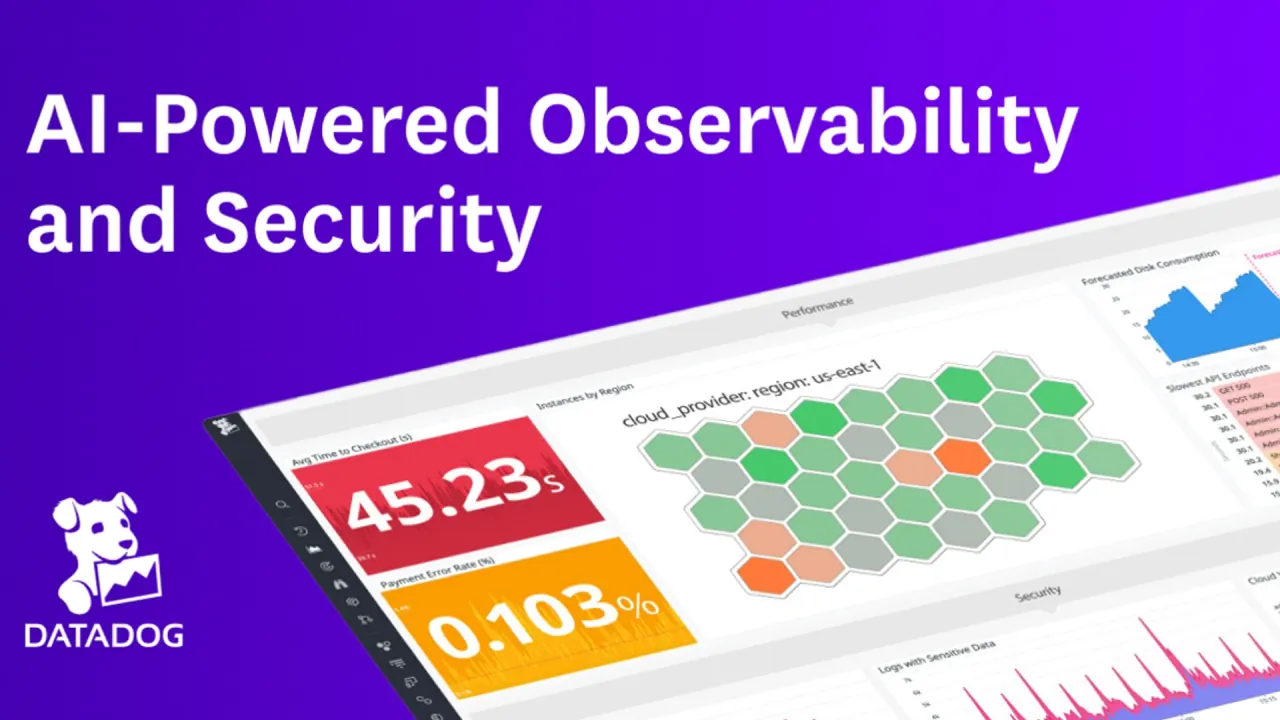
Datadog interface preview
Datadog logo

Datadog

Datadog brings infrastructure, application and log monitoring into one cloud platform, then adds Bits AI agents that investigate alerts and Agent Observability for tracing and evaluating LLM applications.

AnalyticsDeveloper ToolsAI Agent#Cybersecurity#Code Generation#Devops
Try for Free
Saves
Visits
Views
Pricing
Freemium
Published
Sep 27, 2026
Domain
datadoghq.com
Community rating

Used this tool? Rate it

Rate this tool

Datadog Product Information

Try for Free
Tool Information
Saves
Visits
Views
Pricing
Freemium
Published
Sep 27, 2026
Domain
datadoghq.com
Community rating

Used this tool? Rate it

Rate this tool

Featured Tools

Related Tools

Try for Free

What is Datadog?

Datadog is a cloud monitoring platform that collects metrics, traces and logs from servers, containers and applications and brings them into one place for dashboards, alerting and troubleshooting. The company positions it as "the integrated platform for monitoring & security", and its product menu spans observability, security, digital experience, software delivery and service management.

For readers of an AI tools directory, Datadog matters in two ways. First, it now ships its own AI layer: the Bits AI family of agents that chat about telemetry, investigate alerts, propose code fixes and triage security signals. Second, it sells tooling for teams building AI products, most notably Agent Observability (formerly LLM Observability), which traces and evaluates LLM calls and agent workflows. Both sit on top of the same data platform as Datadog's monitoring products.

Datadog describes its audience as "developers, IT operations teams and business users in the cloud age." The company says 33,000+ organizations trust it to keep their infrastructure running. It also promotes being named a Leader in the 2026 Gartner Magic Quadrant for Observability Platforms for the sixth time. It is not a single-price app: each product line is billed on its own unit (hosts, gigabytes, sessions, LLM spans or AI credits), so what you pay depends on which pieces you turn on.

Core features

Datadog's catalogue runs to dozens of products. The ones below are the pieces that most affect whether it fits an AI-heavy team; the rest (network monitoring, RUM, CI visibility, cloud security and so on) follow the same pattern of per-product billing on one shared platform.

Infrastructure, APM and logs

  • Infrastructure Monitoring: The Pro tier is sold to "Centralize your monitoring of systems, services, and serverless functions" and advertises 1,000+ integrations and 15-month metric retention. The Enterprise tier adds machine learning-based alerts, Live Processes and the Governance Console.
  • APM: Application Performance Monitoring is billed per APM host, with separate charges for ingested and indexed spans.
  • Log Management: Logs are billed in two stages, ingestion per GB and indexing per million events, and the indexing price rises with the retention period (3, 7, 15 or 30 days).

These three supply the metrics, logs and traces that Bits Chat and Bits Investigation work from.

Bits AI agents

Bits AI is sold as a set of agents rather than one chatbot. The product page lists five:

  • Bits Chat: Ask questions about your systems and instantly retrieve relevant metrics, logs, traces, monitors, and documentation.
  • Bits Investigation: Described as an AI SRE that autonomously investigates alerts, surfaces root causes, and suggests remediation steps.
  • Bits Code: Produces AI-generated, production-ready code fixes and unit tests, grounded in your observability data.
  • Bits Security Analyst: Aims to reduce alert fatigue by autonomously triaging Datadog Cloud SIEM signals.
  • Bits Agent Builder: Lets teams build custom agents that can connect to 2,000+ prebuilt actions across cloud, security, CI/CD, and collaboration tools without custom code.

Bits Investigation also hands off to the tools on-call teams already use: Datadog lists AI-generated summaries, postmortems, and integrations with Slack, MS Teams, Jira, ServiceNow, GitHub, and more. Independent coverage of the June 2026 DASH conference reported that Bits AI runs inside tools teams already use, including Slack and Anthropic's Claude. Bits Chat, Bits Investigation, Bits Code and Bits Agent Builder are billed through AI credits, covered under Pricing.

Agent Observability for LLM apps

Agent Observability is Datadog's LLM observability product for teams shipping their own AI features. Its stated goal is to evaluate, improve, and trace your AI agents with offline experimentation and production observability in one platform.

  • Tracing: Follows each request across prompts, retrieval steps, tool calls and agent decisions, with latency, token usage, retries and errors per step.
  • Evaluation: Datasets, experiments, a testing playground, offline and online evaluations, prompt workflows, and human review and annotation are included in every package rather than gated by plan.
  • Safety checks: The page says it can catch hallucinations, prompt injection attempts, and PII exposure as they happen.
  • Full-stack context: Correlate LLM spans with APM services, infra signals, and RUM sessions, which is the practical difference from LLM-only tracing tools.

Watchdog and AI access

Datadog calls Watchdog a built-in intelligence layer that continuously analyzes billions of data points from across your infrastructure and applications to help you resolve issues quickly. Its automated root cause analysis is pitched as a way to discover the root cause of critical failures without manual investigation.

For developers who prefer their own AI tools, the Datadog MCP Server and Pup CLI expose live telemetry to outside agents. Datadog says you can feed live logs, metrics, and traces directly into AI coding agents like Claude Code, Cursor and Codex when investigating production issues. Agents authenticate with user-based access that automatically respects your existing RBAC controls.

Guide

A typical first setup follows the trial and Agent route:

  1. Start the free trial. The trial page says "Try Datadog for 14 days" and notes that no credit card is required at sign-up.
  2. Pick the Datadog site (region) for the account, because data cannot later be shared across sites (see Platforms).
  3. Install the Datadog Agent on each host. It is software that runs on your hosts and collects events and metrics that it sends to Datadog for analysis.
  4. Turn on integrations for the cloud services, databases and frameworks you run, then build dashboards and monitors on top.
  5. For AI apps, instrument your application with one prompt via AI assistants such as Claude Code or Cursor, or use the SDKs directly.

Agent Observability can also be tried without an account: Datadog offers a way to trace your AI apps and coding agents on your machine, free and no signup needed.

Datadog use cases and examples

  • On-call incident response: Bits Investigation is described as an always-on SRE agent built to handle complex troubleshooting and late-night alerts.
  • Fixing production errors: Bits Code can be scheduled and triggered from Error Tracking, Test Optimization, APM Recommendations and Bits Investigation to propose code fixes.
  • Shipping LLM features: Teams test prompt, model and tool changes against real production data before rollout, then trace every agent step in production with Agent Observability.
  • Security triage: Bits Security Analyst focuses on suspicious signals tied to critical assets and high risk users in Cloud SIEM.
  • Regulated workloads: Healthcare and similar teams can keep AI features inside a signed agreement, because several Bits agents appear on Datadog's HIPAA-eligible list (see Limitations).

Who is it for

Datadog fits best where telemetry is already large and spread across many services:

  • SRE and platform teams that want alert investigation, dashboards and incident workflows on the same data.
  • AI engineering teams that need LLM tracing correlated with the backend and user sessions, not just prompt logs.
  • Security teams already on Cloud SIEM who want automated triage.
  • Enterprises with data-location rules, since accounts can be placed in US, EU, Japan, Australia or UK sites, plus FedRAMP-oriented government sites.

It is a weaker fit for a solo developer with a small app. The free infrastructure tier covers only up to 5 hosts with 1-day metric retention, and APM, log indexing and AI credits have no free tier on the price list. On one enterprise software review platform, Datadog holds 4.3 out of 5 from 211 reviews with 97% willing to recommend, as captured on September 27, 2026.

Platforms

  • Web app: The main interface runs in the browser on the account's Datadog site.
  • Datadog Agent: The Agent is open source and its source code is available on GitHub. Datadog documents Agent setups for Kubernetes, Amazon ECS and AWS Fargate, plus an IoT Agent for embedded devices.
  • Mobile: The Datadog Mobile app is available from the Apple App Store for iOS and from the Google Play store for Android, mainly for viewing alerts, monitors and dashboards on the go.
  • AI SDKs: Agent Observability supports OpenAI, Anthropic, Gemini, Vertex AI, LangChain, CrewAI, Pydantic, Bedrock, LiteLLM and Strands Agents, with SDKs for Python, Node.js and Java and OpenTelemetry or HTTP API ingestion elsewhere.

Datadog sites and data location

Datadog offers different sites throughout the world. Each site is completely independent, and you cannot share data across sites. Beyond three US sites, the EU1 site is located in Germany, while AP1 is in Japan, AP2 in Australia and UK1 in the UK. The US1-FED site is described as Datadog's FedRAMP High Certified site for US government agencies and partners.

Pricing

Datadog pricing is set per product and per billing unit, and the public price list shows three columns: billed annually, billed month-to-month and billed on-demand. The figures below are list prices; for products with included allotments, existing customers are told to refer to their latest billing agreement.

ProductBilling unitAnnualMonth-to-monthOn-demand
Infrastructure ProPer infra host, per month$15$18$18
Infrastructure EnterprisePer infra host, per month$23$27$27
APMPer APM host, per month$31$36$36
Log indexing (15-day retention)Per 1M indexed logs, per month$1.70$2.04$2.55
AI CreditsPer 500-credit bundle, per month$500$600$650
Agent ObservabilityFirst 100K LLM spans, per month$160$200$240

Several rules sit outside the table:

  • Free tier: Infrastructure Monitoring has a $0 tier for up to 5 hosts with 1-day metric retention.
  • Log ingestion: Ingesting logs costs $0.10 per GB on every billing option, before any indexing charge.
  • AI credits: One credit costs $1.30 on-demand. Datadog's reference estimates are about 0.5 credits per Bits Chat message, 3 per Agent Builder run, 5 per Bits Code fix and 6.5 per autonomous investigation.
  • LLM spans: The Free tier includes up to 40K LLM spans per month with 15-day retention. Only calls to an LLM provider are billed; tool, workflow, agent, embedding and retrieval spans are free.
  • Extra LLM spans: Beyond the first 100K, usage costs $3.50 per 10K LLM spans annually, $4.20 month-to-month or $5 on-demand at 15-day retention.
  • Evaluations: There is no separate product fee for offline or online evaluations; LLM calls made during an eval run count as LLM spans.
  • Credit overage: If usage exceeds the purchased monthly bundle, additional credits are billed automatically at the On-Demand rate, with no manual top-up.

Retention also differs by commitment for Agent Observability. On-demand Free and Pro plans have a 15-day trace, span and experiment data retention, while annual or month-to-month contracts keep experiment results for 90 days; datasets have a separate 3-year retention.

Datadog alternatives

In a 2026 developer-forum thread about a cheaper Datadog, one reply pointed out that you can use Grafana, which contains APM, logs, metrics and alerting with a free tier for tiny projects. Other replies named New Relic, Sentry, Scout APM and SigNoz.

  • New Relic: Its pricing page lists 100 GB of free data ingest per month and $0.40/GB ingested beyond.
  • Grafana Cloud: Its always-free plan includes all Grafana Cloud services with limited usage and 14 days retention for metrics, logs, traces, profiles and k6 performance tests.

On Datadog's side, the closest free entry points are the 5-host infrastructure tier and the 40K-span Agent Observability tier, while Bits AI is billed through AI credits.

Limitations

  • AI output accuracy: Datadog's service terms state that the output produced by the Generative AI Services uses technology that may produce incorrect or inaccurate output, and that code and tests should be reviewed before use.
  • Credit usage varies: The per-feature credit figures are averages; actual consumption for any single request may vary with task complexity and the amount of context the model processes.
  • No rollover: AI Credits reset on the first day of each calendar month. Unused credits do not roll over to the next month.
  • Government sites: The pricing page marks AI Credits and Agent Observability as currently unavailable on the US-FED site.
  • HIPAA scope: The Datadog Services listed on the HIPAA-eligible page may be used to process PHI only under a business associate agreement. Bits Agent Builder, Bits Investigation, Bits Chat and Bits Security Analyst are on that list; Bits Code was not listed in the version checked.
  • Cost control: A review platform's summary of Datadog reviews says improvements focus on alerting, cost visibility, and user experience, and that accurate cost tracking and prediction is challenging.
  • RUM compliance: For Real User Monitoring and Session Replay, Datadog makes no representations or warranties that a customer's use is permitted under applicable law.

Privacy and AI data use

Datadog claims no ownership in Generative AI Service output, but it reserves the right to use Generative AI Service output for quality control and service improvements. Whether customer telemetry is used to train models is not stated in the terms, privacy policy or product pages checked. For third-party models, Bits Investigation is marketed with zero data retention for third-party AI service providers. Datadog's subprocessor list names Anthropic, PBC as an AI services provider located in the United States. OpenAI, LLC appears on the same list for AI services, also in the United States.

FAQ

Q1. Is Datadog free?

Partly. Infrastructure Monitoring has a free tier for up to 5 hosts with 1-day retention, Agent Observability includes 40K free LLM spans, and the full platform can be trialled for 14 days without a credit card.

Q2. How is Bits AI priced?

Bits AI runs on AI credits: $500 per 500-credit bundle per month on an annual plan, or $1.30 per credit on-demand. A chat message uses roughly half a credit and an autonomous investigation around 6.5.

Q3. Is Agent Observability the same as LLM Observability?

Yes. Datadog's HIPAA-eligible page lists "Agent Observability (formerly LLM Observability)", and pricing is based on LLM spans.

Q4. Can I keep my data in the EU?

Yes, by choosing the EU1 site, which is located in Germany. Sites are fully independent, so data does not move between them.

Know a Similar Tool?
If you know other great AI tools, feel free to submit them to us