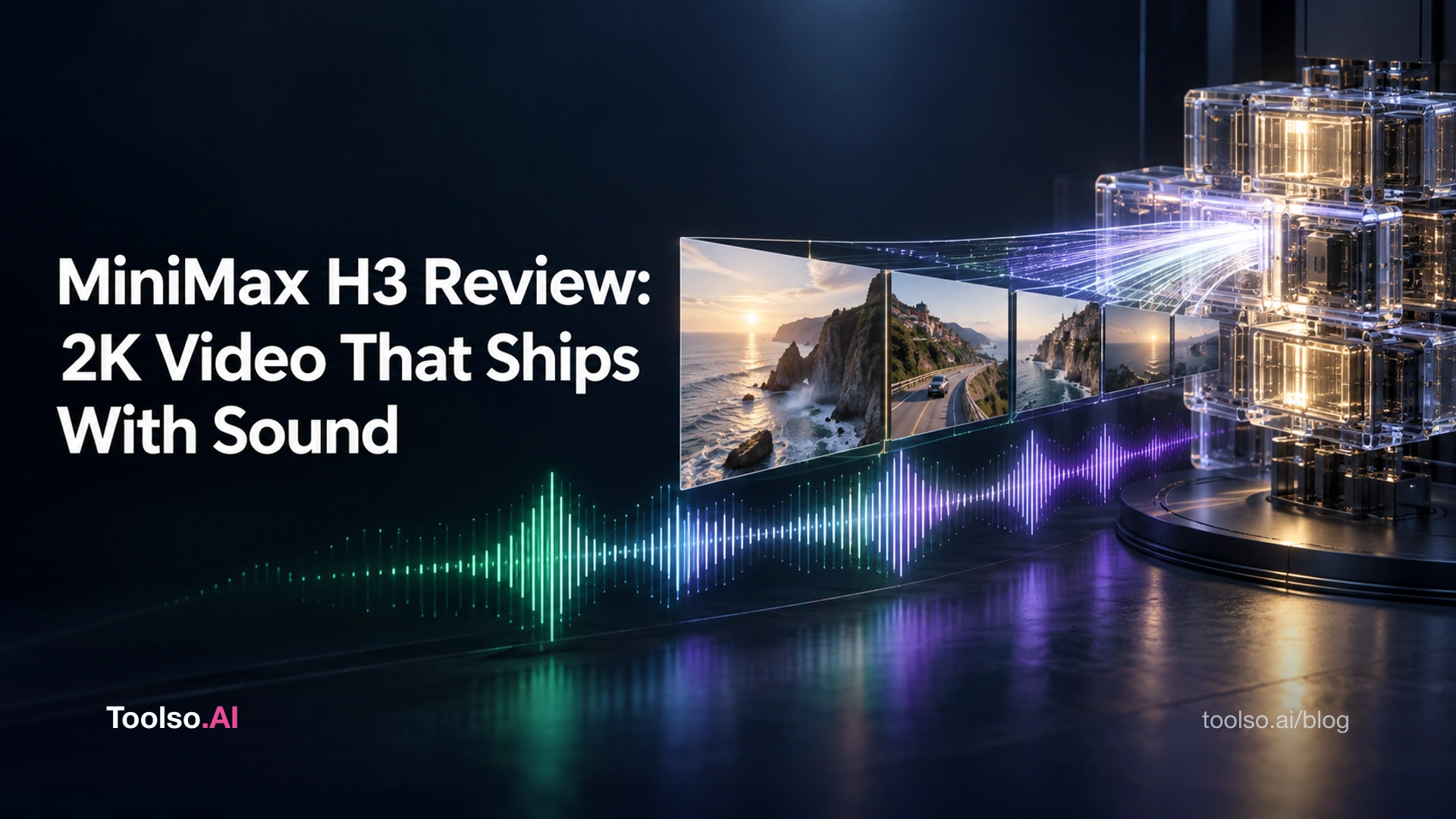
MiniMax H3 generates 2K video with native stereo audio, publishes per-second pricing, and offers H3-Base weights under a Community License.
| You are… | Verdict |
|---|---|
| Making short-form content with dialogue | Put it through an acceptance batch. MiniMax documents joint audio-video output, but your dialogue and sound brief still need testing |
| Running a local H3 workflow | Check the licence and architecture; H3-Base weights are available, but the full 2K workflow still includes hosted stages |
| Needing shots longer than 15 seconds | Compare it with Seedance 2.5. Seedance documents up to 30 seconds of joint audio-video generation; confirm the access path for your account and region |
| Budgeting precisely | Yes; per-second pricing is published, which is rarer than it should be |
The one-line summary: this MiniMax H3 review examines MiniMax's documented native audio-video generation, published API rate card and released H3-Base weights under a Community License. Treat them as capabilities to validate with your own brief, not as a finished-video guarantee.
MiniMax launched H3 on July 31, 2026, and describes native stereo sound generated in the same pass as the picture. Its product claim covers dialogue, sound effects and ambience. A conventional pipeline often generates silent footage, then sources music, foley and voice separately before synchronising them.
For H3, “native” means MiniMax designs the audio and video as one generation rather than as a post-production layer. Whether footsteps, dialogue, ambience and edits remain coherent is an acceptance criterion to test on your own prompts, not a property to assume from a product description.
For short-form social content, product demos and dialogue scenes, this can remove a manual handoff between picture and sound. The advantage narrows for teams that already plan a full edit pass or need tightly controlled dialogue replacement.
MiniMax's current H3 materials document 4 to 15 seconds at 24 fps. The hosted API offers 768P and 2K output; the released H3-Base workflow defaults to a 768-pixel short side, while the complete 2K path uses MiniMax's H3-Regenerate-2K stage. The frame rate is not configurable, which matters if your delivery target is 30 or 60 fps.
MiniMax describes H3 as supporting native multi-shot modeling. Test whether a title sequence or shot-reverse-shot dialogue beat is coherent enough for your brief before assuming it can replace separate generations and editorial assembly.
H3 accepts text, images, video and audio together. The current V2 API documentation lists up to 9 reference images, 3 video clips and 3 audio files for a reference-to-video request. It also documents first/last-frame and reference-to-video modes; test the roles and limits with the materials you are licensed to use.
On August 3, 2026, MiniMax announced the H3 release and published its H3-Base checkpoints. The official model card is available through MiniMax's Hugging Face organization under the MiniMax H3 Community License. That resolves the launch-era question of whether any weights would arrive.
The release is not an unconditional global open-source license. MiniMax's Community License excludes the United States, European Union, United Kingdom and South Korea from its applicable territory. Commercial products or services with more than $20M in yearly revenue need prior written authorization, and commercial interfaces must prominently display “MiniMax H3.”
MiniMax describes the complete H3 workflow as H3-Context-IR, H3-Base and H3-Regenerate-2K. The released base model can produce local 768P output, while the full 2K workflow combines it with official API stages. For deployment planning, “H3-Base weights are available under a custom licence” is more useful than assuming every H3 capability is fully local.
As of September 10, 2026, MiniMax's official pricing page lists $0.13 per output second for 2K and $0.08 per output second for 768P. Audio input is free; the first five images are free, additional images cost $0.04 each, and video input is billed by its duration at the selected output-resolution rate. A 768P-to-2K regeneration is listed at $0.05 per regenerated output second, with separate regeneration input charges.
At the listed $0.13 per output second, a 15-second 2K clip works out to about $1.95, and a minute of generated 2K output to roughly $7.80. Those are output-only calculations, not fixed finished-video prices: extra references, video input, regeneration and discarded takes all change the bill. Budget for a discard ratio.
Run a small, representative batch with your real prompt, approved references, target aspect ratio, duration and delivery format. Record the generated seconds, input material, retries, accepted takes and total bill. That makes the H3-versus-Seedance decision reproducible inside your workflow.
MiniMax documents a V2 API, native audio-video generation, reference inputs and H3-Base weights. Those statements define what to test. They do not establish your latency, moderation outcome, dialogue quality, acceptance rate or finished-project cost without a reproducible batch.
| Dimension | MiniMax H3 | Seedance 2.5 |
|---|---|---|
| Duration | 4–15s; MiniMax describes native multi-shot modeling | Up to 30s single shot |
| Resolution | 768P or 2K at 24fps | 480P or 720P in current BytePlus LAS documentation |
| Audio | Native stereo, same pass | Joint audio-video generation |
| Access | API + published rate card | Documented BytePlus LAS API + dynamic pricing |
Both models generate audio and publish a documented API path, so compare the workflow rather than treating either as a placeholder. Choose H3 when 2K output, H3-Base weights within its licence boundary, or its current API rate card are central. Choose Seedance 2.5 when a single scene can run up to 30 seconds and a larger mixed-reference package or timeline editing matters more. The broader AI video landscape has more options than this pair.
Multi-shot generation inside one clip helps, but 15 seconds caps what you can tell in a single run. Narrative work still requires assembly, and assembly still costs continuity.
MiniMax's Community License provides H3 works and outputs “as is,” without warranties including non-infringement, and says the user is responsible for deciding whether use is appropriate. For commercial or high-visibility output, review the licence, your rights in every input and the output review process with the appropriate counsel.
H3-Base is available, but that does not make every H3 workflow local or globally licensed. Teams must account for the Community License territory restrictions and the fact that MiniMax's full 2K workflow still uses official H3-Context-IR and H3-Regenerate-2K stages.
Consider H3 when your acceptance batch benefits from its documented native audio-video workflow, 768P/2K V2 API and current rate card. The official V2 documentation lists the endpoint and Pay-as-you-go requirement, but it does not substitute for testing your account, region, moderation path and finished output.
Teams needing long-form continuity or a wholly local 2K workflow should test before committing. Check the Community License territory, validate the hosted stages your pipeline would still need, and compare accepted takes rather than assuming that a released checkpoint solves deployment.
H3-Base weights are published under the MiniMax H3 Community License, but the release is conditional rather than globally unrestricted. The licence excludes the United States, European Union, United Kingdom and South Korea, and commercial products or services over $20M in yearly revenue need written authorization. The full 2K workflow also retains official hosted stages.
As of September 10, 2026, MiniMax lists $0.13 per output second for 2K and $0.08 for 768P. A 15-second 2K output is therefore about $1.95 before input-video, additional-image, regeneration or discarded-take costs.
MiniMax describes H3 as generating native stereo audio with its video in the same pass. Test dialogue, sound effects and ambience against your own brief before removing an audio or post-production step.
The current MiniMax H3 V2 documentation lists 4 to 15 seconds at 24 fps, with 768P and 2K output. MiniMax also describes native multi-shot modeling, but assess continuity on your actual scene before replacing editorial assembly.
Neither is universally better. H3 combines native stereo audio, 768P/2K API output, a current rate card and released H3-Base weights under a restricted licence. Seedance 2.5 documents joint audio-video, up to 30-second scenes, broader mixed references and targeted editing. Compare the same brief, references, account access and acceptance standard.
Sources: MiniMax — H3 launch · MiniMax — H3 open-weights release · MiniMax API Platform — H3 V2 API · MiniMax API Platform — current H3 pricing · MiniMax official H3 model card and license · ByteDance Seed — Seedance 2.5 launch · BytePlus LAS — Seedance 2.5 API and pricing
Last updated: September 10, 2026
Seedance 2.5 brings 30-second audio-video generation, 50 mixed references and timed editing. Here is what is official, priced and still worth testing.


Hermes Agent blends persistent memory with self-improving skills, but its security and outcome depend on the backend, approvals, and review you choose.
OpenClaw is a high-capability agent runtime whose value depends on deliberate gateway security, skill review, and operating discipline.
AI music in 2026: Suno v5.5's capabilities and legal defiance, Udio's settlement path, the Warner deal retiring unlicensed models, and creator rules.
The AI video market after Sora's exit — with real pricing: $0.50 to $2.50 per 10-second clip, who leads the rankings now, and how to choose per shot.

The honest 2026 free-tier comparison: Gemini's generous bundle, Claude's quality-first plan, ChatGPT's capped breadth, and when free stops being enough.

Archived review of GPT-5's August 2025 launch: the unified-router design, the 4o backlash, what improved — and how it reads from mid-2026.
An honest 2026 assessment: what GPT-5.5, Dreaming V3 memory and agents actually deliver, where Claude and Gemini beat it, and who should pay for Plus.
